EXCLUSIVE: "NOW is the TIme!" Kirit Bhatia, Banking Circle in 'The Fintech Magazine'
By Lauren Towner · 12 October 2026
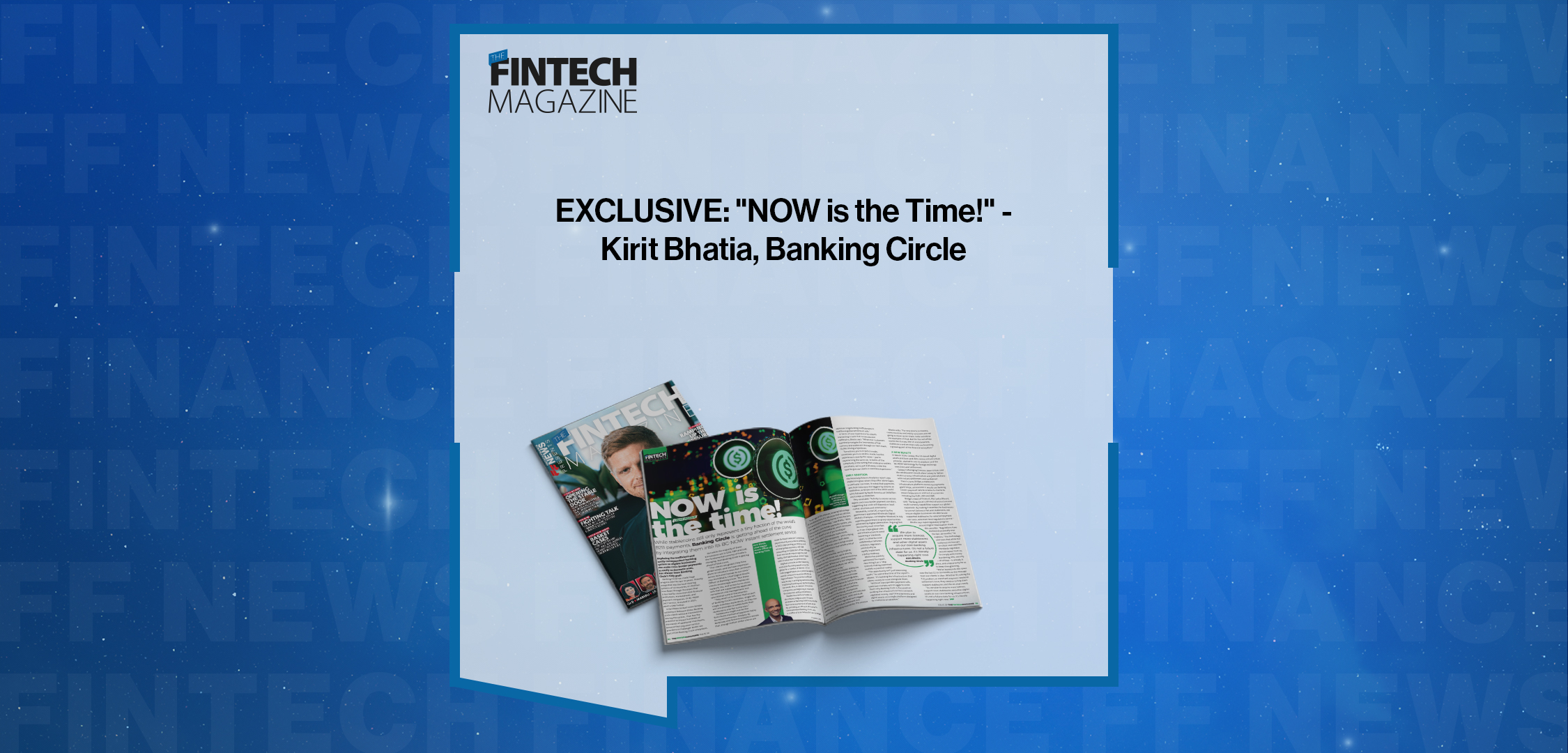
While stablecoins still only represent a tiny fraction of the world’s B2B payments, Banking Circle is getting ahead of the curve by integrating them into its BC-NOW instant settlement service
Replacing the inefficient and costly correspondent banking system so eligible businesses can make cross-border payments as easily as domestic ones, has always been Banking Circle’s holy grail.
Banking Circle has made huge progress over the last 13 years. Directly integrated into the local clearing systems of 10 countries, €1.5trillion now flows through the pipes that it has laid for more than 850 financial institutions, marketplaces, and payment companies. Its BC-NOW 24/7 service, launched in 2025, went a step further.
It facilitates instant cross-border settlement between those Banking Circle clients without transactions leaving the system. That has the potential to impact hundreds of thousands of additional merchants, because their payment service providers or challenger banks are part of the Banking Circle ecosystem.
But while the majority of these transactions are in USD, GBP and EUR, the fundamental currency of trade is changing. And Banking Circle is getting ahead of that curve.
“Our clients are global, they have global needs, and we have expansion plans to introduce more fiat currencies across Asia and Canada to our stack,” says Kirit Bhatia, Chief Digital Assets Officer at Banking Circle. “But those clients increasingly want stablecoin support, too, and access to on-chain rails that are supported by applicable compliance risk management and operational control frameworks.
“They want us to deliver that as part of Banking Circle’s seamless, single API, single-interface experience, so they can use one provider to settle both their stablecoins and fiat currencies.”
Stablecoins might not be the first-choice method of payment today for most businesses. Analysis by McKinsey and Artemis Analytics reveals that, though trillion-dollar claims are made for total stablecoin transactions, payments only amounted to $390billion in 2025 (representing just 0.02 per cent of total global payments), with B2B accounting for $226billion of that. Although their real-world impact might be small today, that B2B total had soared 733 per cent in value over the previous year.
Digital currencies are fast becoming a solution for many people across the globe for a number of reasons. USD or EUR-pegged tokens are a protection against wealth erosion in countries afflicted by high inflation. They provide an efficient way to pay in emerging economies where traditional banking and payment systems are weak. Plus, in western economies, companies are beginning to wake up to the potential utility of stablecoins.
Stablecoins held and traded via distributed ledgers solve the same problem as Banking Circle’s cross-border fiat currency payment infrastructure by providing an efficient alternative to correspondent banking. It was only a matter of time before the two converged.
“In an age of the internet, amazing technology, AI and blockchain, it’s ridiculous that we still live in a world where settling money across borders can take two or three days,” says Bhatia. “With the current cross-border payments system, you have multiple intermediaries, which increases fees, plus there’s a lot of pre-funding of accounts, which introduces capital costs.
“Then there’s the complexity – you’re trying to access local rails and often that’s donethrough intermediaries, which brings nested and layered transactions that include a lot of compliance complexity.
“So, wherever possible, we try to go as close to the rails as we can; we’re directly integrated into 10 countries, and we continue to expand that. Where we’re not integrated, the BC-NOW internal platform can settle 24 currencies, 24 hours a day.”
As of this year, BC-NOW includes stablecoin settlement. That came after Banking Circle was granted a crypto-asset service provider licence by Luxembourg’s financial regulator, Commission de Surveillance du Secteur Financier (the CSSF). Banking Circle said at the time: “Direct integration with our core platform allows clients to seamlessly interoperate between supported fiat currencies and selected stablecoins, including USDC, USDG and EURI (Banking Circle's own regulated euro-pegged stablecoin), with instant settlement and appropriate regulatory traceability. The solution addresses longstanding inefficiencies in traditional global settlement rails.”
In terms of user experience for clients transacting in both fiat currencies and stablecoins, Bhatia says: “When our customers seamlessly navigate the two worlds of fiat currency and stablecoin through our tech stack, it’s like driving a hybrid car.
“Sometimes you’re in petrol mode, sometimes you’re in electric mode, but the experience is exactly the same – you’re experiencing the same car. In terms of the complexity of the wiring that underpins wallets and chains, we’ve put it all away under the hood to give our clients a seamless experience.”
EARLY ADOPTION
The McKinsey/Artemis Analytics report says stablecoins grow where they offer advantages in particular use cases. It noted that payments sent from Asia were the biggest by volume at $245billion, or 60 per cent of the 2025 world total, followed by North America at $95billion and Europe at $50billion.
They concluded: “Activity is uneven across regions and cross-border payment corridors, suggesting that scale will depend on local market structure and constraints.”
Meanwhile, in the UK, a report by the government-appointed Wholesale Digital Markets Champion, Christopher Woolard, in July urged the government to grasp opportunities presented by digital tokenisation. Arguing that the country must move fast so it can shape global rules and infrastructure to avoid becoming a ‘standards taker’, it called for close collaboration between ministers, regulators and industry to rapidly implement a policy roadmap.
Bhatia has publicly welcomed the report, describing it as a ‘step towards making tokenised markets a practical reality’.
“The opportunity isn’t just tokenising assets,” he said at the time of the report’s release, “it’s building the infrastructure that allows money to move alongside them.
“Without interoperable payment rails, tokenised markets will struggle to scale. That’s why Banking Circle is focussed on building the infrastructure that connects regulated money, real-time payments and digital assets on a single platform designed for institutional adoption.”
Bhatia adds: “For very practical reasons, many countries and many currencies are not going to show up on-chain. India and China are examples of that. But for the rest of the world, like Europe, the US and elsewhere, stablecoins and on-chain rails are becoming a growing part of the financial ecosystem.”
A NEW REALITY
In March 2026, Galaxy, the US-based digital assets platform and data-centre infrastructure provider, started to use its platform and the BC-NOW technology for foreign exchange execution and settlement. Galaxy’s Managing Director, Jason Urban, said the collaboration would allow Galaxy to ‘deliver multi-currency infrastructure and yield solutions with instant settlement and confidence’.
Then in June, Bridge, a stablecoin infrastructure platform owned by payments giant Stripe, announced it would use Banking Circle’s payment rails to enable its clients to move stablecoins in and out of currencies including the EUR, USD and GBP. Bridge’s Head of Product, Mai Leduc Blount, said: “Banking Circle’s API-led infrastructure and multi-currency capabilities support our global expansion. By making it seamless for businesses to convert between fiat and stablecoins, we ensure eligible businesses are able to use supported stablecoins for selected payment use cases, wherever local regulations permit.”
Bhatia says rapid regulatory progress around digital tokenisation made this possible.
“Regulations have evolved dramatically over the last 18 months,” he explains. “The technology and tools that allow our customers to transact on-chain and meet the standards regulators would expect from us, to comply with money laundering, KYC, security – all of that – is already in place, and a top priority for us to keep strengthening.
“We’ve leaned into this space over the last 12 to 18 months as the message from our clients is clear. Whether it’s solving the T+2 problem, or merchant acquirers’
weekend settlement issue, they need us to help them support stablecoins and the on-chain world.
“So, we plan to acquire more licences, support more stablecoins and other digital assets on our core banking infrastructures. It’s not a future state for us. It’s literally happening right now.”