ZX Squared Capital’s Zheng Called the Last Bitcoin Bottom and This Time, He Says $80,000 Is the Final Window
By Lauren Towner · 9 October 2026
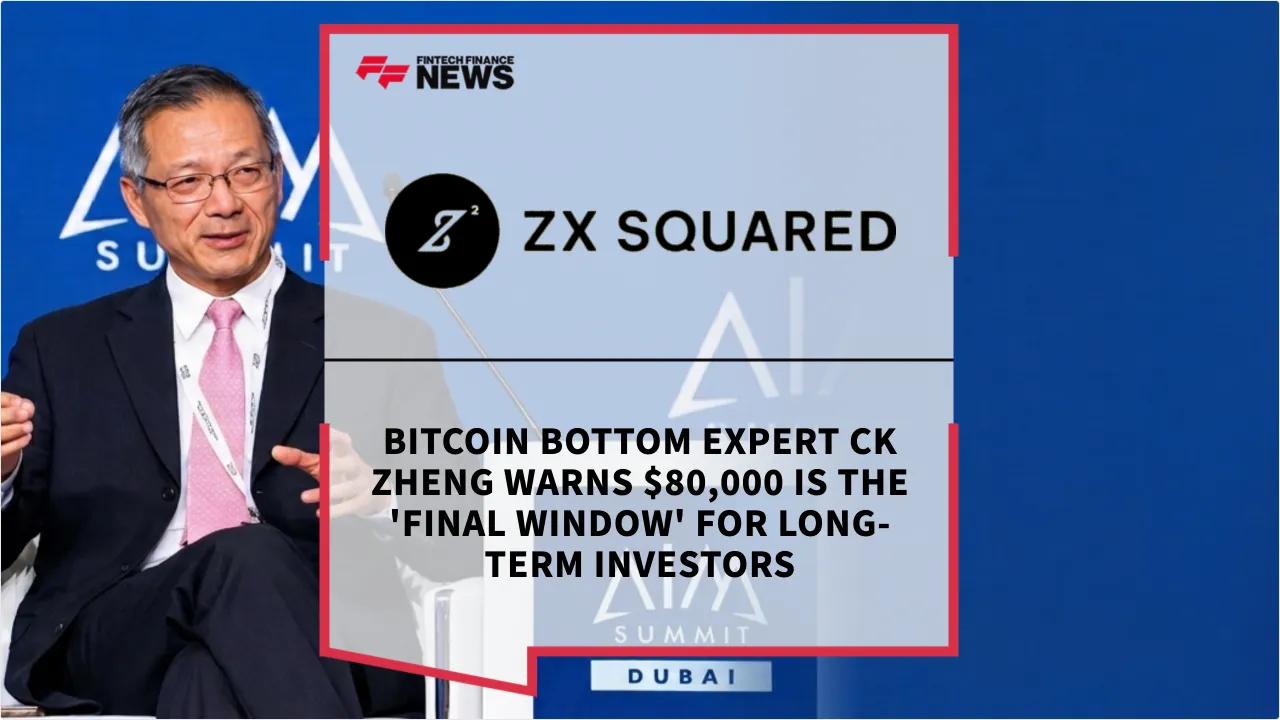
Calling a bitcoin bottom correctly is something even most experts aren’t able to do; however, ZX Squared Capital’s CK Zheng has done better than most in this regard. To elaborate, he spelled out the 2022 dip right after the Luna crash in May, stating that Bitcoin would fall to $15,000 under stress. One day after FTX imploded in November, he said the exchange's collapse would be the last wave of bad news for that bear market, which it was.
So now that Zheng says roughly $58,000 may be this four-year crypto cycle's floor reached in June 2026, and $80,000 could be the "last window of opportunity" for long term investors as a new crypto bull market may have already started, people have started to listen.
Where the market sits right now
Looking at Bitcoin’s value over the past year, one can see that the cryptocurrency has spent a good chunk of 2026 grinding around $60,000 and subsequently forged a solid recovery (even though it’s still down about 34% from its $126,000 high last October). At press time, the asset is trading just above $84,000, a little ahead of Zheng's window line.
Even then, he isn't ready to declare the four-year cycle dead as institutions are estimated to make up only about 10% of the market, with retail still in charge. "It may take institutions reaching 30% to 50% before the rules are truly rewritten," Zheng believes.
His own team got this wrong once in late 2025, thinking that a flood of institutional money might break the cycle and stretch the rally; but by the first quarter of 2026, that view had been dropped.
Why Wall Street is still hesitant
Part of the holdup is simply familiarity and Zheng believes that risk committee members who “have actually read” the Bitcoin whitepaper are extremely rare. Moreover, with AI soaking up attention, committees are increasingly leaning toward infrastructure they can see and touch, and unhedged bitcoin exposure is a hard sell.
For family office CIOs, a 5% allocation paired with precise downside hedging is suggested, especially as more and more legal clarity is entering the picture. In this broader context, Zhen asserts:
"[A 5% allocation] captures the asymmetric upside of digital assets without jeopardizing the safety of the overall portfolio, or your sleep, during extreme drawdowns. [Moreover] the Genius Act is effective, and the Clarity Act may be the final threshold. Once legislation is clear, Wall Street will feel comfortable doing crypto."
That threshold, however, has gotten taller because just last month, the Senate cloture vote failed 49 to 50, and passage before year-end now looks unlikely. Spot bitcoin ETFs shed roughly $746 million over the next two days, though about $2.4 billion came back the following week.
Stablecoins, RWAs and the AI question
Looking ahead, Zheng sees three main roads for traditional capital into crypto:
ETFs and crypto treasury companies
Stablecoins becoming core infrastructure
Real-world assets (RWAs) plugging into traditional finance's clearing and liquidity layers.
Stablecoins, in his opinion, are the most underappreciated of the three since they are already primed to have a major impact on the payments and credit card industries. The United States, too, is pushing hard for their increased utilisation, with the primary driver behind the move being one related to ‘dollar hegemony.’
Numberswise, the sector has already scaled to an immense level, with the global stablecoin supply hovering around the $311 billion mark (as of Oct. 1.)
Lastly, as far as AI goes, Zheng is skeptical, noting that while the technology is good, it isn’t necessarily a good investment, adding that how all that spending gets recouped remains unknown. However, as some of that capital rotates back toward crypto, he sees room for opportunities to emerge. He closed out by saying:
"Crypto is hard to time. Ordinary people find it even harder to grasp the rhythm, so what's needed is the discipline to hold, a strategy to reduce risk, and a long-term mindset."