EXCLUSIVE: "Is Wero The Euro's Hero?" - Breno Oliveira, payabl. in 'The Fintech Magazine'
By Lauren Towner · 9 October 2026
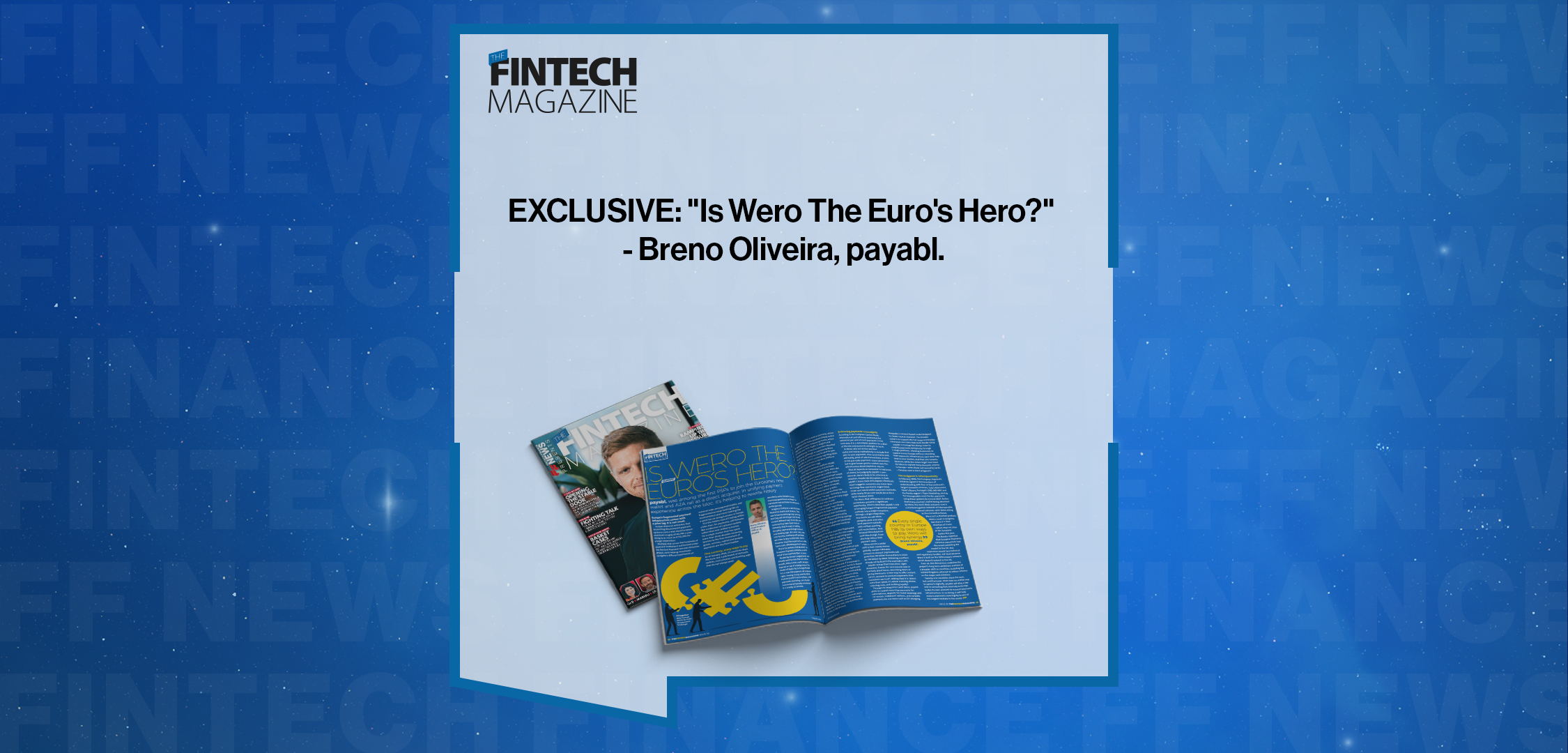
payabl. was among the first PSPs to join the Eurozone’s new wallet and A2A rail as a direct acquirer. In unifying payment experience across the bloc, it’s helping to rewrite history
Europe’s fragmented payment infrastructure comes with a price tag. It is not small.
Juniper Research estimates that reconciling disconnected payment systems costs a mid-sized European merchant roughly €244,000 a year, rising to as much as €732,000 for a large corporation. Multiply that across the hundreds of payment institutions authorised under the Revised Payment Services Directive (PSD2), each helping merchants navigate a different patchwork of national rules and payment habits, and fragmentation stops looking like an inconvenience and starts looking like a quiet tax on doing business in Europe.
It is the hidden cost of trading within a bloc that, for payments, still behaves like a collection of national markets rather than one unified economy. For a single market that has spent more than three decades removing barriers to the free movement of goods, services, capital and people, payments are the final frontier.
One currency, many ways to pay
As of January 2026, 21 countries share the euro, but a patchwork of domestic wallets, card schemes and banking apps that do not always work seamlessly across borders creates enormous operational overhead for merchants and confusion for consumers on the ground. Imagine a family on a road trip from Munich to Austria and Slovenia. They won’t have to exchange any currency, but they will have to get their heads around different ways to use the one currency they have.
Back home in Germany, they’re used to making everyday payments through Girocard and banking apps. But when they cross into Austria, merchants will probably ask them to pay via Bluecode. And in Slovenia, they’ll be expected to use Flik. Same euro, different payment systems. This is the problem that spawned the European Payments Initiative, and it’s what it has now built Wero to solve. Backed by Europe’s largest banks and already used by more than 53 million people, Wero is not a wallet wrapper layered on top of existing cards in the model of Apple Pay or Google Wallet.
It is a new A2A payment rail in its own right, moving money over the SEPA Instant Credit Transfer scheme, with payments (including cross-border transactions) typically completed in a snappy 10 seconds. Wero launched in 2024 in Germany, where it replaced the bank-operated Giropay online payment system, followed by France, where it took over from Paylib. In Belgium and Luxembourg, it acquired and then absorbed Payconiq (although in Luxembourg Wero can only currently be used for peer-to-peer transfers), and it’s currently migrating iDEAL in the Netherlands to the Wero platform.
That’s just the first stage.
Merchant payments platform payabl. joined Wero as one of its first licensed direct acquirers in October 2025, when the wallet had just passed 43.5 million users, giving its customers a route to accept instant account-to-account payments across Europe through a single setup. Wero, says Breno Oliveira, Chief Product Officer at payabl., is an answer to some fervent prayers.
“Fragmentation in Europe has been the standard for years,” he says. “And why is there fragmentation in Europe? Because every single country has its own ways to pay.”
That has a huge impact on merchants.
“Unification is a real issue,” says Oliveira. “Merchants want to move to different jurisdictions and expand their businesses, and they are completely overwhelmed by the changes required. Wero will bring synergy and help merchants integrate and penetrate different markets that otherwise would be much more difficult.”
It’s designed to solve more than fragmented payments, though. Wero also fits into a wider political agenda: it reflects a growing push for European payments sovereignty. That’s because today much of Europe’s everyday digital commerce – from contactless card payments to online checkouts and point-of-sale transactions, using wallets wrapped around plastic – runs over payment rails owned by two American companies: Visa and Mastercard.
Wero offers Europe its first credible home-grown alternative and, if it succeeds in prising cards out of consumers’ hands in favour of A2A transfers, the prize will be significant. Card payments were the EU’s most widely used non-cash payment method in 2023, accounting for 70 billion transactions, or 54 per cent of the total. While many nations operate their own domestic card schemes – as Germany does with Girocard – 13 Euro area countries don’t, leaving them entirely reliant on international providers.
And, because domestic schemes don’t operate cross-border, most of the local cards are, in any case, also dual-branded
Embracing payments sovereignty
According to the European Central Bank, international card schemes accounted for around 61 per cent of card payments in the euro area. It is a remarkable position for a bloc of this size and economic strength to be in. As Wero rolls out across member states and moves methodically to include first peer-to-peer payments, then ecommerce and, ultimately, point-of-sale transactions, it aims to not just make payments more convenient, but to give Europe greater control over the infrastructure those payments rely on.
That all depends on consumer acceptance, of course, but judging by payabl.’s own research, there’s likely to be a bounce in adoption, despite the disruption. In fact, payabl.’s latest State of European Checkouts report suggests consumers are more open to change than merchants might think: 53 per cent would switch payment methods, while nearly 30 per cent would do so for a faster checkout alone.
For Wero, that willingness to embrace convenience presents a significant opportunity. Oliveira describes payabl.’s role as bringing Europe’s fragmented payment methods into a single ecosystem. Through a single integration, merchants can add Wero alongside cards and other local payment methods, with unified reporting and reconciliation. And, because Wero bypasses card interchange, it can also help reduce their payment costs.
Wero mirrors a wider shift in how money moves globally. Juniper estimates account-to-account payments will grow from 60 billion transactions in 2024 to 186 billion by 2029, following a pattern already set by Brazil’s Pix and India’s UPI. payabl. Group Chief Executive, Ugne Buraciene, frames the commercial case in similarly direct terms, describing Wero as giving merchants ‘a new way to offer instant, secure, account-to-account payments that customers can trust’, adding that it is ‘about more than speed, it’s about creating choice, reducing costs, and building loyalty’.
Through its integration with Wero, payabl. plans to support recurring payments for subscriptions, deposits for hotel bookings and car rentals, instalment options, and variable payments for use cases such as EV charging, alongside a consent-based model designed for faster repeat checkout. The broader vision is to support the full range of everyday commerce use cases that cards handle today. payabl.’s strategy has always been to simplify payments complexity through a single platform, allowing businesses to expand across Europe without rebuilding their payments infrastructure each time they enter a new market. And that role remains, because, while the vision might have been for Wero to replace every domestic scheme in Europe – even those not owned by banks – the plan now is more pragmatic.
The endgame is interoperability
In February 2026, the European Payments Initiative signed a memorandum of understanding with four of the continent’s largest domestic schemes, Italy’s Bancomat, Spain’s Bizum, Portugal’s SIBS-MB WAY and the Nordic region’s Vipps MobilePay, aiming for interoperable cross-border payments using those systems by around 2027. Rather than every country’s wallet being absorbed by Wero, the more likely outcome now is a stitched-together network of interoperable national schemes, with Wero acting as the connective tissue.
Wero isn’t a finished product, more a work in progress, but there is a clear direction of travel – which may not stop at the Eurozone. Earlier this year, The Banker reported that European Payments Initiative executives had discussed extending the model to the UK. Any expansion would face technical and regulatory hurdles, not least because Wero is built on the SEPA Instant network, which doesn’t extend to the UK.
Even so, the discussions underline the project’s long-term ambitions and hint at a broader shift as countries, including the United Kingdom, attempt to reduce reliance on the major card schemes.
Twenty-one countries share the euro, but until last year, there was no unified way to spend it digitally. payabl. will play a key role in correcting that anomaly as Europe builds its own account-to-account payments infrastructure. In so doing, it will help restore payments sovereignty to one of the largest markets in the world.