EXCLUSIVE: "Navigating Change Safely" - Heather Crowley, J.P. Morgan Payments in 'Discover Sibos'
By Lauren Towner · 8 October 2026
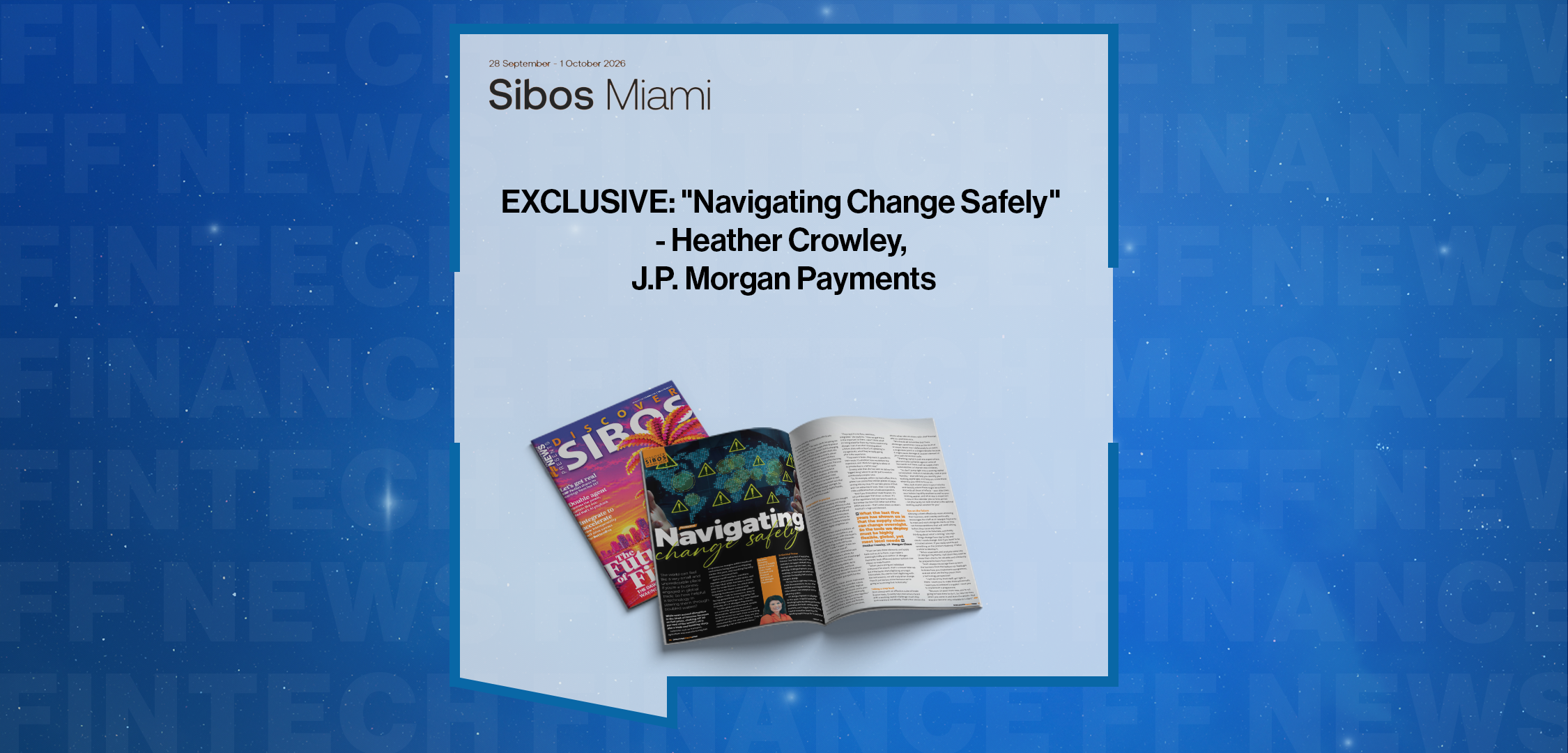
The world can feel like a very small and unpredictable place if you’re a business engaged in global trade. So how helpful is technology in steering them through troubled waters?
While news around disruption in the Strait of Hormuz focusses on fuel prices, choking off 20 per cent of the world’s oil is also a trade and banking story. Industries such as transport, agriculture and manufacturing felt a squeeze on margins within weeks of restrictions being placed on shipping earlier this year, and resulting liquidity pressures increased fast.
Add in tariff warfare, sanctions regimes and private credit strain, and it’s clear that 2026 has been a torrid year for trade finance. So, what does this mean for those tasked with keeping businesses and trade afloat?
“When I talk to treasurers, they’re facing geopolitical risk, liquidity risk and foreign exchange risk,” says Heather Crowley of J.P. Morgan Payments. “In the global environment, people are currently working to protect themselves. Whereas treasurers used to be focussed on cash from a working capital perspective, now they are also consumed by risk and resilience. They’re managing a lot at the same time.”
Embedded finance
Crowley’s job as Head of Supply Chain Finance, Core Trade Product and Product Delivery is to support the bank’s clients through these real-time events, while defining J.P. Morgan Payments’ product roadmap, so businesses can achieve and maintain the liquidity that’s crucial to navigate change.
The key theme right now is frictionless trade finance products, she says, which embed and integrate banking services into a client’s own enterprise resource planning system. J.P. Morgan Payments is a big player in this space. In April it launched the Working Capital Accelerator platform that centralises the bank’s working capital products, and in August won the Working Capital Innovation Award from The Working Capital Forum for its Supply Chain Finance solution, hosted within the Oracle Fusion Cloud ERP.
Crowley says: “The tools clients are asking me for are still, for example, supply chain finance or receivables, but how I deliver them is changing.
“You see a lot of native solutions built into ERPs, whether that be SAP or Oracle, where the client can just turn on these solutions without having to invest in [extra] tech to bring it about – it’s frictionless at their end. The onus is on us as providers to take on this work.
“Clients also want the process to be frictionless for their suppliers, all the way down to their small and medium-sized suppliers. Tools have to be flexible as well. What the last five years has shown us is that the supply chain can change overnight. So the tools we deploy must be highly flexible, global, yet meet local needs.”
Pragmatism in practice
The increased pressures on treasurers brought about by geopolitical instability and change mean the pursuit of speed and efficiency is vital. Crowley explains that at the beginning of the 2020s, platforms were launched that offered every trade finance instrument in one place, but banks failed to identify the incentive for using them. Six years on, Crowley is hopeful AI will now improve digital integration on a more practical level.
“We saw a lot of these utopian solutions, all the trade instruments on one platform, and [the idea was that] the buyer, seller, the buyer’s bank, the seller’s bank, the freight forwarder and insurer would all go to the site to use them,” she says. “It didn’t happen. It was too large to take on, so it never took off.
“As a trade organisation, what we’ve seen are more pragmatic solutions, where, for example, the eBoE [electronic bill of exchange] has a meaningful impact for the client.
“I do think, with AI being added, we’re going to see interoperability, and [such platforms] will take off. We were too euphoric about the whole thing before. We have a lot of fintechs in the fintech graveyard, but the ideas were sound.
“I always tell my clients: pick an instrument you already do today. Pick a provider, a bank that you’re comfortable with today. Digitise that piece that’s meaningful to you and to your industry. If we all do those pieces externally, that interoperability is going to come together.”
Crowley says that in the race to create AI-powered solutions, banks and fintechs must focus on what matters to the client.
“They need frictionless, seamless, integrated,” she explains. “How we get there is less important to them. I don’t think what I’m being asked for from my clients necessarily changes. Even if we start thinking about a future state with a client’s AI speaking to my agents etc, what they’re really going after is the experience.
“They want it faster, they want it specific to their needs. It’s all about how we deliver the experience, and I think AI is going to allow us to provide that in a better way.”
Crowley adds that she has seen AI deliver the ‘biggest bang’ where it can be put to work in a particularly complex area.
“So, for example, within my back office, this is where I can control four million pieces of paper coming into my shop. If I can take pieces of that and I can utilise the AI tools, then I can really make a difference from a trade perspective.
“And if you think about trade finance, it’s not just the paper that slows us down. It’s all the regulations that we have to work on. Remember the Dear CEO letter out of the EMEA and so on – that’s what slows us down. And that’s a high-cost element.
“If we can take those elements and apply tools such as AI to them, I can make a meaningful difference within J.P. Morgan Payments’ back office and deliver bottom-line impact to trade finance.
“When you’re doing an individual instrument for clients, that’s a slower take-up. But if the banks start digitising amongst themselves, the clients start digitising with the instruments, we will truly drive change. There’ll just be less noise because we’re going to be driving that holistically.”
Taking a step back
Once armed with an effective suite of trade finance tools, Crowley says executives faced with a working capital challenge must step back and think holistically. That’s the advice she shares when she sits down with chief financial officers and treasurers.
“We should all remember that these challenges sometimes come as the result of an event. Never react defensively to an event, a single data point or a single indicator because it might cause damage at another element of your cash conversion cycle.
“Working capital is just one aspect where you can build resilience against some of the events out there, such as supply chain vulnerabilities or interest rate increases.
“So, don’t jump right into a working capital conversation. Look at it holistically. Look at your liquidity – that will help you identify your working capital gap, and help you understand what else you need to focus on.
“Also, look at your peers in your industry and identify where there might be outliers. And with all these artefacts – your objectives, your holistic liquidity position as well as your working capital, and what else is important to you in this calendar year or time period – we [the bank] can look at what is the optimal working capital solution for you.”
Eye on the future
Advising a client effectively means knowing their business, and Crowley continually encourages her staff at J.P. Morgan Payments to meet and work alongside clients so they can foresee problems that will need solving before they cause any chaos.
“You have to be futuristic, constantly thinking about what’s coming,” she says. “Things change from day to day and clients’ needs change. And if you want to be a trusted adviser, if you really want to put something on the product roadmap, it takes a while to develop it.
“When associates and analysts come into J.P. Morgan Payments, I tell them they need to know their clients, be valuable and constantly be prepared to learn from them. “And I always encourage them to learn the business from the bottom up. Really get to know how you implement a programme, and ask what are the key pieces from a technology perspective?
“I tell the entry-level staff: get right in there. I want you to make those phone calls. I want you to onboard a supplier. I want you to implement a programme.
“Because 15 years from now, you’re not going to have time to do it. So, take the time when you come in and learn the details. That way you become very valuable to a client.”