The CLARITY Act's Failure Will Not Stop Innovation. It Decides Where Innovation Lives
By Lauren Towner · 14 October 2026
By 2024, 81% of the world's crypto developers worked outside the United States. The Senate's 49-50 cloture vote on the CLARITY Act on September 15, 2026, extends the conditions under which that share formed by at least one more Congress.
The likeliest cost of the vote shows up in geography and firm size: where digital-asset activity gets built, and who builds it. Global activity itself is unlikely to shrink much.
Uncertainty Works Like a Tax on Building Here
A firm deciding where to incorporate and hire engineers and build market infrastructure prices regulatory risk the way it prices any other cost. When crypto regulation is legible, capital can underwrite a 10-year build. But when the rules can change with an administration—the same project needs a higher return to justify it, or it gets built where the answer is already known.
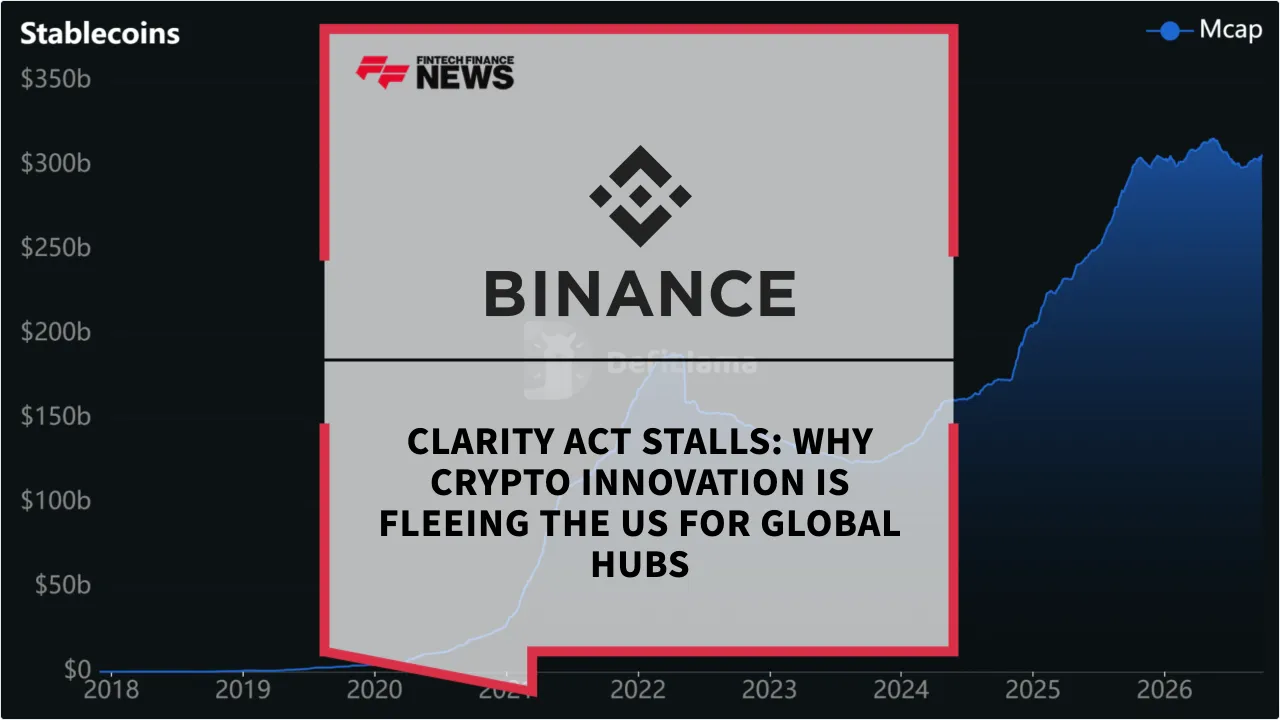
Stablecoins offer a natural experiment in lifting that tax. After the GENIUS Act was signed on July 18 last year, Anchorage Digital argued that stablecoins came onshore as foreign issuers moved assets under US supervision. Total stablecoin supply grew roughly 50% during 2025 to about $308 billion and has held near that level since, at roughly $305.7 billion on October 1. Plenty of factors drove that growth, but the sharpest expansion came in the year the rules were settled.
"GENIUS demonstrated that the United States can establish durable rules for digital finance. The unfinished task is the market-structure bookend," says Steven McWhirter, Global Policy Lead at Binance. "In a global, 24/7 market, regulatory uncertainty does not stop technological development, but it can influence where innovation, liquidity, infrastructure and expertise develop."
The four nouns in that last sentence aren't equally mobile. Developers and liquidity move fast, crossing borders with little friction. Infrastructure and institutional expertise put down roots slowly and rarely come back quickly once they settle elsewhere. That asymmetry is what makes a long uncertainty window expensive.
Capital keeps following clarity where it exists. Within days of the vote, the Office of the Comptroller of the Currency granted national trust bank charters to three stablecoin issuers.
Where Developers and Capital Already Went
The location shift started long before this vote, during a decade in which US crypto rules were defined largely through enforcement. That makes it the best available measure of what prolonged uncertainty has cost.
Electric Capital found that the US share of crypto developers fell 51% between 2015 and 2024, to 19%. Over the same stretch, Asia's share climbed from 13% to 32%, with India alone at about 12%. An earlier a16z analysis showed the US share falling 26% between 2018 and 2022. Both datasets track where code is written rather than developers' nationality, which makes them a direct map of where engineering work happens.
Firms build where rules are legible because the capital that funds them demands it. Economist Carlo De Meijer has argued that prolonged US uncertainty could slow investment and innovation in the United States and push firms toward jurisdictions with consistent rules.
The market's first reaction carried a similar note of caution. Bitcoin fell about 3% on September 15 while Coinbase and Circle shares dropped 8% and 10%. The move came amid a broader sell-off and a day before a Federal Reserve rate decision so it says more about short-term sentiment than about long-run location.
The Gravity Argument, Taken Seriously
The strongest counterargument is that the US remains the largest pool of capital and the deepest set of financial markets in the world, and that capital has mostly stayed put.
The data back that up. Galaxy Research figures published on September 16 show US-based crypto companies took 73.5% of the $5.68 billion invested across 384 venture deals in the second quarter. Gravity is real and it still anchors the largest rounds.
Uncertainty also redistributes activity inside the US. Without a statute, the advantage tilts toward incumbents that can afford to build under shifting rules. Davis Wright Tremaine's lawyers expect large, well-resourced banks to keep investing in crypto infrastructure while community banks fall further behind, a gap that would put smaller players at a clear disadvantage. Where innovation lives, in that sense, is measured by firm size as much as by geography.
A closer read of the Galaxy data points the same way. US companies took nearly three-quarters of the capital but only 39.1% of the deals, which suggests the US is winning the larger, later-stage rounds while most new companies are being formed elsewhere.
The Length of the Window Is the Cost
The economic damage from the vote depends less on September 15 itself than on how long the uncertainty window stays open. Developers and liquidity can return quickly once rules are settled. Infrastructure and expertise, once established elsewhere, tend to stay. Gravity buys the US time to finish its rulebook, and the developer and deal-count data suggest some of that time has already been used up.