EXCLUSIVE: "A Team Effort!" - James Bushby and Rivo Uibo,, Tuum, and Chris Wordsworth, LHV Bank in 'The Fintech Magazine;
By Lauren Towner · 13 October 2026
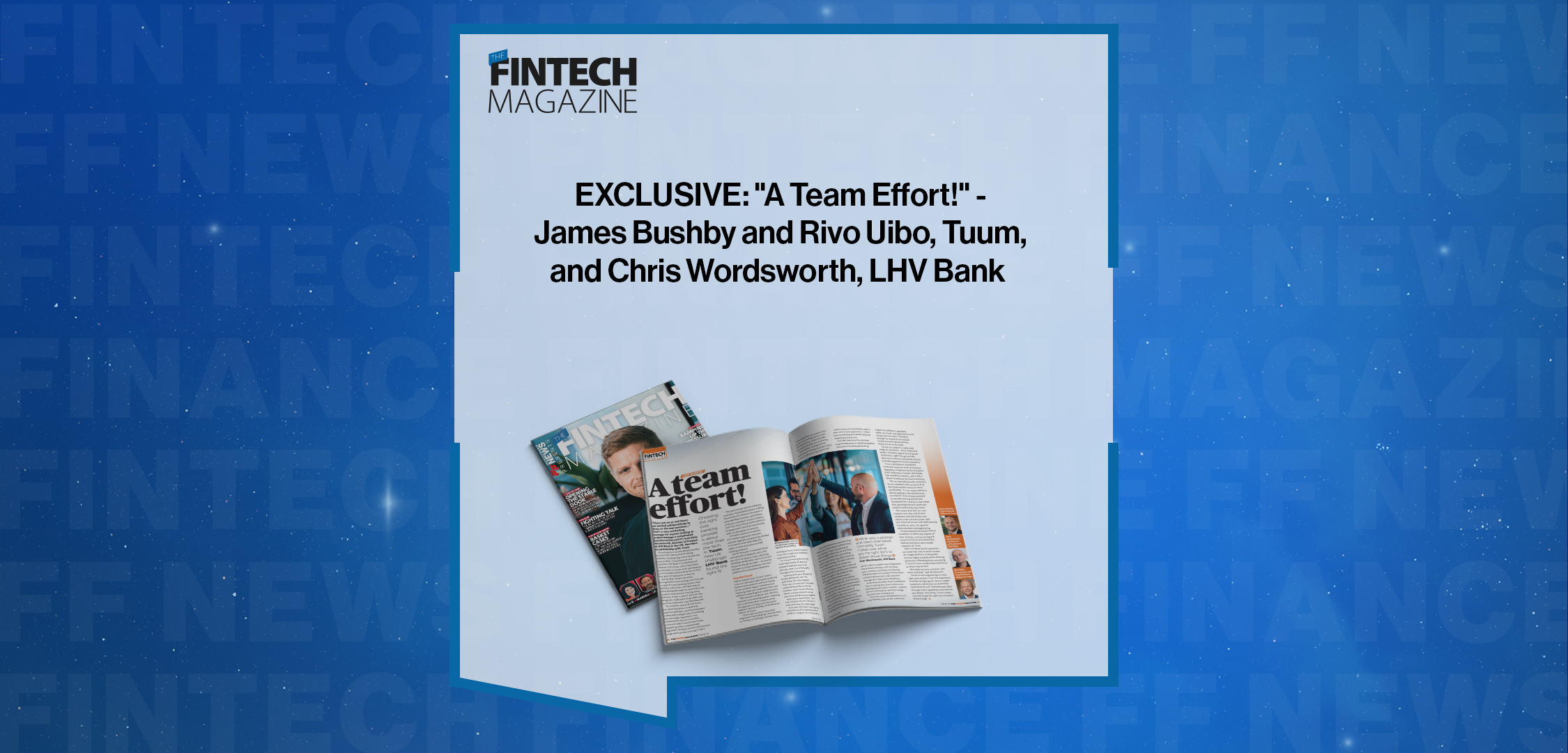
Choosing the right core banking provider is about more than the tech. In Tuum, new UK challenger LHV Bank found the right fit
“There was no us and them; we worked collaboratively to focus on the end customer...”
That’s a very comforting message for anyone looking to project manage a complicated transformation and it’s how Chris Wordsworth, Director of Product at LHV Bank in the UK, describes its partnership with Tuum. A banking-as-a-service (BaaS) provider to more than 200 customer-facing fintechs, including big-name companies such as Wise, Currencycloud and Coinbase, LHV Bank is a subsidiary of Estonian LHV Group, and it had relied on the same in-house-built architecture as its European parent bank for its first four years of operation in the UK.
But by 2022, Brexit transition arrangements were ending, and LHV was in need of a core banking system that met the criteria for a UK bank licence while being optimised to cope with new products and services coming down the track. It was a case of ‘pick out the things you really want to go after and do those really well’, says Wordsworth. The modular nature of the Tuum core banking system suited that selective approach, and the developers’ instinctively collegial way of working was the magic ingredient. The collaboration was so successful, customers didn’t even know it was happening until a substantially upgraded LHV Bank service and product range were up and running in 2023.
The partnership saw the relatively unknown ‘bank behind banks’ shifting thousands of customers for whom it provided BaaS services, and millions of those customers’ account holders, onto the Tuum Cloud-native platform. It happened in less than two months with no disruption to services.
LHV Bank went on to process 47.7 million payments that year, and the upgrade subsequently allowed it to launch new retail deposits, retail current accounts and SME lending products. Earlier this year, it revealed 99 per cent growth in deposits and a 136 per cent increase in loans, declaring £5million profit after tax in its annual financial results for 2025 – its second full year as a licensed bank. The new platform has more than delivered.
Flexible friend
Tallinn-based Tuum (‘tuum’ means ‘core’ in Estonian) helps banks build and launch new products without having to rip out their legacy infrastructure, meaning they can modernise their core without impacting their daily business.
“We provide a feature-rich, API-first, modular core banking system, meaning our customers don’t need an army of engineers to help with the build,” explains James Bushby, Chief Revenue Officer at Tuum “That said, we don’t stop their engineers from helping customisation, so if they’re looking to embed their existing partners or build new products in our core, we give them the flexibility to be able to do that.”
It is a way of working that was very much welcomed by LHV Bank, as it enabled it to keep its focus on the end user, rather than on the supplier throughout the build process. Speaking at this year’s Money20/20 Europe, Wordsworth said: “The partnership felt really integrated. There was no us and them. We worked collaboratively to focus on the end customer. Tuum felt part of the team. There’s a mutual interest in why we want to accelerate and grow together.”
Both second-wave fintechs, Tuum and LHV Bank were not unknown to each other when the project began. In October 2021 they’d come together to develop an API-powered payments platform using the LHV Connect API so Tuum could offer its customers 24/7 access to instant payments in both sterling and euro, via the UK Faster Payments and SEPA Instant schemes.
Nevertheless, moving from the autonomy of running one’s own core to a SaaS model was a big step for LHV.
“There tend to be two extremes that banks face when they’re offered cores,” says Bushby. “One is something we call the legacy black box, so very fixed features set within the core banking system gives them very little control of what they’re doing. The other extreme is something we call an empty neo core, which means they need a team of engineers just to build that basic product. Tuum sits right in the middle of that, offering the best of both worlds.”
LHV Bank weighed up the options and came to the decision that the lower cost associated with SaaS compensated for any loss of autonomy over roadmap prioritisation – as it turned out, it didn’t need to make any compromises. The second deciding factor was opportunity cost: it decided the bank’s resources would be better deployed building more differentiated capabilities – both in terms of orchestration and in areas such as user experience – rather than on spending time developing the underlying architecture.
And then there was the seamless plug-and-play access to a wider ecosystem offered by a Cloud-based banking system, which enables easy integration into ancillary services, such as know- your-customer and fraud monitoring.
LHV Bank went on to plug in transaction monitoring from Salv, and customer management tools from Salesforce. As Bushby describes Tuum’s platform: “You’re looking at a Cloud-native core banking system that’s modular, resilient, API first and built on real-time ledger microservices architecture.
“From the point of deployment, it’s very flexible; each of our customers might have different regulatory needs, so a SaaS-managed service isn’t always best for them. Therefore, they get to choose private Cloud, on-premise and hybrid options, which are all on the table.
“So we can support a really wide range of customers – from traditional banks, neobanks, digital-first financial institutions, right through to EMIs [electronic money institutions], fintech, and PSPs [payment service providers].”
From a compliance standpoint, Tuum also supports multi-jurisdiction regulatory compliance across European, Gulf Cooperation Council, and Middle East and Africa markets, and it offers Sharia compliance for Islamic banking.
“We can basically provide a platform to our customers that removes all of the hassle and the worry for them,” says Bushby. “It’s our responsibility to do the upgrades, the maintenance; we make it’s free of technical debt. So we effectively give them the foundation for a platform that meets their growing business needs and products when they need them.”
This means that LHV can now support more than 200 fintech customers and 100 million end clients in the UK and Europe, with just a team of around 130 staff covering compliance, sales, risk, general administration and engineering. It’s also allowed the bank’s fintech customers to define key aspects of their business, such as pricing and account structure and hierarchies, without having to make change requests via Tuum.
Both LHV Bank and its customers can build their own business on top of a single platform, making their services highly scalable while retaining autonomy. Offloading time-consuming IT work to Tuum meant they could focus on what they do best.
“We really are very customer- and client-oriented,” says Wordsworth. “Product and engineering is a very tight partnership – from the experience to really having a great view on target customers, which you can build that experience to suit. That obviously plays through to the capabilities and services you deliver. Ultimately, Tumm makes sure we’ve got the right tech to deliver those things.”
Thanks to the partnership with Tuum, 75 per cent of LHV Bank’s IT budget goes towards delivering customer value – compared to the average bank, which spends 80 per cent on maintenance, 50 per cent of it on core banking.
Transformation at pace
A crucial part of the LHV Bank decisioning process was influenced by Tuum’s ‘smart migration’ service, which yields faster and lower-risk handovers, thanks to a configuration-first approach to deployment with migration APIs and other migration tools. Migration concerns are always top of mind for leadership teams looking at modernising their core, and it’s one of Tuum’s strengths, says Bushby.
“We make sure that they don’t have to change any of their legacy systems until their core is proven. And once they’re ready, we provide the blueprint so they can migrate at their own pace,” he explains. “We’ve never failed in implementation. It’s really unique to be able to say that in this marketplace. Typically, it takes us just a few months to deploy. That’s not proof of concept, not a sandbox. That’s production-ready, live with customers on the system.
“That’s in a world where banks can take more than five years to complete a core modernisation, and often end up with something that looks very similar to what they originally started with. Our approach around migration and deployment means we change the conversations we can have with customers,” he adds.
In the end, LHV successfully migrated millions of UK accounts onto the Tuum platform within two months – an achievement that was honoured for its speed and smooth implementation by an IBSi Global Finance Innovation Award for Best Core Banking Implementation in 2024.
Providing such a speedy, friction-free and customer-centric service was extremely important for LHV Bank, competing as it was against long-established rivals such as Monzo, Revolut and Starling.
“[They’ve set] the minimum expectations and hygiene now for customers,” says LHV’s Wordsworth. “Obviously, they have 10 years of being a neobank – if you can still call them a neobank 10 years in – so chasing them is a tough one. It becomes more about ‘OK, meet the standard, then pick out those key aspects that you really want to go after’.
“I think if you know who your customers are, if you know what you’re about, you know what you want to do, and do it well, you can have a very successful business.”
Despite the crowded marketplace, there’s still a lot to play for, agrees Tuum’s Co-Founder and Chief Business Officer, Rivo Uibo. As he puts it: “The right value prop at the right time, to the right individuals, and the demand will still be there.”
Looking at the year ahead, Wordsworth says the LHV team will continue to meet customer need for savings products with innovation, while building out its new current account.
“It’s important that we’re focussed on quality and doing something that’s helpful to people’s lives,” he says. “We might not be the bank for everyone, but the ones we are for, we will serve very well.”
The birth of a bank
OCTOBER 2021
LHV UK (which would become LHV Bank), signs a strategic partnership with Tuum, formerly Modularbank, for API-based payments, giving its fintech customers around-the-clock access to instant payments in GBP and EUR, via the UK Faster Payments and SEPA Instant schemes.
FEBRUARY 2022
Tuum closes a €15million Series A funding round to support its product development and global expansion.
MARCH 2022
LHV UK selects Tuum to replace and power its core banking infrastructure to increase its flexibility in serving customers and build its product offering.
APRIL 2022
LHV UK parent company, LHV Group, invests €1million in Tuum.
EARLY 2023
LHV UK executes a phased ‘smart migration’ onto Tuum, running the new Cloud-native platform in parallel to migrate millions of accounts in under two months.
MAY 2023
LHV UK receives its UK banking licence after being authorised by the Prudential Regulation Authority.
AUGUST 2023
It completes the transfer of its UK branch operations to its newly licensed banking entity now known as LHV Bank.
SEPTEMBER 2023
LHV Bank upgrades and launches its SME lending system on Tuum, offering UK small businesses property and trading loans of up to £5million.
DECEMBER 2024
Tuum and LHV Bank win the IBSi Global Finance Innovation Award for Best Core Banking Implementation for revamping the latter’s core banking system – a pivotal move that supported LHV’s successful application for a UK banking licence.