EXCLUSIVE: "Upgrade the Tech, but Trust Still Moves the Money" - Simon Eacott, NatWest in 'Discover Sibos'
By Lauren Towner · 7 October 2026
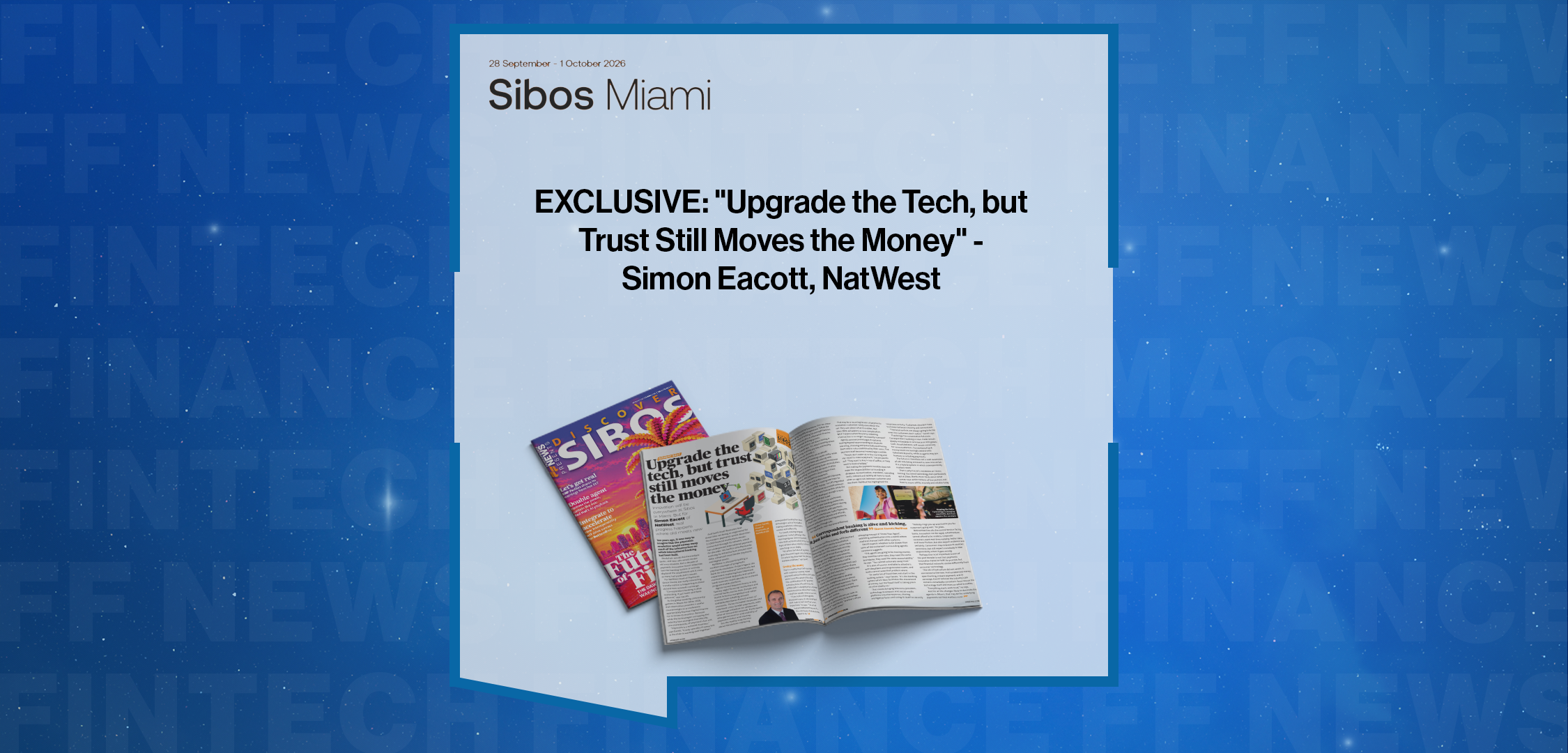
Innovation will be everywhere at Sibos in Miami. But for Simon Eacott of NatWest, real progress happens where old meets new
Ten years ago, it was easy to imagine that the payments revolution would sweep away much of the infrastructure on which international banking had been built. Blockchain would disintermediate banks, and new rails would render old ones obsolete. But a decade of payments innovation hasn’t killed the two-tier banking system or entirely displaced the established rails it uses, as many had predicted it would.
For NatWest Head of Payments Simon Eacott, the really interesting transformation is happening as these old and new networks converge.
“Correspondent banking is alive and kicking, it just looks and feels different,” says Eacott.
As the global banking community gathers in Miami for Sibos 2026, that observation provides a useful counterweight to a conference appropriately themed Digital Finance For AI-Driven Economies. Because while the technologies occupying the industry have changed dramatically, one characteristic of payments has not.
"Payments is a network business,” says Eacott. “It only operates if every link in the chain is working well together.”
And Swift itself illustrates how those links are being re-engineered for the modern payments world. More than 11,000 financial institutions remain connected through its network, which has underpinned international payments for decades. Yet Swift is simultaneously evolving its infrastructure around richer data, enhanced cross-border payments and digital assets.
NatWest is also participating in another example of pragmatic payments evolution: Project Agorá, the Bank for International Settlements-led experiment exploring how tokenised commercial bank deposits and central bank reserves could operate on a shared programmable platform. Agorá moved beyond theory in July. Twenty-eight financial institutions and central banks across Asia, Europe and North America completed real-value transactions totalling around CHF800,000 (Swiss francs) across 17 scenarios. Those included corporate and interbank cross-border payments, with an average initiation-to-settlement time of around 80 seconds.
Participants also gained end-to-end visibility of payment status and routing. So, the reality may be less about blockchain replacing correspondent banking than about technologies such as tokenisation making established, collaborative models work differently. For Eacott, evolving alongside traditional, trusted pathways rather than leaping over them is important. How that’s achieved is likely to be a top topic at Sibos where industry’s shiniest new things are on display.
“It’s where the future of payments gets discussed, it gets stress tested, and it’s where big ideas meet the practical realities of delivery,” says Eacott.
Seeing the money
That’s a reality check that resonates with corporate treasury. Instant payments attract headlines, but speed alone is not the whole of the value. The combination of 24/7 payment infrastructure, APIs and richer ISO 20022 data is changing what corporate treasurers know about their liquidity – and how quickly they can act on it.
“If you look at it through the treasurer’s eyes, it’s the visibility of that cash in real time that’s most important,” he says. “The actual instant settlement behind it is the mechanics that the banks need to do.”
For multinational businesses, that can mean managing liquidity as operations ‘follow the sun’, instead of waiting for overnight batches or weekends to pass or information to arrive from disparate banking systems.
“I think the value is not about moving it faster,” Eacott says. “It’s about knowing where your money is at any one time and exactly what you can do with it.”
Real-time payments can accelerate order-to-cash and working-capital cycles, while APIs can connect bank data directly with treasury management and enterprise resource planning systems, enabling faster reconciliation, forecasting and liquidity decisions. In other words, the payment is becoming as much about information as movement.
At the other end of the corporate payments chain, open banking is creating new ways for businesses to collect money. The UK’s regulated open banking framework has created common standards for banks and third parties, while the US has historically developed through a more fragmented, market-led model.
NatWest has put those UK rails to work through Payit, its open banking proposition. Businesses can collect money without storing a customer’s card details, with payments settling within seconds over Faster Payments. Payit also supports payouts and refunds, account validation and recurring payments, and integrates through APIs.
For merchants, near-real-time settlement can improve cashflow visibility, while payment status information assists reconciliation. Removing the need to collect card or bank credentials can also reduce data-security exposure. Eacott resists framing A2A as a strategic move against card networks, though, as it is often portrayed in Europe.
“I don’t think it’s necessarily a battle between account-to-account payments and cards,” he says. “It’s about customer choice effectively, and that’s both for merchants and for the customers themselves.”
Cards have had decades to develop protections, chargebacks and an almost universally understood experience. Open banking payments will need similarly compelling services if they are to become intuitive and routine.
“It is going to be around use cases as opposed to necessarily the technology behind it,” says Eacott, “and that’s where the growth will come.”
That may be a recurring lesson of payments innovation: customers rarely care about the rail. They care about what it enables. But Sibos 2026 will address a new complication. What happens when the party initiating a transaction is no longer necessarily a person?
Agentic commerce envisages AI systems moving beyond recommending products to searching, choosing and potentially purchasing them within rules established by their users. The payment itself becomes increasingly invisible.
“People don’t wake up in the morning and say I want to make a payment,” Eacott points out. “They want to buy a cup of coffee, or they want to book a holiday.”
But making the payment invisible does not make the responsibilities surrounding it disappear. Authentication, mandates, spending limits, consent and liability all have to work when an agent sits between customer and merchant. NatWest has highlighted the emerging concept of ‘Know Your Agent’, extending authentication into a world where machines transact with other systems.
Eacott expects adoption to be slower than some of the excitement surrounding agentic commerce suggests.
“If AI agents are going to be moving money, they need the same rules, they need the same boundaries, they need the same accountability,” he says. “You cannot automate away trust.”
AI is also, of course, available to attackers, with deepfakes and AI-generated scams, and banks cannot solve that problem alone.
“An awful lot of fraud does not start in the banking system,” says Eacott. “It’s the banking system which then facilitates the movement of money, but the fraud itself is taking place on other platforms.”
That means bringing telecoms providers, technology businesses and social-media platforms into the response, sharing intelligence faster and using AI itself to identify suspicious activity. Customers shouldn’t have to choose between security and convenience.
“The best controls are always going to be the ones the customers don’t notice,” Eacott says.
That brings the conversation full circle. Correspondent banking is alive. Cards remain deeply embedded in commerce as A2A grows. Cash, Eacott believes, will remain necessary for some customers. Conventional bank money could increasingly coexist with tokenised deposits, while AI agents may join humans in initiating payments. The future is therefore not a neat succession of old rails being removed as new ones arrive. It is a hybrid system in which interoperability matters more.
That is why Eacott’s insistence on ‘stress testing’ the latest technology feels particularly apt at Sibos. Banks must think about what comes next while millions of transactions still have to move safely, securely and reliably today.
“Nobody rings you up and thanks you for a payment going well,” he jokes.
Behind that line sits the central tension facing banks. Innovation can be rapid; infrastructure cannot afford to be reckless. Corporate customers want real-time visibility, better data and lower friction, but also expect resilience and certainty. Consumers may embrace AI-assisted commerce, but still expect somebody to take responsibility when it goes wrong.
Perhaps the most important lesson of the past decade is not that payments innovation failed to fulfil its promise, but that financial networks evolve differently from consumer technology.
The old infrastructure did not vanish. It connected to the new. And as tokenised money, open banking, instant payments and AI converge, Eacott believes the industry’s job remains remarkably consistent: focus less on the technology itself and more on what it enables.
“Everything starts with trust,” he says. And for all the changes likely to dominate the agenda in Miami, that may be the underlying payments rail that matters most.