EXCLUSIVE: "Banking (All Of) Europe" - Matthias Dekan, Raiffeisen Bank in 'The Fintech Magazine'
By Lauren Towner · 6 October 2026
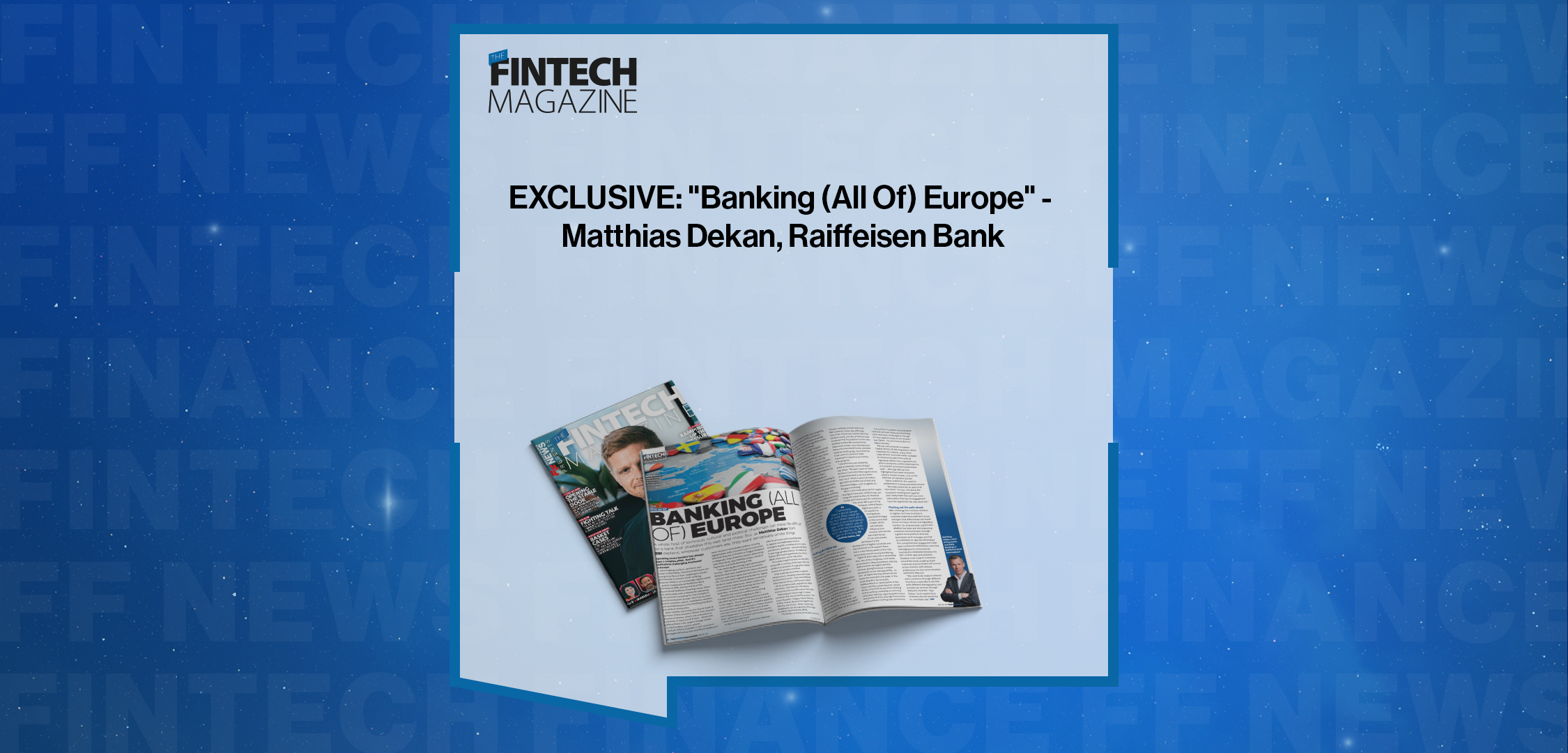
A whole host of technical, cultural and political challenges can make life difficult for a bank that straddles this vast land mass. But, as Matthias Dekan from RBI explains, wherever customers are, they want remarkably similar things
Operating across borders has always been a complex affair. And it’s particularly challenging at present in Europe. Amid ongoing conflicts, sanctions and Trump’s trade battles, financial institutions are having to be fleet of foot, adapting to remain commercially successful while meeting customer needs in an increasingly digital world.
Austria-headquartered Raiffeisen Bank International (RBI), the key entity of the decentralised Raiffeisen Banking Group, faces this reality daily, with subsidiaries operating in 23 countries, including 11 core markets in Central and Eastern Europe. Each has its own distinct customer cohort, compliance realities, cultural expectations of its banking providers, and political sensitivities.
Most recently, the Group has found itself at the heart of the sanctions fallout from Russia’s invasion of Ukraine, which has embroiled its businesses in Austria and Russia – where AO Raiffeisenbank is the largest foreign lender – in the European justice system. And yet, while it straddles a vast continent, still largely defined by East and West, Raiffeisen’s main mission is remarkably uniform: to bring digitalisation with a human touch to customers.
Whether they are in Pristina or Prague, Budapest or Belgrade, they all desire a better relationship with their bank, says Matthias Dekan, Head of Payments and Daily Banking at RBI.
“I see banking becoming super-personalised,” he says. “We’ve seen a lot of very successful fintechs that have redefined the way customers interact with their bank and with their financial life. This has been a good accelerator for legacy banks to really think and do better in terms of the customer experience. What matters for customers is that their banking services are seamless, intuitive, and value-adding.” Despite the current conflicts consuming Europe and its close neighbours, RBI is benefitting from a generally positive outlook in the region.
The European Investment Bank’s most recent report highlights a healthy appetite for consumer and housing loans in these markets and says three-quarters of the cross-border banking groups it surveyed intend to expand their operations in Central and Eastern Europe – that includes RBI itself.
In April, it launched a voluntary takeover offer for all issued and outstanding shares in regional rival Addiko Bank, aimed at strengthening RBI’s market position in Croatia and Slovenia specifically – two countries where it sees huge growth potential. The Addiko bid follows RBI’s recent agreement to buy Garanti BBVA’s Romanian unit for €591million.
The market might be diverse, but behind the scenes RBI is striving to build a back office that unifies its subsidiaries through great customer service and seamless workflows. It has made big investments in payments infrastructure, including its Romanian-based shared service centre – Centralised Raiffeisen International Services and Payments (CRISP) – which processes data, supports back-office operations, and reconciles and matches transactions for local RBI banks across Europe.
Operating as it does in eight European countries that are outside the eurozone – the Czech Republic, Hungary, Poland, Romania, Serbia, Kosovo, Bosnia & Herzegovina and Albania, plus Russia – Dekan is personally delighted to see the expansion of the Single European Payments Area (SEPA).
“The Balkan countries, for instance, which are very important to RBI, are now getting or have in place SEPA connectivity,” he says.
And with Europe mandating real-time banking through SEPA Instant that could be a real boost.
“I think it’s the right thing for customers and for the economy overall because there are tangible benefits of having instant payments,” says Dekan. “RBI is ready for it – we are fully integrated into all the instant payment rails. And we proactively work with our respective regulators and work across the ecosystem to leverage what we can to build over and above them.”
RBI puts a lot of emphasis on collaborative partnerships, including its recent tie-up with Wise to enable faster and lower-cost international payments for both retail and business customers.
“We have a pragmatic view,” says Dekan. “For us to rebuild what someone like Wise builds is very difficult and very expensive. So, obviously, a partnership makes sense – and for the customer, it’s seamless because we integrate it into our ecosystem, so they are not being sent somewhere else to execute the payment. The fact the payment is routed through our partner Wise is a secondary concern for them.”
Shifting the digital dial
Digitalisation – both from a product standpoint and to bolster security in an age of increasing cyber threats – is key to the way RBI approaches every market. While each retains unique characteristics and RBI subsidiary banks develop their own products to match them, some concepts are so successful that they are of interest to the wider group.
Take Serbia, where digital innovation across retail and SME products and user experience has driven considerable success for Raiffeisen banka a.d. Beograd.
It introduced two signature offerings: iKeš (iCash), a fully online personal loan that has made the approval process 10 times faster, and iRačun (iAccount), a fully online digital current account that can be set up in 15 minutes. Available to both retail and SME customers, these two offerings have driven impressive market share for the bank locally, and iKeš (iCash) proved so popular that the platform is now also available to other RBI country banks.
Meanwhile, Serbia’s one-click payment feature for investment funds, available inside the banking app, accounted for 70 per cent of customers’ total investments in the first six months after going live.
“I think humans are inherently wired to automate certain things,” says Dekan. “We don’t want to make decisions. Customers have a good sense of what they need to do, but often don't do it – there's a procrastination gap. With the better use of data and new technologies, such as agentic AI, this gap is shrinking.”
RBI is a vocal local advocate for crypto and digital currencies, which it says can bring new opportunities for financial market participants and the customers they serve. RBI is part of the European Central Bank’s digital euro pilot, a 12-month live testing phase scheduled to begin in the second half of 2027, which will evaluate infrastructure, security, and real-life user experiences.
It’s an enthusiastic participant in the development of digital currencies and the infrastructure to support them, but it is also keenly aware of the risks, particularly around money laundering. Digital ID plays a key role in controlling that, and, across the group, local banks are involved in national electronic identity (eID) and bank-led digital identity schemes, giving the Group a unique perspective on the interoperability – or not – of digital identity infrastructure across the continent of Europe. In the Czech Republic, for example, Raiffeisenbank a.s. participates in the citizen identity system Bank iD, which allows consumers to use their existing online banking credentials to securely verify their identity, log in to government and private portals, and sign documents online without creating new passwords.
“A lot of the incumbent authentication methods we have today are becoming more and more challenged in the age of more sophisticated, AI-led attacks,” says Dekan. “So we’re very bullish on digital identity.”
RBI has welcomed the European Digital Identity (EUDI) Regulation, which mandates EU member states must make at least one EUDI wallet available to everyone by late 2026, with all regulated entities then required to be able to accept the wallet credentials for SCA and KYC processes by December 2027 – although RBI has also highlighted that some important aspects remain unclear, such as the liabilities of individual parties.
Dekan underlines the need for collaboration to keep consumers secure.
“No single player will be able to do that alone,” he says. “It’s about the ecosystem working well together, and I really hope that we’ll see more information sharing and engagement from the regulatory side. We need that.”
Plotting out the path ahead
RBI’s challenge has not been whether to digitise, but how to enhance customer experience with the human strengths that differentiate the brand across so many cultures and regulatory borders. So, at group level, a great deal of effort has been put into improving customer communication through a global cloud platform that lets businesses send messages and talk to customers on apps like WhatsApp.
This comprehensive engagement layer spans outbound notifications, two-way messaging and conversational touchpoints embedded directly into RBI’s mobile apps and websites. Chatbots now support customers around the clock, enabling faster responses and consistent self-service across markets with distinct preferences for the communication platforms they use.
“We need to be ready to interact with customers through different interfaces, especially as we deal with different demographics and provide our services through different channels,” says Dekan, “and maybe these channels are not owned by us. And that’s OK.”