EXCLUSIVE: "Converging on Co-Existence" - Isabelle Delorme, Euroclear in 'Discover Sibos'
By Lauren Towner · 6 October 2026
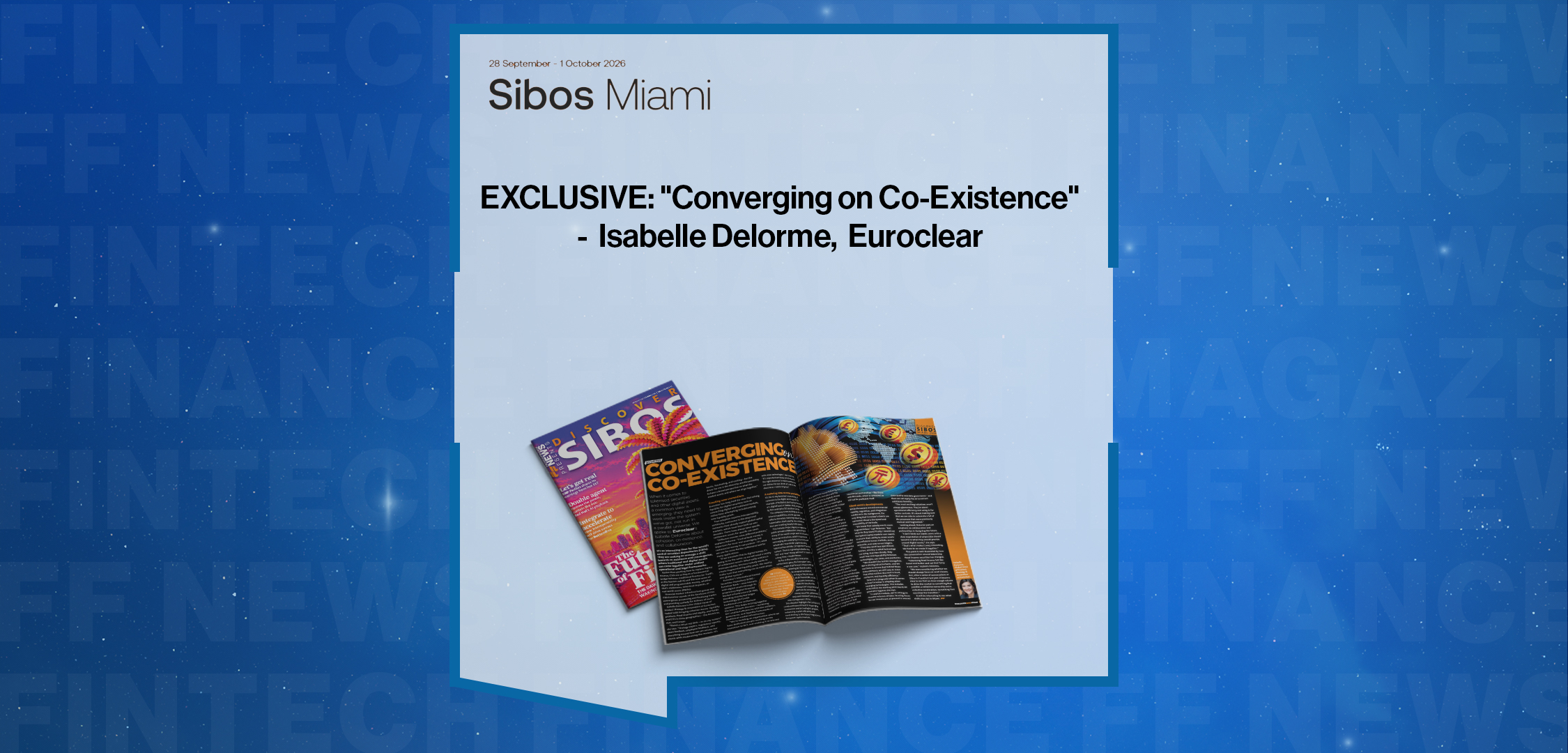
When it comes to tokenised securities and other digital assets, a common view is emerging: they need to work inside the system we’ve got, not run in a parallel universe. We spoke to Euroclear’s Isabelle Delorme about cohesion, co-existence, and collaboration
It’s an interesting time for the world’s central securities depositories (CSDs). They are seeking to manage a shift towards co-existence and convergence, where traditional and digital assets can come together under unified operational and legal frameworks. Rather than plotting how to replace legacy finance, CSDs are acting as a fundamental bridge between traditional finance (or TradFi, as the hipsters call it) and the new wave of digital and programmable money, whether that’s stablecoins, tokenised deposits, or real-world assets (RWAs).
Financial market infrastructure group and CSD Euroclear stands at the forefront of this convergence, processing and finalising trades and providing custody for trillions of euros. Isabelle Delorme is the Global Head of Product Strategy & Innovation at Euroclear, tasked with bringing cohesion across liquidity products, fixed income and equity, and funds and ETFs in three geographies – the Americas, Asia, and Europe.
“There’s a lot on my desk – or on my screen,” she says. “Strategy papers, regulatory reports, client feedback, employee feedback, and everything around how we can service our clients while modernising the markets. It’s hectic, fascinating, and exciting – but the driver for me is the diversity, and the possibility to have a broad perspective on what the market wants and where we all go together.”
Creating new connections
Euroclear has long held the view that solving liquidity for digital securities rests on connecting digital and traditional markets, rather than attempting to build entirely new liquidity pools. True adoption requires interoperability, continuity, and access to the deep trust networks that already support global capital markets, which have been built up over decades. There have always been specific settlement assets for specific use cases.
“Different monies solve different problems,” explains Delorme. “Central bank money is important for trust and sovereignty, but commercial money is everywhere – it’s what we use for cross-border settlement and for many applications.
“If we translate that to digital money, it’s going to be the same, so we will need a variety of settlement assets. What really matters is interoperability, because nobody wants to create fragmented liquidity pools. We need to make sure that everything can co-exist across one global system.”
Euroclear’s International Central Securities Depository (ICSD) – Euroclear Bank – now interacts with digital assets through its proprietary Digital Financial Market Infrastructure (D-FMI), blending distributed ledger technology (DLT) with traditional core settlement systems. This helps to bring together the best of both domains – combining DLT-enabled efficiencies with the resilience, governance, and liquidity frameworks of traditional market infrastructure.
“We’re building an organisation where we have dedicated people working on the transition to DLT, and enabling it to interact with other technologies,” says Delorme. “It’s important we equip ourselves with the right resources to make sure that we can deliver for our clients at scale in the short term – not in 10 years.”
A maturing view on new possibilities
It’s fair to say Euroclear is something of a pioneer in the digital assets world. For example, it facilitated the first live issuance of a digital bond in October 2023, supported by R3’s enterprise DLT platform Corda. The company is now building up its own internal capabilities, and its approach reflects the wider, maturing view of DLT and tokenisation illustrated by new initiatives that are investing heavily in the space.
This includes Project Agorá, an expansive public-private collaboration comprising of many of the world’s major central banks and financial institutions, which is focussed on converging the underlying infrastructure of wholesale cross-border payments using tokenisation and the correspondent banking system. There is a growing realisation that ‘old’ and ‘new’ money will need to coexist for a long time – maybe forever.
As far as the use of DLT in securities settlements goes, the Eurosystem took a major step forward in March 2026 by allowing DLT-based assets to be accepted as collateral, so long as they are issued via DLT-based CSDs, settled in systems connected to TARGET2-Securities (the Eurosystem’s single technical platform for central bank money securities settlement), and meet standard Eurosystem risk and management criteria.
This decision highlights the Eurosystem’s continued commitment to encouraging innovation and technological progress, enhancing market efficiency, and contributing to the future integration of European capital markets. In a statement issued following this announcement, Euroclear said the development places digitally issued securities on the same footing as traditional ones, and is a meaningful milestone for the entire market, a clear signal that digital assets are being integrated into the core of Europe’s financial infrastructure.
For Euroclear, the Eurosystem announcement is much more than a policy update; it’s validation of years of purposeful investment, innovation strategy and industry collaboration.
“What’s changed is that we now have clarity on common expectations,” explains Delorme. “After years of experiments, and years of speeches, the collective aim is becoming much clearer.”
While Euroclear and other companies have cracked the technical viability of DLT, the question now turns to how they can unlock commercial viability.
“We’re implementing these new technologies, but which financial goals do we have in mind?” says Delorme. “Because that’s probably what’s missing – a clear idea of how we’re all going to get returns on the considerable investments we’re making to leverage these technologies at scale. I think Sibos provides an excellent opportunity to discuss this aspect.”
This question perhaps helps to explain why it’s taken so long for the industry to get to grips with DLT. After all, it’s been on the blocks for around 20 years with a long line of ‘test transactions’, ‘proof of theory’, and commercial partnerships – like those with R3 Corda, which is rumoured to still not be profitable itself.
Client-centric developments
While discussions around commercial viability, regulation, and integration rumble on in the background, the only thing that Euroclear’s clients are concerned about is the speed and accessibility of the trade.
“We know that nobody wants more fragmentation,” says Delorme. “But what do they want? Firstly, I would say the typical capital markets user wants to ensure their ability to move assets and collateral across markets, across networks, and now across ledgers.
“They also want less operational friction, and this is what technology can bring. And then thirdly, they want true interoperability between technologies, use cases, and platforms.
“We shouldn’t be techno-evangelists. We’re driving infrastructures, and we are there to ensure that behind these three elements we still keep in mind that what matters the most is trust, resilience, and liquidity efficiency.”
Delorme is pragmatic when it comes to how Euroclear is adopting other emerging technologies. This includes AI for which the starting point has to be good data hygiene, she says.
“In capital markets, we’re sitting on massive volumes of data. So a big focus for our investment at present is around data quality and data governance – and then we can apply the AI to extract additional benefits.
“The most exciting initiatives aren’t always glamorous. They’re about operational efficiency and using AI for better controls. It’s about making sure that we are able to automate a lot of the processes that were previously manual and fragmented.”
Looking ahead, Delorme puts an emphasis on collaboration and partnerships in designing the future.
“I don’t think our clients come with a clear expectation of what CSDs should become or what they should provide around digital assets,” she says. “That’s what makes it very interesting. We have to co-create it together.”
This point is well illustrated by how the conversation around tokenising fixed-income securities has changed.
“Tokenising fixed income felt like bread and butter and not that fancy a use case,” explains Delorme. “We were considering whether we should change focus on asset classes.
But, after a series of conversations at Sibos in Frankfurt last year, it became clear to me that we have enough volume to drive the market to something that justifies a collective ownership and a collective acceleration. Something that can drive the transition.”
It will be interesting to see what shifts the dial in Miami.