EXCLUSIVE: "Too Much Information!" - Amber Henderson-Smart, HSBC in 'The Paytech Magazine'
By Lauren Towner · 4 November 2026
In brief: HSBC has launched HSBCnio, an API-first platform that orchestrates corporate payments, allowing businesses to focus on transaction outcomes while the bank manages the underlying technical complexity.
| Platform Name | HSBCnio |
|---|---|
| Launch Event | Sibos 2026 in Miami |
| Release Frequency | Near-daily (30 out of 31 days) |
| Core Technology | API-first, Model Context Protocol (MCP) |
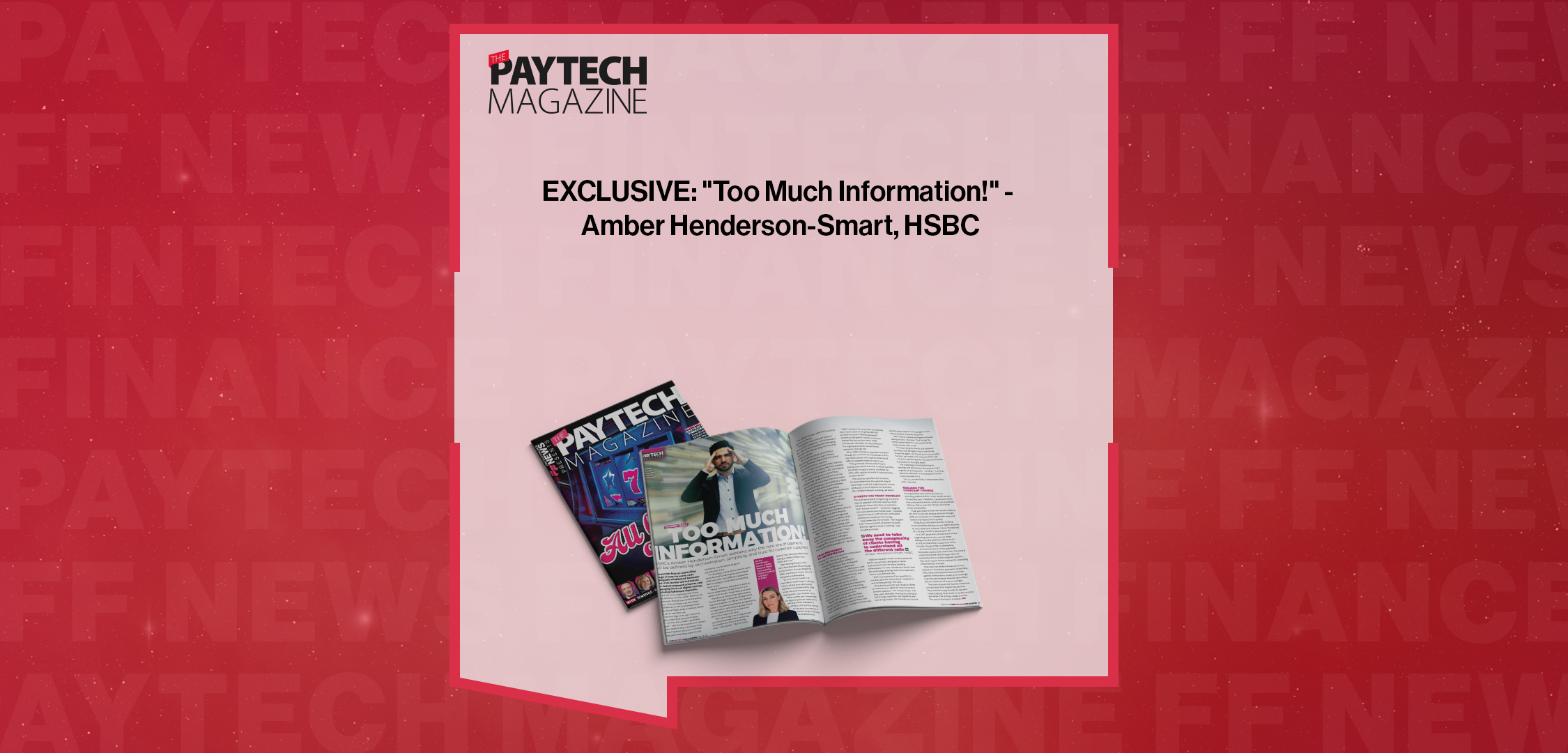
HSBC’s Amber Henderson-Smart explains why the next era of payments will be defined by orchestration, simplicity and trust for corporate customers
Corporates face an expanding range of ways to move cash. Alongside established domestic and cross-border infrastructure are instant payment schemes and emerging forms of digital money, including tokenised deposits.
But the more sophisticated these rails become, the less HSBC believes its customers should have to think about them. That principle is at the heart of HSBCnio, an API-first proposition unveiled at Sibos 2026 in Miami, that’s an API to rule them all.
“No one logs on to say ‘I want to make a real-time payment today’ or ‘I want to do a CHAPS payment today’,” says Amber Henderson-Smart, Global Head of Client Connectivity, Global Payment Solutions at HSBC. “They just know they need to pay someone, and it needs to go at a particular time.
“In the past, many of our clients were accustomed to having to understand different rails and different payloads. We’re trying to hide that complexity from them.
“With HSBCnio, they don’t need to know what type of payment it is or which API to call. They have just one.”
Henderson-Smart has held clients’ hands through a decade of payments transformation. In 2016, she started HSBC’s real-time payments programme, as regulators and clearing operators accelerated efforts to modernise domestic payment rails.
“We saw a big rise in regulators and clearing operators wanting to modernise the underlying rails,” she recalls. “But it went beyond that, into value-added services: paying to mobile numbers, direct debits and so on.”
Open banking followed, ‘which I don’t think has taken off as consistently across markets’, she says, alongside ISO 20022 and the push towards richer data and greater interoperability.
“So, over the last 10 years it’s all been about modernising the underlying rails to achieve more speed, visibility, confidence and interoperability. Digital assets and currencies are the new tipping point,” says Henderson-Smart. “What matters now is how we design our digital experiences, whether that’s web and mobile, embedded in a platform or AI interfaces. We need to take away the complexity of clients having to understand all the different rails.”
This reflects a broader rethink of how banks present themselves.
“Historically, banks have been proud of their product capabilities – and we should be. But now it’s about stepping back and asking how the client looks at things and how their systems operate.”
For Henderson-Smart, connectivity is becoming an abstraction layer between complex financial infrastructure and a client who simply wants an outcome.
“If I can make connectivity simpler, with less effort and cost, I can deploy more new capability to clients over the same API or rail,” she explains. It’s worth noting that in some of these relationships, speed of transaction is not the winner-takes-all metric. Real-time information around the transaction can be gold dust. While the treasurer does not have to be bothered about which mechanism delivered the information or payment, knowing a live balance can affect liquidity and funding decisions.
“It really comes down to the use case and the client: where does speed actually add value?” Henderson-Smart adds.
Businesses are undertaking treasury transformations and replacing legacy systems. Cloud has changed what ERP (enterprise resource planning), treasury management and accounting platforms can deliver, while APIs are moving banking services into the environments where clients already work.
“More clients want to operate in their own systems,” Henderson-Smart says. “That’s grown over the last two or three years.”
AI could accelerate that shift again.
“Plugging APIs into an AI agent to deliver information will be foundational,” she adds.
FROM PROCESSING TO ORCHESTRATION
If hiding the rails is the objective, orchestration is how HSBC intends to get there.
“Processing is really about taking an instruction, validating it, then storing and forwarding it,” Henderson-Smart says. “Orchestration lets us take an instruction in and make more decisions based on the information, do enrichment and multiple processes, and hide that complexity from the client.”
Tokenised deposits provide a useful illustration. HSBC has already developed APIs around tokenised deposits, but interacting with them can require clients to initiate token creation, transfer and destruction.
“Many client systems, ERPs and TMSs (treasury management systems), haven’t caught up with how to integrate these new forms of digital money,” Henderson-Smart says.
HSBC’s answer is to move that complexity back into the bank. A simplified API for account-to-account tokenised deposit transfers is designed to let the customer request the transaction, while HSBC orchestrates the token activity behind it. It is a glimpse of where conventional payments could go, too. When HSBC introduces payment initiation through this architecture, Henderson-Smart says clients should not need to understand different payment types to select one.
“They just need to know who they’re paying, from which account, in which currency and when it needs to arrive, and then we either offer options or route it automatically on their behalf.”
The customer specifies the outcome; the bank determines the optimal way of achieving it. And that might prompt a more profound choice of options for the bank than simply making an existing rail faster.
AI MEETS THE TRUST PROBLEM
The same philosophy is beginning to extend beyond payments into the interface itself. Henderson-Smart describes an evolution from ‘human-to-bank’ – customers logging into bank portals and mobile tools – towards ‘system-to-bank’, with services embedded directly into corporate technology.
Now comes the third model.
“We’ve gone from human-to-bank, to system-to-bank, and now agent-to-bank is coming,” says Henderson-Smart.
HSBCnio includes model context protocol (MCP) connectivity, designed to allow authorised AI tools to query banking information. For now, Henderson-Smart sees the technology playing more of an advisory than a transactional role.
“We’re seeing more of an appetite to use AI to process information, interpret it and do forecasting,” she says.
Whether businesses are ready to allow an autonomous agent to move money is another question. “It’s really mixed,” she says, with attitudes varying according to technology readiness, risk appetite and operating models. But Henderson-Smart nevertheless expects AI to progress from interpretation towards execution.
“We’ll see AI mature and agents actually taking action,” she says.
That brings the conversation back to a concept banking understands well: trust.
“The key thing for banks and payment providers will be agent trust: how do we know the agent, tie it back to an accountable human and make sure everyone feels safe – that it’s operating with the right permissions and access to the right data?”
The challenge is in establishing an identity and permission framework that’s capable of proving who – or what – is acting, what it is allowed to do and which human is accountable for it.
“For us, connectivity is what makes that safe,” she says.
BUILDING FOR CONSTANT CHANGE
For capabilities core to the business or providing differentiation, HSBC wants to own the architecture. Elsewhere, Henderson-Smart says partnership and co-creation can accelerate delivery. Either way, the infrastructure has to be composable.
“That goes back to how we’ve built HSBCnio: API-first, so we can expose services through different channels in a composable way, and evolve and deploy them quickly.
“A big focus this year has been shifting from quarterly releases on our digital channels to near-daily tech releases. I think 30 days out of a 31-day month is where we’re at.”
In a 24/7 payments environment where upgrading one service cannot mean taking an entire platform offline, that’s a critical timeframe. It also hints at the broader change HSBC is attempting.
For the first phase of the payments revolution, banks built faster rails. The second connected those rails through APIs and embedded them inside corporate systems. The next may be about making the underlying choice almost invisible.
That does not make infrastructure less important. Real-time payments, richer data, APIs, tokenised deposits and eventually agentic transactions create an increasingly sophisticated engine beneath the surface. But the measure of success changes. The client should not have to know how complicated that engine has become.
They should simply be able to say who needs paying, how much, in which currency and when the money needs to arrive. The rest is the bank’s problem
Frequently asked questions
What is HSBCnio and how does it work?
HSBCnio is an API-first orchestration platform that simplifies corporate payments by providing a single interface for multiple payment rails. It allows businesses to request a payment outcome—specifying the recipient, currency, and timing—while HSBC automatically routes the transaction through the most efficient rail, such as real-time payments or tokenised deposits.
How does HSBC handle tokenised deposits for corporate clients?
HSBC moves the complexity of digital money back into the bank's infrastructure. Through HSBCnio, the bank orchestrates the creation, transfer, and destruction of tokens behind the scenes. This allows corporate clients to use tokenised deposits for account-to-account transfers without needing to upgrade their legacy ERP or Treasury Management Systems.
What is the 'agent-to-bank' model mentioned by HSBC?
The agent-to-bank model is the next evolution of banking interfaces where authorized AI agents, rather than humans or static systems, interact with banking APIs. HSBC is using Model Context Protocol (MCP) to allow AI tools to query information and eventually execute actions, supported by a framework that ensures trust and human accountability.