EXCLUSIVE: "Engineered at the Centre, Personal at the Edge" - Hussam Nasser and Bassel El Sabban, G+D in 'The Paytech Magazine'
By Lauren Towner · 5 November 2026
In brief: Saudi Arabia has reached 85% electronic payment adoption in 2025, five years ahead of schedule, supported by G+D's security and card issuance infrastructure.
| Electronic Payment Share | 85% of retail transactions (2025) |
|---|---|
| Annual Transactions | 14.6 billion |
| Tourism Target | 70 million visitors |
| Onboarding Speed | Under 5 minutes via kiosk |
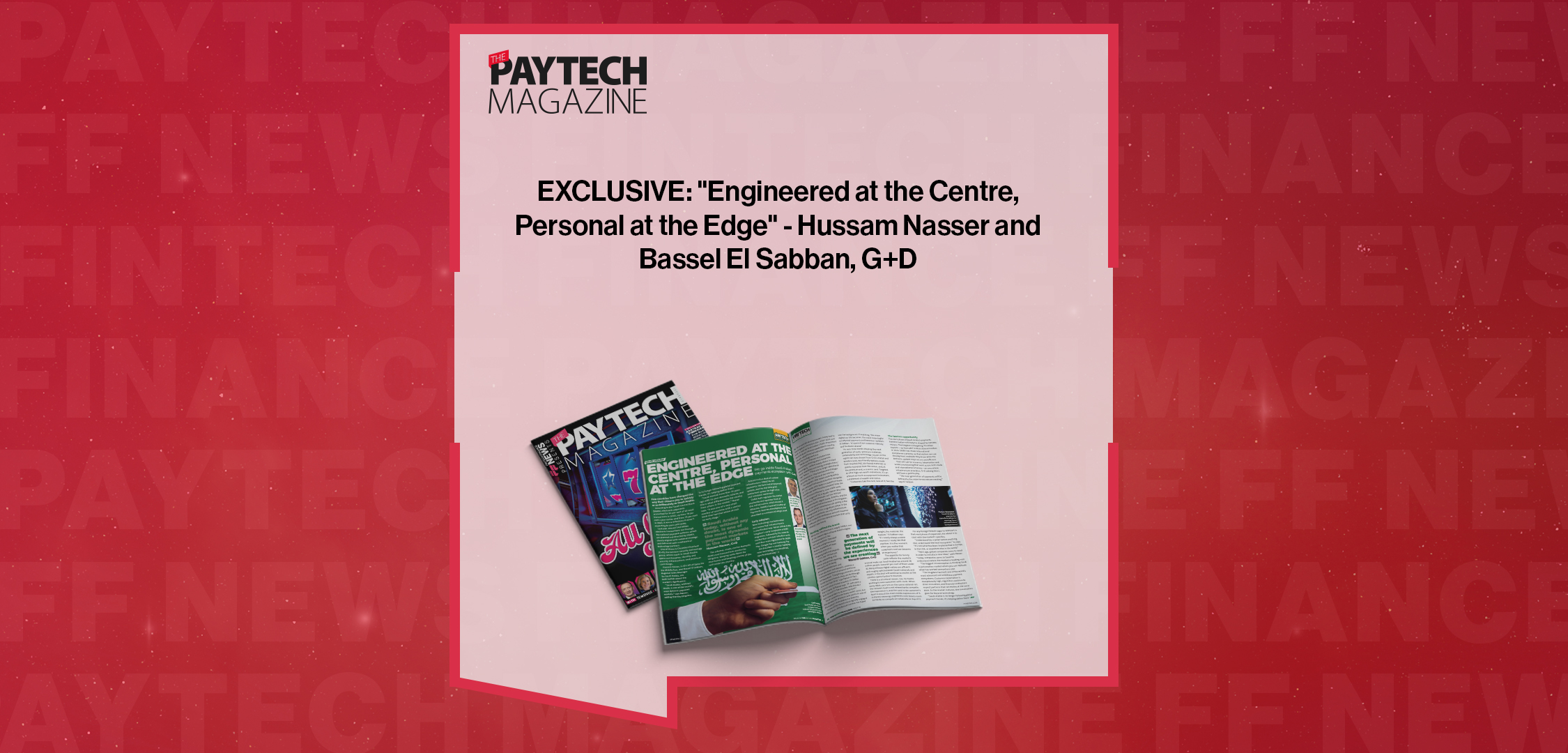
We go inside Saudi Arabia’ payments ecosystem with G+D
Few countries have changed the way the citizens pay as quickly or deliberately as Saudi Arabia.
According to the Saudi Central Bank (SAMA), electronic payments accounted for 85 per cent of all retail transactions in 2025, up from 79 per cent a year earlier and from 70 per cent in 2023. It was a milestone it wasn't expecting to pass until 2030. Last year, around 14.6 billion electronic transactions ran through the national payment systems, which are planned and directed by SAMA, closely aligned with national strategy, and delivered with a network of technology partners.
One of those is Giesecke+Devrient (G+D), the German security technology group, whose work in Saudi Arabia spans card issuance, identity and security infrastructure, and premium card design. Hussam Nasser, G+D’s VP of Sales for the Middle East, and Bassel El Sabban, Regional Sales Manager for Saudi Arabia, are both bullish about the market’s significance.
“Saudi Arabia, without doubt, is one of the world’s most dynamic payment markets,” says Nasser, adding that the kingdom 'is no longer following global payment trends, it's helping define them"
"Saudi started more than 25 years ago, with its own domestic scheme, and that is what differentiates the country from others in the market" Nasser says.
“It was one of a very small number of countries with a central bank that had that vision at such an early stage"
The scheme, mada, carries domestic debit card transactions across the kingdom, keeping costs down for merchants and keeping control of the rail inside the country.
Around it sits a stack of national infrastructure: SADAD for bill payments, the Sarie instant payment system, and the real-time gross settlement system for high-value and interbank settlement.
SAMA both regulates the market and builds and operates much of this infrastructure, which Ahmed K. Alhassan, SAMA's General Director of Payments Business Development has electronic transactions ran through described as a national strategic asset.
Early adopters
New technology has been rolled out across that infrastructure in a coordinated way. Nasser points to the kingdom’s early completion of EMV migration, followed by the move to contactless and dual-interface cards, and then mass digitisation for Apple Pay, Google Pay and Samsung Pay. He describes a country ‘applying new technology in a considered, synchronised way’.
That centrally directed model, closely tied to the kingdom’s economic plan, Vision 2030, and with a push by Saudi Arabia’s Public Investment Fund to build national capabilities in-country, shapes what financial institutions need from their technology partners.
“Banks and financial institutions are increasingly thinking about ecosystem sovereignty, resilient supply chains, trusted local capabilities and having strategic choice,” says Nasser. “These are no longer operational considerations, they have become strategic priorities for the future of the industry.”
For suppliers, that means working within the national framework rather than alongside it. G+D works with SAMA in support of mada, and Nasser notes that the company holds the certifications required to issue mada cards. With a regional HQ in Riyadh, Nasser describes its role as ‘the connector and the catalyst’ between banks, digital banks, fintechs, and the major personalisation bureaux in the kingdom.
Much of that contribution sits quietly in the background: G+D is a significant player in the kingdom’s payments security infrastructure, and its identity verification and card issuance software often runs behind services that carry a bank’s own brand.
Banking without the branch
While the infrastructure is largely hidden, one of the clearest signs of Saudi Arabia’s digital transformation is the self-service kiosk. Operated by banks and government bodies, hundreds of these machines now sit in shopping malls and airports.
G+D’s own version can handle onboarding, KYC checks and account opening, then print an instantly personalised payment card. It can also take cash deposits, produce a stamped statement of account and issue a chequebook.
“Everything customers can do inside the bank branch, they can do through one kiosk from G+D,” says Nasser.
In fact, when it comes to card issuance, it’s better than a bank.
As Nasser says: “If I can open a bank account in five minutes, why should I wait several days to receive my card?”
Saudi customers are heavy wallet users, but the demand for physical cards points to one of the market’s more distinctive features. In one of the world’s most digitally engaged populations, the physical card has not faded into the background. If anything, ‘the more digital our life becomes, the more meaningful our physical payment card becomes’, believes
El Sabban. “It’s part of our customer identity and the bank’s brand.”
He sees three trends shaping the next generation of cards: premium materials, sustainability and technology. Issuers in the region can now choose from G+D’s metal and wooden cards, eco-friendly options made from recycled PVC, bio-based materials or plastic recovered from the ocean, and, at the premium end, a ceramic card. Targeted at ultra-high-net-worth individuals, it’s an artwork as much as a payment instrument, a statement of wealth and status.
“Customers take the card, look at it, feel the weight, the material, the texture,” El Sabban says. “It’s nearly always a wow moment. I really like that reaction. It is the moment when you realise that a payment card can become an experience.”
The appetite for luxury cards reflects the market’s unusual make-up. Saudi Arabia has around 36 million people, some 63 per cent of them under 35. Many of these digital natives are affluent, and roughly split between Saudi nationals and expats, a mix that will continue to evolve as the country opens further to tourism.
There is a structural reason, too, for banks wanting to woo customers with cards. When every debit card runs on the same national rail, the network itself is not where banks compete: the experience is, and the card in the customer’s hand is one of the most visible expressions of it. A shared, sovereign payments core leaves room for banks to compete on what sits on top of it.
The tourism opportunity
The next phase of Saudi Arabia’s payments transformation will likely be shaped by overseas visitors. The kingdom is targeting 70 million tourists – up from 29.7 million inbound visitors in 2024. SAMA has made international acceptance a priority, so that visitors can use the payment methods they know while the domestic system stays secure and efficient. That will call for issuance, tokenisation and wallet provisioning that work across both mada and international schemes – an area where infrastructure providers, G+D among them, will have a part to play.
“The next generation of payments will be defined by the experiences we are creating,” says El Sabban.
For any foreign fintech eager to take part in that next phase of expansion, his advice is to start with the market’s specifics.
“Understand the market before anything else, understand the local ecosystem,” he says. “It’s not what has been implemented in Europe, in the USA, or anywhere else in the world.”
“Years ago, global companies came to Saudi in order to introduce new ideas,” adds Nasser. “Today, companies come to Saudi to understand where the market is heading next.
“The biggest misconception is thinking Saudi is just another market where you can replicate what has worked somewhere else.
“The kingdom has built one of the world’s most advanced and ambitious payment ecosystems. Customer expectation is exceptionally high, regulators continue to drive innovation, and financial institutions expect partners that can evolve at the same pace. As the market matures, the conversation goes far beyond technology.
“Saudi Arabia is no longer following global payment trends, it’s helping define them”
Frequently asked questions
What percentage of payments in Saudi Arabia are electronic?
As of 2025, electronic payments account for 85% of all retail transactions in Saudi Arabia. This is a significant increase from 79% in 2024 and 70% in 2023, surpassing the government's Vision 2030 milestones five years ahead of schedule.
What is the mada payment scheme?
mada is Saudi Arabia's domestic debit card scheme that carries transactions across the Kingdom. It is designed to keep merchant costs low and ensure that payment rails remain under national sovereign control, managed by the Saudi Central Bank (SAMA).
How does G+D support Saudi Arabia's banking sector?
Giesecke+Devrient (G+D) provides the security technology infrastructure for card issuance, identity verification, and digital wallets. They also deploy self-service kiosks that allow customers to open accounts and print personalized debit cards in just five minutes.