Crypto Trades Chaos for Caution: How Stellar’s Meridian Signals a New Institutional Era
By Ali Paterson · 30 October 2026
By Tom Matsuda for FFF News
Crypto isn’t exactly known for its caution. But this year’s edition of Meridian, an annual conference hosted by the team behind blockchain Stellar, was one of the more sedate digital asset events I’ve been to.
Unlike prior crypto shindigs I’ve attended, there were no lofty promises of tearing down traditional finance, multi-billion dollar investment announcements or lyrical waxing about the potential of NFTs.
In fact there was remarkably little mention of the C word (crypto before you get any ideas!) at all on stage.
Instead much of the discourse in Lisbon, where the event took place, focused on the institutional money flowing into the digital asset space with the Stellar Development Foundation talking up the control, trust and utility traditional finance players see in the blockchain.
And with panels focusing on subjects straying outside the typical crypto affair — topics of talks included quantum computing, cybersecurity and AI — the conference agenda also appeared to reckon with crypto’s place in the world which now has to play second fiddle to buzzier technologies like artificial intelligence.
“AI is this black hole for attention and capital right now,” said Ben Lakoff, managing partner at Bankless Ventures. “So if you’re a founder building outside of this super hot category, you have to have a very strong reason for doing so.”
The crypto convent
Founded in 2019 and hosted in a different city for each edition, Meridian is the annual conference of the Stellar Development Foundation, the non-profit behind the blockchain, and aims to bring together Stellar builders with the banks, asset managers and payment companies using the chain.
This year’s edition was its first in Lisbon, and took place at the historic Convento Do Beato, a former Christian convent built in the 15th century which now operates as an event center.
And in my opinion, it was a great choice of venue. Much of the original marble staircase and church were kept intact since its renovation into a conference center, but a particular highlight for me was the atrium, which was bathed in natural light thanks to its unique grid of skylights.
In many ways, the venue also suited the calmer, less chaotic interpretation of crypto Meridian wanted to present, a step change from prior crypto conferences I’ve attended.
In the two editions of Paris Blockchain Week I’ve been to, I’ve watched Binance cofounder Changpeng Zhao almost get trampled on by a collapsing tarpaulin as he gave an opening keynote speech, partied with Snoop Dogg and his son in a Parisian nightclub, and gotten the fright of my life when a man carrying a rifle wandered into the media room (an incident which later turned out to be a marketing ploy to promote fake NFT weapons).
That’s not to say Meridian didn’t have any starpower or some crypto panache. Former White House comms director-turned-crypto investor Anthony Scaramucci, Fireblocks CEO Michael Shaulov and DTCC Digital Assets’ Nadine Chakar were just some of the names to grace the stage.
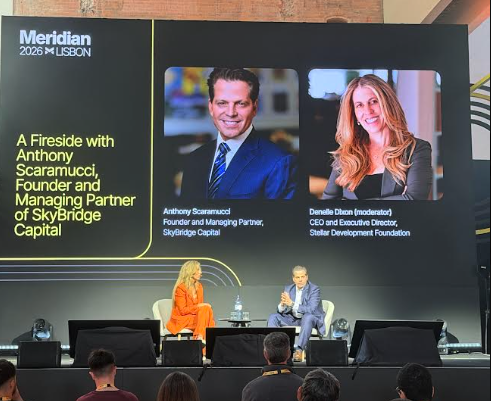
Scaramucci’s appearance, in particular, provided a little bit of theatre by taking a pop at the “great dysfunctionality" in current US politics as well as lamenting how we’ve shifted into a “post-truth society”.
“We’ve anaesthetised lying,” he exclaimed during his fireside interview. “But I think we’re now at an exhaustion point. That’s when you start to see authenticity and veracity move forward.”
He also hung around after his stage appearance to sign copies of his latest book All the Wrong Moves, which examines the rise of his former boss Donald Trump, for attendees.
All grown up
But with the vast majority of the headline panels and firesides featuring traditional finance players, much of the event felt engineered to present crypto as all grown up, and align the Stellar brand with institutional money.
On Day 1, for instance, DTCC’s global head of digital assets Nadine Chakar talked up the potential of tokenised “digital twins” of existing securities, and urged the Stellar ecosystem to build products for institutional clientele.
A similar sentiment was echoed by Patrik Bjorkland of asset manager Janus Henderson and Eli Cohen of institutional DeFi infrastructure provider Centrifuge who underlined the importance of partnership between both spaces.
“When Centrifuge started in 2021, it would have been impossible for us to even meet with an asset manager,” said Cohen.
Things have clearly changed since then. Franklin Templeton, for instance, uses Stellar to issue tokenised US treasuries and money market funds.
But while Meridian did position Stellar as the blockchain favoured by traditional finance, it also inadvertently flagged where it was lacking. Stellar may have been co-signed by some of the bigger names in traditional finance, but it’s yet to build the liquidity, users or distribution which would make it the de facto financial network.
According to crypto data aggregator DeFiLlama, Stellar has about $415m in tracked stablecoins, for instance, compared to the $145bn on fellow blockchain Ethereum.
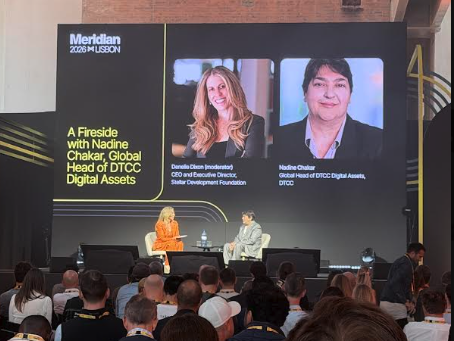
And even on stage, Stellar Development Foundation CEO Denelle Dixon seemed aware of that too, promising to the audience that Stellar’s volume will get there at some point during her fireside with DTCC’s Chakar. Crypto wallet MetaMask also used the conference to announce it was making Stellar a default network, another suggestion the blockchain was aware of its user adoption levels.
Change in crypto
Elsewhere during the two day event, there were also some panels which initially felt like an odd fit for a crypto conference.
One panel, which featured investors from Bankless Ventures, Onigiri Capital, FGV and Stake Capital Group, focused on how crypto founders should raise VC funding in the AI era.
Onigiri’s Qin En Looi, in particular, urged founders to focus on trust and reputation-building as a differentiator in a time where AI-built pitch decks and email outreach have become the norm.
“I would encourage founders to constantly build on the power of human connection,” he said. “I think that’s going to hold true even as AI continues to improve.”
This focus on the slow but important work of building trust and reputation throughout the conference program made it clear to me that crypto is in a very different place to when I first covered the sector five years ago.
Meridian wasn’t trying to convince anyone that blockchain was still this new cutting-edge technology that will upend traditional finance. In fact, it presented a safer, more trustworthy (and frankly, more boring) future of what crypto is shaping up to be — one that will see it work with asset managers, bankers and institutional investors on Wall Street rather than against them.
And those people, unsurprisingly, do not get excited by chaos.