EXCLUSIVE: "The Infrastructure Era" - Victor Mithouard, Mambu and Emma Hagan, ClearBank in 'The Paytech Magazine'
By Lauren Towner · 30 October 2026
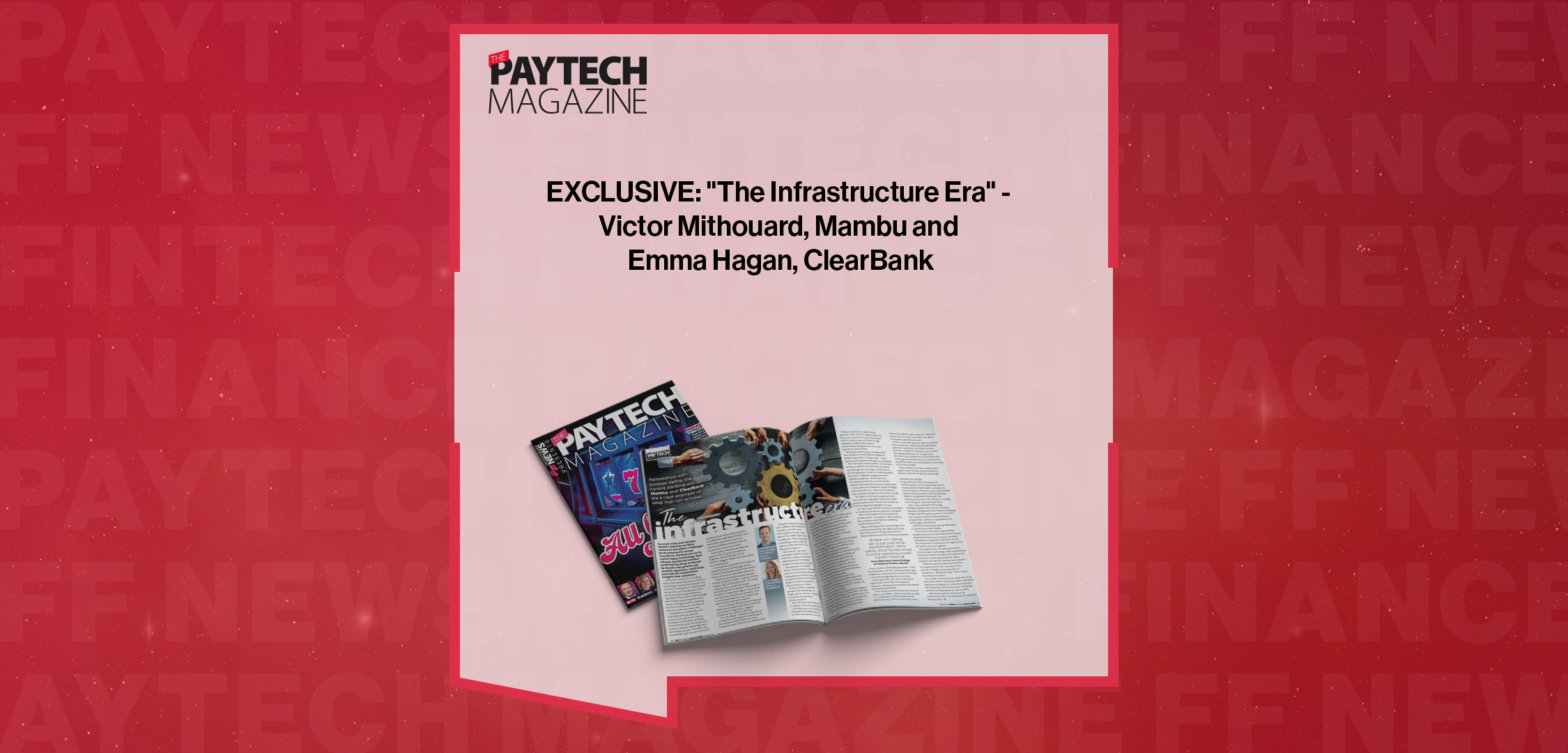
Partnerships with purpose define the current banking era. Mambu and ClearBank are a clear example of what that can achieve
For much of the past decade, fintech’s defining narrative centred on disruption. Challenger banks promised to unseat incumbents. Startups set out to replace legacy technology. New entrants questioned whether traditional banking, burdened by decades-old systems and complex regulation, could keep pace with the expectations of digital-first customers.
Today, that narrative is changing. Rather than replacing banks, fintech is increasingly helping them evolve. The industry’s next phase is being shaped not by consumer-facing apps alone, but by the technology platforms, regulated infrastructure and strategic partnerships operating behind the scenes. The organisations defining the future of financial services are the ones customers never see.
Among them are Mambu and ClearBank. One has become synonymous with Cloud-native, modular core banking, enabling financial institutions to modernise products without replacing entire technology estates. The other has established itself as one of the UK’s leading Cloud-native clearing banks, providing the regulated infrastructure that allows payments, accounts and embedded banking services to operate securely and at scale.
Individually, they occupy different layers of the financial ecosystem. Together, they illustrate one of fintech’s biggest shifts: from disruption to collaboration. It is a partnership built not simply on complementary technology, but on a shared philosophy about how modern financial services should be delivered.
“We’re quite careful about who we choose to partner with,” explains Emma Hagan, CEO of ClearBank UK. “It’s really important to us that we’ve got something that’s valuable, that we go to market in a way that aligns not just with our commercial aims but actually, from a cultural perspective, our values and what we’re looking to achieve.”
In an industry where partnerships are often announced with little more than a technical integration, Hagan’s emphasis on culture is telling. For ClearBank, resilience, regulatory confidence and long-term thinking are not simply product features; they underpin every commercial relationship.
“A big part of that on the ClearBank side is stability, resilience and built-in compliance, and with a view to future-proofing,” she adds. “Things like new ISO standards, digital assets or stablecoins – that interoperability is something we look to build in. It’s part of our DNA rather than an extra thing we’re trying to be.”
Those priorities have become increasingly important as financial institutions navigate one of the most significant periods of technological change since digital banking emerged. The rapid growth of embedded finance, real-time payments, AI-powered financial services and tokenised assets is reshaping customer expectations just as regulators introduce new standards designed to improve transparency, interoperability and resilience.
For banks, fintechs and payment providers alike, the challenge is no longer whether innovation is necessary. It is how to innovate without compromising trust.
That balancing act lies at the heart of the Mambu and ClearBank partnership. While Mambu provides the flexible, Cloud-native core banking platform on which new products can be built, ClearBank delivers the regulated infrastructure that allows those products to operate in the real world. Together, they enable financial institutions to accelerate development while relying on infrastructure engineered for compliance, scalability and resilience.
It is also a model that reflects a broader trend across financial services. The first generation of fintech asked whether technology companies could become banks. The current generation asks whether banks need to build everything themselves. Increasingly, the answer is no. Instead, financial institutions are assembling ecosystems of specialist partners, each responsible for a distinct layer of the banking stack.
Core banking, payments, compliance, identity, fraud prevention and customer experience are becoming modular capabilities delivered through trusted partnerships. For Hagan, that shift changes how organisations should think about regulation. Too often, she argues, compliance is viewed solely as a cost of doing business. Instead, she sees it as an opportunity.
“People often look at regulation or change as a hurdle – something you have to do,” she says. “But if we look at it through a different lens, it’s actually an opportunity to deliver something better for consumers, better compliance standards, less friction and less burden.”
History, she believes, supports that argument. When the UK’s Faster Payments Service was introduced, many institutions saw it as another expensive technology programme. Within a few years it fundamentally changed how consumers expected money to move.
“What seemed like a major change at the time has become completely embedded in people’s expectations,” Hagan says. “Today, payments are expected to happen immediately.”
The next major transformation, she believes, will be no different. As financial institutions work through the last stages of ISO 20022’s phased adaptation, many are understandably focussed on migration programmes and regulatory deadlines. Yet beneath the messaging standard lies a much broader opportunity to rethink financial infrastructure.
Victor Mithouard, Mambu’s Senior Strategy and Delivery Director, believes the industry risks underestimating the scale of that change.
“ISO 20022 is a fantastic opportunity to harmonise the language of payments while providing the instant infrastructure that can fully leverage that language,” he says
For many organisations, however, the project is mistakenly viewed as a payments initiative.
“We’re not talking about just payments transformation,” he explains. “We’re talking about fundamental financial operating model transformation.”
Legacy banking systems were designed for a world dominated by overnight processing, batch files and end-of-day reconciliation. Instant payments overturn those assumptions.
Every process surrounding payments – from fraud detection and anti-money laundering to compliance screening and customer servicing – must increasingly operate in real time. At the same time, ISO 20022 introduces significantly richer data into payment messages, creating opportunities that extend well beyond settlement.
“That structured data allows the financial system as a whole – banks and fintechs alike – to build better customer experiences,” Mithouard says. “At the same time, those experiences become safer because institutions know more, in a more consistent way, about the payment and the customer.”
Better structured payment data can improve fraud prevention, reduce operational friction, automate compliance and unlock services that were simply not possible under previous messaging standards. For infrastructure providers such as Mambu and ClearBank, the challenge is ensuring clients can access those capabilities without rebuilding their technology stacks from scratch.
That, perhaps more than anything else, explains why infrastructure has become fintech’s newest competitive advantage.
Invisible by design
If regulation provides the catalyst for transformation, infrastructure determines whether that transformation succeeds. For many financial institutions, particularly smaller banks, building societies and fast-growing fintechs, the greatest challenge is not understanding where the industry is heading. It is finding the capacity to get there. Years of accumulated technology, multiple payment rails and ever-evolving regulatory obligations have created increasingly complex operating environments. Innovation now competes directly with compliance programmes, resilience requirements and technology maintenance.
Mithouard sees that challenge repeatedly in conversations with clients.
“There was a time when large banking conglomerates dominated the market because they had the resources to remain compliant and adopt new payment methods,” he says. “But they weren’t necessarily the organisations driving the consumer agenda.”
That opportunity was seized by fintechs, whose modern technology stacks enabled them to innovate faster and deliver the experiences customers increasingly expected. Today, however, both groups face the same problem.
“When we speak to banks and fintechs, we regularly hear that more than 40 per cent of IT budgets are being spent on compliance,” Mithouard says. “That’s outlay that stops innovation.”
For smaller institutions, the trade-off can be particularly acute. Every pound spent maintaining regulatory obligations is a pound unavailable for improving customer journeys, developing products or expanding into new markets. Mithouard believes infrastructure partnerships offer a powerful way to rebalance that equation.
“Organisations need trusted partners that continually evolve their platforms as regulation changes,” he explains. “You invest once with trusted partners, and those partners continually evolve the platform as regulation changes.”
The emphasis is not on outsourcing responsibility, but removing unnecessary complexity. That philosophy resonates strongly with Hagan. For her, the best infrastructure is almost invisible.
“I call it the invisibility layer,” she says. “You don’t really know it’s there, but you know somebody is taking care of it every single day.”
Whether regulation evolves, payment schemes introduce new requirements or best practice changes, clients should not have to rebuild their operating model each time. Those changes should happen beneath the surface.
“It allows organisations to focus on servicing customers, moving money and delivering a great digital experience,” Hagan says. “The infrastructure partners take care of the difficult part.”
It is perhaps the clearest illustration of how banking itself is changing. Customers increasingly differentiate financial institutions through experience. Banks increasingly differentiate themselves through partnerships.
Building for growth before growth arrives
That invisible infrastructure becomes even more important when businesses begin to scale. Few events expose weaknesses in financial systems more quickly than rapid customer growth. While product launches generate headlines, operational resilience determines whether organisations successfully move from challenger to established institution. For ClearBank, Hagan says, scalability has never been treated as a future consideration.
“We don’t actually look at it as a growing pain,” she explains. “Growth and scalability have always been part of our DNA.”
That philosophy reflects ClearBank’s journey. Since launching in 2017, it has evolved into a significant component of the UK’s payments ecosystem, while many of its clients have scaled at extraordinary speed. Those clients, Hagan argues, should never have to question whether the infrastructure underpinning them is up to the task.
“When they’re growing, the last thing they want is to worry about whether their supporting infrastructure can keep pace,” she says. “If we have an outage, they’re taking calls from consumers and SMEs. That’s real damage.”
Rather than reacting to growth, ClearBank plans for it: “We’re always asking what we need to do today to stay ahead of where our clients will be tomorrow.”
That forward planning extends beyond capacity. Every new product, regulatory requirement and operational process is assessed not simply on whether it works today, but whether it will continue working as transaction volumes and customer expectations evolve.
The same thinking underpins Mambu’s approach to Cloud-native banking. Modern banking platforms are no longer static software deployments but continuously evolving services. New regulation, payment standards and customer expectations become incremental improvements rather than major transformation programmes.
Together, Mambu and ClearBank embody a broader shift across enterprise technology – from periodic change programmes to continuous modernisation.
Collaboration becomes an advantage
Collaboration, according to both Hagan and Mithouard, is the way to service the needs of an increasingly sophisticated client base.
“If you went back a few years, everyone tried to do everything themselves,” Hagan reflects. “The world’s changing. The expectation now is that you do something really well – and partner with people who are really good at what they do.”
Mithouard concurs: “Clients don’t want lock-in anymore,” he says. “They want the best clearing partner, the best payments platform and the best core banking engine – but they also want those partners to work together.”
That interoperability is becoming even more valuable as financial institutions prepare for developments such as digital assets, tokenisation and programmable money.
For Hagan, these technologies are no longer theoretical. “As they’ve moved beyond theory and headlines to become something real, we’ve been looking at how we integrate them into our infrastructure,” she says.
Rather than expecting every institution to develop specialist expertise independently, ClearBank’s objective remains the same: absorb complexity centrally so that clients can focus on serving customers.
“The research, the thought and the build has already been done,” Hagan explains. “Clients can concentrate on serving their customers while we take care of the complexity beneath the surface.”
It is the same principle that defines the partnership itself: not replacing banks, but enabling them.
The next chapter
Financial services have always evolved through successive waves of infrastructure. Card networks transformed retail commerce. Faster Payments redefined domestic money movement. Cloud computing reshaped technology delivery. Now, real-time finance, ISO 20022, embedded banking and digital assets are converging to create another inflection point. What distinguishes this transition is that no single institution can deliver it alone.
Banks require technology partners. Technology companies require regulated banking infrastructure. Infrastructure providers rely on open ecosystems capable of integrating seamlessly with one another. For Mambu and ClearBank, that future is already taking shape. One provides the flexible banking platform. The other delivers access to regulated rails. Together, they remove much of the operational complexity that has historically constrained innovation, allowing banks and fintechs alike to focus on where they create the greatest value: understanding customers, developing products and building trust.
As regulatory expectations continue to rise and technology cycles accelerate, infrastructure itself is becoming a source of competitive advantage. The winners will not necessarily be those with the largest balance sheets or the most recognisable consumer brands. They will be the organisations capable of combining resilience with agility, compliance with innovation, and partnership with purpose.