EXCLUSIVE: "The Missing Piece" - Nick Kerigan, Swift in 'The Paytech Magazine'
By Lauren Towner · 6 November 2026
In brief: Swift has launched a blockchain-based ledger currently used by 13 banks to facilitate 24/7 tokenised cross-border payments, bridging the gap between digital assets and traditional banking systems.
| Live Banks | 13 |
|---|---|
| Currencies Supported | 5 |
| Markets Active | 8 |
| Technical Implementation | 9 months |
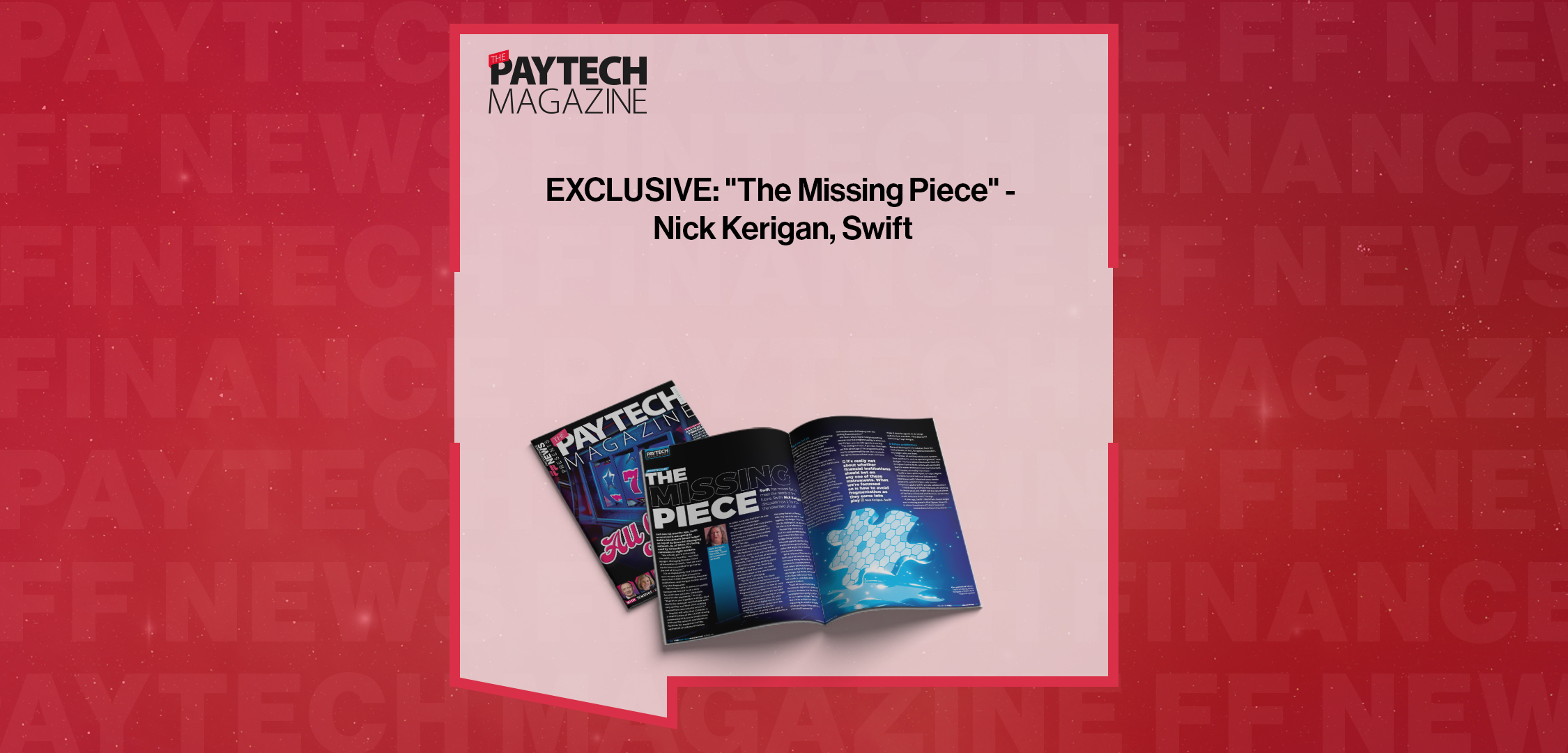
Swift has moved fast to meet the needs of the future. Swift’s Nick Kerigan discusses how it fits into the tokenised picture
Just over 12 months ago, Swift announced it was going to build a blockchain-based ledger on top of its financial messaging network. As of Sibos, it’s being used by 13 banks for five currencies in eight markets.
“We actually got it technically live within nine months,” says Nick Kerigan, Managing Director, Head of Innovation at Swift, “and six more banks have committed to go live by the end of this year.”
It’s an impressively fast timescale for a co-operative that answers to more than 2,000 shareholding financial institutions. And Kerigan is clear about why that happened.
“We’ve been able to move so quickly because we homed in on a very focussed core use case: wholesale cross-border payments,” he says. “That let us put together a design that the banks could get comfortable with very quickly, and then start putting transactions and volume across it.”
Sceptics will note that 13 banks is a small fraction of the 12,500-strong community of financial institutions that use the network worldwide to facilitate the movement of the equivalent of trillions of dollars in value every day. But that’s to miss the point, believes Kerigan.
“We have a model that’s now proven: we’ve seen interbank transactions, corporate treasury transactions and out-of-hours, weekend transactions. A range of currencies are flowing 24/7,” he says.
And it stands up an argument that he has been making for some time.
“We believe in a future that will be multi-rail, multi-asset and multi-chain,” says Kerigan. “As we look at tokenised deposits, CBDCs and stablecoins – all of this emerging, exciting world of digital money – we think they will each find their own use cases and their place in the new financial system that’s emerging.
“So for us, it’s really not about whether financial institutions should bet on any one of these instruments. What we’re focussed on is how to avoid fragmentation as they come into play.”
The industry has spent the best part of three decades converging on a single messaging standard, after all, and a proliferation of digital assets, each using its own chain, could upset the carefully stacked apple cart.
“If they’re all going to be used, in combination with the existing forms of fiat money that we’re all familiar with, they have to be made to work together,” says Kerigan. “That’s the role, the challenge and the opportunity we take on as an infrastructure.”
The new ledger is not a rail in itself. It’s more accurately described as an orchestration layer, which bridges the gap between the tokenised payment network and the traditional correspondent banking system that largely relies on Swift for cross-border transactions.
But it’s only one of three ways that Swift says it will keep that old and new money moving side by side. The second is the messaging network itself, where ‘we’ll keep updating the standards so they’re fit for purpose’, says Kerigan. And the last, announced at the Sibos conference in Miami last month, is a new digital assets standards platform.
“It will let the community bring standards for digital assets, particularly business standards, onto the platform and publish them openly for others to use,” explains Kerigan. “We think that will be an important way of supporting the adoption of digital assets and digital money across the entire Swift community.”
Not one, but all
In the run-up to Sibos, a cluster of technology vendors announced support for the Swift ledger: ACI, IBM, Oracle and Chainlink.
“That matters because it means connectivity to the ledger can be embedded within the technology solutions banks already use, which eases adoption for financial institutions,” says Kerigan.
And it reflects a step change he’s seen in institutions’ willingness to adopt digital assets over the past 12 months.
“That’s the key difference,” he adds.
Kerigan puts it down to three things: regulatory clarity around digital money, the technology itself maturing, and ‘the catalytic effect of stablecoins’ growing utility’, which has also spurred developments in tokenised deposits and CBDCs among a much wider set of digital assets.
“So, you see, it’s not about one specific aspect, one instrument or one use case any more. It’s really about how we think about a tokenised financial system.
“It’s essentially about programmability: how do you programme and automate money? Putting programmability into the token and the smart contract means you can achieve different things – things that may be more challenging with the existing financial system.”
And here’s where it gets really interesting. Because once that programmability is achieved, says Kerigan, you can add agentic AI on top.
“The intelligence layer, if you like. That layer can take advantage of the programmability, but the programmability can also constrain the agents, because those smart contracts make it hard for agents to do things outside their mandate. I find that quite reassuring,” says Kerigan.
A future architecture
None of this happens in isolation from the central banks; in fact, for optimal execution, the ledger relies on them.
“A number of existing settlement systems face constraints, such as operating hours,” says Kerigan. “So innovations like Pontes from the European Central Bank, which will eventually start to move settlement into that tokenised, 24/7 model, are really important.”
Swift is also a participant in Project Agorá, the Bank for International Settlements’ experiment with tokenised cross-border payments, which Kerigan calls ‘a very important global public-private collaboration’.
“I think many of these initiatives are starting to create what you might call the jigsaw pieces of the future financial architecture, so we very much welcome them,” he says.
A year ago, Swift’s blockchain-based ledger was a missing piece in that jigsaw. Now it’s in place, the picture of future tokenised transactions is becoming clearer.
Frequently asked questions
What is the Swift blockchain-based ledger?
The Swift blockchain-based ledger is an orchestration layer built on top of Swift's financial messaging network. It bridges the gap between tokenised payment networks and traditional correspondent banking, allowing for the seamless movement of CBDCs, stablecoins, and tokenised deposits alongside fiat money.
How many banks are currently using Swift's new ledger?
As of the Sibos conference, 13 banks are actively using the ledger for transactions across five currencies in eight markets. An additional six banks have committed to going live on the platform by the end of 2024.
What are the primary use cases for Swift's tokenisation platform?
The core use case is wholesale cross-border payments. The platform has already proven successful for interbank transactions, corporate treasury management, and 24/7 out-of-hours or weekend transactions that were previously restricted by traditional settlement hours.