EXCLUSIVE: "No More 'Business as Usual'"- Edward Ireland and Natasha Lapierre, Bottomline in Discover Sibos
By Lauren Towner · 29 September 2026
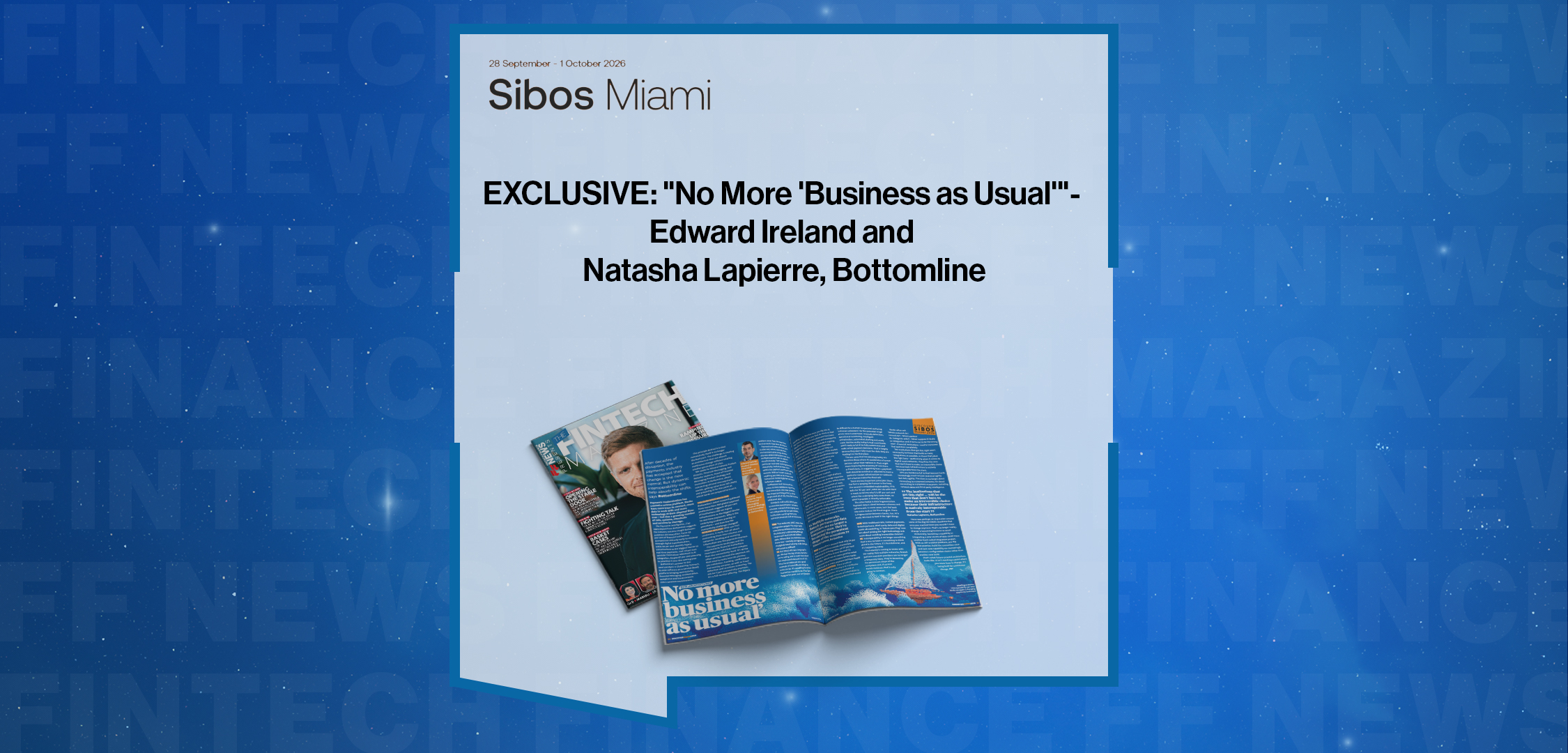
After decades of disruption, the payments industry has accepted that change is the new normal. But dynamic interoperability can help absorb the shifts, says Bottomline
Payments modernisation has created a curious problem. Banks have more ways to connect, more data to work with and more technology at their disposal than ever – but also a growing number of rails, systems, standards and services to manage. The Payments Intelligence_Gap 2026 Report from Bottomline suggests the industry remains caught between ambition and execution. Some 63 per cent of financial institutions surveyed are still only early-to-midway through digital transformation, while 40 per cent identify legacy infrastructure as the biggest barrier to real-time payments.
Just 14 per cent consider themselves advanced in AI integration, despite 67 per cent planning to prioritise it over the coming year. Bottomline’s answer to this semi-paralysis is Global Pay Connect, its new software-as-a-service (SaaS) platform bringing connectivity, financial messaging, orchestration, compliance and fraud controls into a common environment.
The principle behind it is that connectivity itself is no longer the hard part. The challenge is creating an architecture that can absorb continuous change without creating another generation of silos. We spoke to Edward Ireland, Product Director, Financial Messaging, and Natasha Lapierre, Head of Financial Messaging Product Strategy and Innovation at Bottomline, about connecting old and new payment worlds, getting value from ISO 20022 and preparing AI for the point at which banks are prepared to trust it.
DISCOVER SIBOS MAGAZINE
Bottomline’s latest research gathered from more than 300 global payment professionals suggests 40 per cent of institutions still see legacy infrastructure as the biggest barrier to real-time payments. Why is the underlying problem proving so persistent – and how has the connectivity challenge changed?
EDWARD IRELAND With our first customers, it really was all about connecting them into schemes and networks. Sending and receiving information was the payments business. The payments landscape and the requirements financial institutions now have are infinitely more complex than the connectivity itself. It’s all the other services around the payment rail that need to come into the picture: pre-validation, tracking, confirmation and overlay services, as well as fraud detection and sanctions screening.
The ask isn’t just connectivity anymore; it’s a full-service offering. The legacy problem comes from the way these environments have been developed. Payment environments were built in silos and, when a new payment environment came along, another silo was added. Institutions now have multiple payment rails to support simultaneously. That becomes a particular issue with instant payments.
Historically, banks had more time within the payment workflow to apply controls. With an instant payment, anything you need to do around that transaction increasingly has to happen before you make it. Institutions need more controls, access to more databases, reporting and connections into new schemes. The important thing is that, as they implement all of this, they don’t create additional silos.
Standards such as ISO 20022 give us common denominators between schemes. Instead of developing each rail independently for each market, institutions can bring them into common processes and environments. DSM That makes ISO 20022 more than a migration project. The major Swift coexistence milestone has passed, but the industry is still working through issues such as structured address data. Where does the real value come from now – and why can apparently straightforward industry-wide changes still prove so difficult?
EI ISO 20022 still has a long way to go. We had the big cutover, but what we’re seeing now is much more about the implementation and use of ISO. Structured addresses are a good example of how difficult change at scale can be. It’s something the whole market has wanted to do; it has been working on it. But the more you dig into it, the more challenges you find. So much so that deadlines for structured addresses have been delayed from November 2026 and extended to a still undetermined date.
Nobody is arguing that structured addresses are a bad idea – there are multiple benefits and they can drive efficiency – but getting an entire market there shows how difficult coordinated change can be. The upside is that institutions are also starting to appreciate how much commonality exists between different schemes. ISO 20022 has demonstrated the similarities in how information is identified and used across different markets.
If you can bring that into a single platform or common teams, you can leverage expertise rather than maintaining expertise within every individual silo. There are economies of scale, but also the opportunity to take best practice and learning from one market into another. And the environment won’t stand still. New payment rails are being added all the time, particularly as we look towards tokenised deposits, stablecoins and other emerging ways of making payments.
The old schemes don’t die: the new schemes get added while the old schemes remain. Multiple networks, fintech partners and data providers are no longer a temporary state. They’re becoming the permanent shape of the ecosystem
DSM Bottomline’s research finds only 14 per cent of institutions consider themselves advanced in AI integration, yet 67 per cent intend to prioritise AI over the next 12 months. Where can AI create genuine value now and what has to happen before banks will trust AI to make payment decisions itself?
NATASHA LAPIERRE There is a lot of potential, but the industry is at a particular stage of readiness. AI is exceptional at processing huge amounts of information in record time, identifying patterns that would be difficult for a human to spot and surfacing ‘unknown unknowns’. So the potential range of use cases is enormous: anomaly detection, operational monitoring, intelligent orchestration, automated alerting and many more. But the reality today is that most banks aren’t ready to let AI be fully automated and make actual payment decisions. That is largely because they don’t fully trust the data they are feeding it in the first place.
The use cases that are winning today are therefore those where AI accelerates a human decision rather than replaces it. That might mean improving the accuracy of sanctions or fraud alerts, or suggesting how a payment field should be enriched or adjusted to meet a particular market infrastructure or rulebook. But a human makes the final call.
There are two important principles there. The first is keeping the human in the loop. The second is embedded explainability. If AI tells me ‘87 per cent’, what do I do with that? It needs to tell me why it is 87 per cent and where the underlying data came from, so what it provides is directly actionable. The other battle is data fragmentation.
Payment data is siloed between schemes and systems and, in some cases, isn’t fed back into areas such as the fraud engine. There is fragmentation between banks, too. AI is ready. We need to feed it the right things.
DSM With traditional rails, instant payments, fintech partners, third-party data and digital assets all coexisting, is ‘future-proofing’ now less about picking the right technology and more about avoiding irreversible choices?
NL Interoperability is no longer something that is nice to have or something to think about in the future. It’s foundational, and it’s happening today. The industry is coming to terms with the reality that multiple networks, fintech partners and data providers are no longer a temporary state. They’re becoming the permanent shape of the ecosystem and, if current trends continue, that is only going to increase.
Banks often ask ‘Which network do I commit to?’, ‘Which partner do I integrate with?’, ‘What happens if I build an integration and it turns out to be the wrong one?’.
Financial institutions need to transcend that question completely. The institutions that get this right won’t necessarily be those that build as many integrations as possible, or those that place the right bets – particularly when it comes to digital asset networks. They’ll be the ones that don’t have to make an irreversible choice because their infrastructure is natively interoperable from the start.
APIs are fundamental to that because banks increasingly need not just technical agility but data agility. The story is no longer about connecting to a payment scheme; it’s about connecting to a payment ecosystem, including network data and third-party intelligence.
There was perhaps an impression around some of the big ISO 20022 deadlines that once you reached them you wouldn’t have to change anymore. That’s no longer reality. Change is becoming business as usual.
Historically, launching a capability or integrating a new source of data could mean another hard-coded integration project. With an API-enabled platform, you flip that premise: build the connection once and each new capability can increasingly become a configuration choice rather than another new build.
That’s what future-proofed architecture looks like. It isn’t reaching a point where you never have to change. It’s being built for continuous change.