EXCLUSIVE: "Reconciled To the Truth" - Thomas Steinborn, Smartstream in 'Discover Sibos'
By Lauren Towner · 28 September 2026
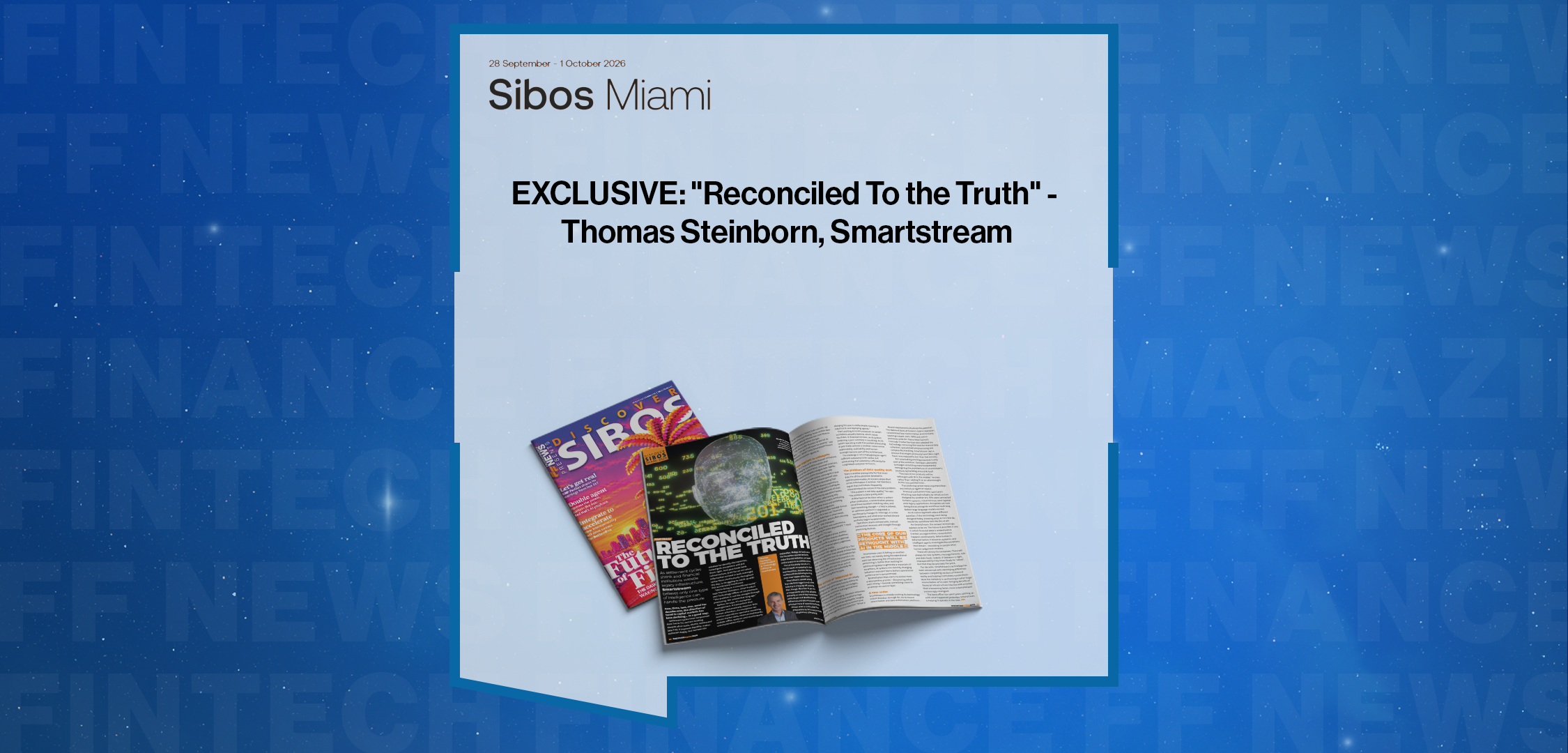
As settlement cycles shrink and financial institutions wrestle legacy infrastructure, Smartstream believes only one type of intelligence can handle the pressure
Four, three, two, one, zero! For decades now, the direction of travel in capital markets has been declining... in a good way. Settlement cycles have compressed from T+4 to T+1 and are heading towards all-or-none, atomic settlement (aka T+0). It improves liquidity, makes customers happy, but narrows the window to identify discrepancies, investigate exceptions and put them right. And post-trade bank infrastructure, built for an era when information arrived in bulk overnight rather than continuously throughout the day, is struggling to catch up with this accelerated timeframe.
“We’re living in a transitional world,” says Thomas Steinborn, Chief Product and Technology Officer at Smartstream. “The problem is not the straight-through processing. We solved that long ago.” Rather, he says, it’s exception management. A transaction that matches automatically requires little human attention. An exception can send an operations specialist searching across market data, internal dashboards, middle-office systems and counterparty communications for an explanation. Multiply that work across the transaction volumes handled by major financial institutions, and speed and accuracy are on a collision course.
The US has already moved to T+1. The UK and EU are preparing for their own transitions. Processes that once waited until the following morning, now must happen within hours.
Smartstream’s research among buy-side firms suggests much of the industry is a long way off achieving that, though. More than 70 per cent of respondents told it they still relied primarily on end-of-day reconciliation, while 53 per cent identified timing differences and data mismatches as the principal cause of reconciliation breaks. Almost seven in 10 described their preparations for T+1 as only partially adapted and still evolving.
Faster markets require faster controls. Yet the infrastructure feeding those controls does not automatically become real-time because the settlement deadline changes.
“I’ve been in this business for the last 25 years – I can say it will never be resolved,” says Steinborn. Which is why Smartstream favours a different solution: agentic AI.
From copilots to colleagues
The first wave of AI inside financial institutions was largely focussed on copilots that summarised information, answered questions or helped employees navigate data. Agentic AI represents a more consequential step because it can take actions and progress a task autonomously within defined approval rules.
Smartstream has been developing that concept specifically for financial operations. Its Smart Agents are designed to investigate exceptions and undertake elements of work traditionally performed by operations teams: retrieving information, determining why transactions have failed to match, monitoring service levels, triaging issues and escalating cases requiring human judgement.
“There will always be a new message format. There will always be a new rail. There will always be a new data feed. In other words, complexity regenerates, and AI offers one way of managing it,” says Steinborn.
He’s not talking about one autonomous system replacing an entire department. “I need a team of agents,” he says.
One might investigate a break, another manage triage, another monitor deadlines, while others handle escalation or approval. Humans remain involved where judgement and accountability matter.
Smartstream says agents recruited by a Tier 1 financial institution have already proved their worth. Investigation time for an exception fell from around 14 minutes to 30 seconds in its trials, while other institutions projected that between 50 per cent and 70 per cent of investigation activity can potentially be automated during the first year.
The arrival of ‘industrial AI’
Steinborn says Smartstream was not initially being pushed particularly hard by clients to introduce AI. Interest existed, but budgets, governance structures and organisational readiness often did not. That picture is changing. Steinborn estimates that while around half have reached a stage where copilots should be deployable, roughly 10 per cent of Smartstream’s customer base already has agentic AI in production: “What is changing this year is really people moving to industrial AI and deploying agents.”
That’s putting AI inside processes on which institutions actually depend, which raises the stakes. In financial services, an AI system producing a poor summary is one thing. An AI system operating inside transaction processing or post-trade controls is another. Governance, explainability, auditability and human oversight become part of the architecture.
The challenge is not simply giving an agent sufficient autonomy to be useful, but constraining that autonomy sufficiently for a regulated institution to trust it. The problem of data quality drift There is another prerequisite for that trust: data. For all the attention devoted to sophisticated models, AI remains dependent on the information it receives. Yet Steinborn argues that institutions frequently misunderstand the nature of the data problem.
“The problem is not data quality,” he says. “The problem is data quality drift.”
A data feed can be clean when a system enters production, a reconciliation process can achieve excellent matching rates, and then something changes – a field is altered, an upstream platform is upgraded, a counterparty changes its message, or a new feed appears, and what once worked almost perfectly begins to deteriorate. Operations teams compensate, manual intervention increases and straight-through processing declines.
Smartstream sees AI taking on another role here: not merely doing the operational work but observing the infrastructure performing it. Rather than waiting for deteriorating data to generate a mountain of exceptions, AI systems can identify changing behaviour and alert teams before operational performance is compromised. Reconciliation then starts to evolve from a retrospective process – discovering what went wrong – towards something closer to an always-on control layer.
A new order
Smartstream is already pushing its technology in that direction through Air, its AI-based reconciliation and data automation platform. Recent deployments illustrate the potential. The National Bank of Greece’s Cyprus operation consolidated four reconciliation environments covering instant, cash, SEPA and nostro processes onto Air. Papua New Guinea’s Comrade Trustee Services also adopted the technology, removing the need for manual data collection, spreadsheet preprocessing and complex file handling. Smartstream says a process that might previously have taken eight hours was reduced to less than five minutes.
But automating existing processes is only part of the ambition. Steinborn ultimately envisages something more fundamental: reimagining the architecture of Smartstream’s products by building around AI itself.
“The core of our products will be rethought with AI in the middle,” he says, rather than ‘adding AI as an afterthought to the core architectures’.
That shift may prove more important than any individual agent or copilot. Financial institutions have spent years attaching new technologies to infrastructure designed for another era. APIs were connected to batch systems. Cloud services were layered onto legacy applications. AI copilots are now being placed alongside workflows built long before large language models existed.
An AI-native approach asks a different question: if the technology were being designed today, knowing what AI can now do, would the workflow look like this at all?
For Smartstream, the answer increasingly appears to be no. The future it describes is one in which financial data is understood as it enters an organisation, reconciliation happens continuously, deterioration is detected before it becomes systemic, and intelligent agents investigate the exceptions that remain – escalating to people when human judgement matters.
There will always be exceptions. There will always be new systems, message formats, rails and data feeds. Indeed, if Steinborn is right, interoperability may never finally be ‘solved’. But that may be precisely the point. For decades, Smartstream’s technology has been concerned with identifying differences between competing versions of financial reality and helping institutions resolve them. Now the company is confronting a rather larger reconciliation of its own: bringing decades of financial infrastructure into line with a market that is becoming faster, more automated and increasingly intelligent.
The back office has spent years catching up with what happened yesterday; Smartstream is helping it operate in the now.