EXCLUSIVE: "Lending a Hand" - Rob Downs, Finastra in 'The Fintech Magazine'
By Lauren Towner · 30 September 2026
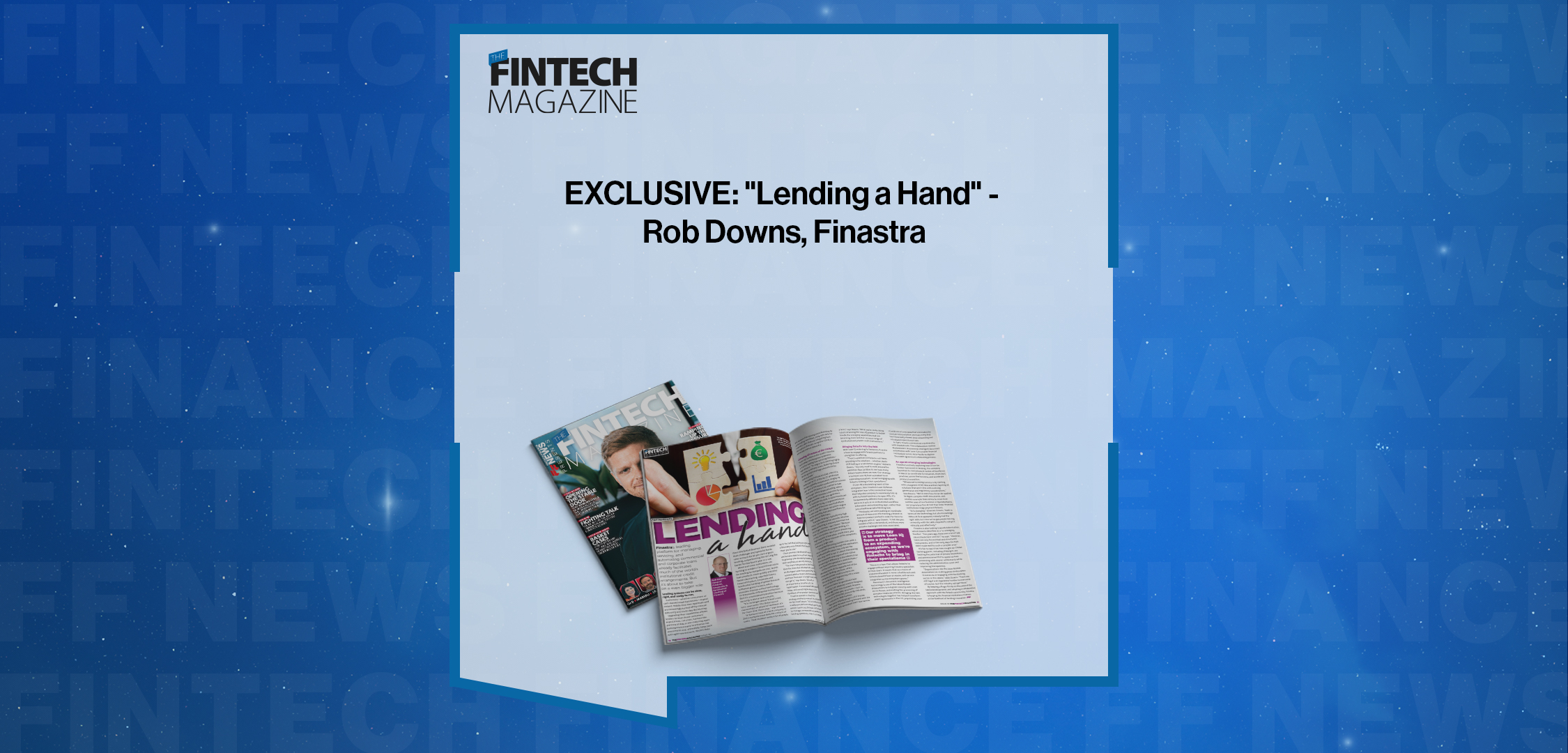
Finastra’s leading platform for managing, servicing, and automating commercial and corporate loans already facilitates much of the world’s institutional credit arrangements. But it’s about to take on a even bigger role up to the fact that just because you have a boundary and a firewall, that doesn’t mean you’re safe.”
Cloud providers like Microsoft Azure and Amazon Web Services have responded to growing cyber threats by increasing their emphasis on security measures.
“The more data you put on the Cloud, then the more that data has to be secure. As the hyperscalers have grown, they’ve concentrated on threats and vulnerabilities and their front door is as tight as anyone can get it,” says Downs. “Security is as important to Finastra as to the hyperscalers. It is considered table stakes today, and something we keep at the forefront of our product development.”
Finastra operates a Cloud-first strategy and hosts many of its solutions on Microsoft Azure. This includes Loan IQ, a software platform relied upon by the world’s banks and financial institutionsto manage commercial and corporate lending operations. Loan IQ increases
Lending systems can be slow, rigid, and costly to run. Customers – whether consumers or cash-starved small businesses – expect instant, mobile-first loan approvals and are increasingly turned off by manual data entry and multi-day decisioning. Upgrading their capabilities allows lenders to meet those customers’ expectations, cut costs, harness the plethora of data in the maturing open banking environment to enhance risk assessments and, ultimately, keep pace with agile new entrants.
Recent data from the British Business Bank revealed that challenger and specialist banks now account for 60 per cent of gross lending, outperforming the UK’s big five banks for the fourth year in a row. More and more institutions are turning to modern Cloud infrastructure for lending to compete on cost, launch loan products more quickly and drive faster decisioning, says Rob Downs, Head of Product, Corporate and Syndicated Lending at global financial software giant Finastra, which provides mission-critical technology to thousands of financial institutions.
But it’s a considered transition because security is also a core concern.
“It’s no longer about ‘Cloud’s cool, let’s save some TCO (total cost of ownership) on physical hardware. It’s far from that these days,” says Downs. “A famous hack of a tech company in 2011 compromised data for millions of users. That incident woke a lot of people up to the fact that just because you have a boundary and a firewall, that doesn’t mean you’re safe.”
Cloud providers like Microsoft Azure and Amazon Web Services have responded to growing cyber threats by increasing their emphasis on security measures.
“The more data you put on the Cloud, then the more that data has to be secure. As the hyperscalers have grown, they’ve concentrated on threats and vulnerabilities and their front door is as tight as anyone can get it,” says Downs. “Security is as important to Finastra as to the hyperscalers. It is considered table stakes today, and something we keep at the forefront of our product development.”
Finastra operates a Cloud-first strategy and hosts many of its solutions on Microsoft Azure. This includes Loan IQ, a software platform relied upon by the world’s banks and financial institutions to manage commercial and corporate lending operations. Loan IQ increases the speed of decisioning and onboarding by automating workflows, using open APIs for seamless data flow and integrating tools like optical character recognition (OCR) to eliminate manual data entry.
Covering all corners of the market
“Loan IQ has been in the market since the mid-1990s and has grown to become a market-leading loan servicing platform,” says Downs. “Its origins lie in servicing highly complex syndicated loans, featuring diverse lender groups and huge amounts on the notional side.”
According to Finastra’s data, Loan IQ is now used by 21 of the top 25 syndicated lenders globally and processes roughly 70 per cent of the world’s syndicated loan volume – but over the years it has evolved to take up a larger role in bilateral lending, where a single lender provides a loan directly to a single borrower under one agreement. To facilitate this shift, Finastra introduced Simplified Servicing, a targeted extension built on top of the core Loan IQ platform.
It uses Loan IQ’s robust calculation engine while providing dedicated workflows for high-volume SME loans.
“Complex lending is typically very high value, but relatively low volumes, whereas bilateral lending is relatively low value but very high volumes,” says Downs. “Because Loan IQ was born in complex lending, it’s a very rich system. But if you’re processing high volumes of low value, simple loans, you just want to focus resources on the exceptions, not every single loan.
“Simplified Servicing provides users with a much simpler journey through the application; a different path where they only see the data they need to see. It’s about maintaining the brainpower and engine of Loan IQ but presenting it differently to the subset of our user base who specialise in bilateral loans.”
At the same time, there have been developments at the opposite end of the corporate lending spectrum, where complex private credit structures are diversifying and fragmenting into a wider array of distinct options. Finastra’s Loan IQ specialised credit capability is an advanced module designed to manage these non-standard, bespoke, and complicated debt structures – such as payment-in-kind (PIK) processing, club deals, and unitranche debt facilities.
“We were initially going to call it Private Credit when we were moving forward with the programme, but we realised that’s too narrow a term,” says Downs. “What we’re really doing is just enhancing the Loan IQ product to better handle the emerging capabilities that are becoming more common across a range of syndicated and private credit transactions.”
Bringing fintechs into the fold
With Loan IQ widening its footprint, Finastra is keen to engage with fintech partners to strengthen its offering.
“There’s a plethora of fintechs out there, providing niche solutions – whether that’s OCR tooling or a calculation engine,” explains Downs. “You only need to walk around the exhibition floor at Sibos to see how many fintech booths there are now. Our strategy is to move Loan IQ from a product to an expanding ecosystem, so we’re engaging with fintechs to bring in their specialisms.”
If Loan IQ is the beating heart of the ecosystem, then Finastra’s Loan IQ Nexus integration layer is the connective tissue that helps the company to seamlessly link up with its fintech partners via open APIs. It’s fundamentally different from older APIs because it acts as an orchestrated workflow automation and onboarding layer, rather than just a traditional data-fetching tool.
“Previously, we were putting an inordinate amount of resources into training a fintech in how our product worked in order for them to integrate with it,” says Downs. “It felt like you needed a PhD in the product, and there were broader challenges and risks associated.
“Nexus is a layer that allows fintechs to engage without requiring Finastra specialists to train them. It means that our choice of resource allocation is never a bottleneck and fintechs benefit from an easier, self-service integration as the ecosystem grows.”
Nammu21’s document intelligence technology is one of the latest fintech propositions to integrate directly with Loan IQ via Nexus, automating the processing of complex credit documents. Bringing the two technologies together has helped transform credit agreements in the US, populating Loan IQ with structured data that eliminates the manual interpretation and data entry that has historically slowed deal onboarding and introduced operational risks.
In April, Finastra announced a partnership with Marketnode. The collaboration meshes Marketnode’s AI-powered intelligent document automation with Loan IQ to enable financial institutions across Asia-Pacific to digitise the credit agreement onboarding process.
An eye on emerging technologies
Finastra is actively exploring how AI can be further harnessed in lending. The company launched its centralised AI Centre of Excellence in March to coordinate AI initiatives, share best practices across the business, and accelerate product innovation.
“Where we’re seeing success is by starting with a targeted, small idea and then layering on solutions that are in line with evolving governance and regulatory considerations,” says Downs. “We’ve seen how AI can be applied to digest complex credit documents, and another example that comes to mind from another area of our business is OperatorAssist, our proprietary Gen AI tool that helps financial institutions triage payment failures.
“AI is changing,” observes Downs, “both in terms of the technology but also knowledge. When AI first appeared, nobody had the right skills but now we’ve got people leaving university with the skills required to adopt it ethically and effectively.”
Finastra is also looking towards tokenisation, which Downs describes as a ‘re-emerging frontier’. “Ten years ago, there was a lot of talk about blockchain and DLT,” he says. “However, loans are very hierarchical and structured instruments, and in the early days the tech didn’t scale well to such a complex area.” It’s fair to say it has now caught up. Global banking giants, including JPMorgan, are backing the potential of private blockchains and permissioned DLT to speed up loan processing with atomic settlements while reducing the administrative costs and improving transparency.
“Organisations like the Loan Market Association are making great strides when it comes to re-engaging with the banking sector in this space,” adds Downs. “There are still legal and regulatory hurdles to overcome of course, but the industry will get there.”
By keeping a finger firmly on the pulse of the latest developments and adopting a collaborative approach with the fintech community, Finastra is keeping the financial institutions it serves at the forefront of lending innovation.