EXCLUSIVE: "The Future is Here (Almost)" - Wayne Hughes, BNP Paribas Securities Services in 'Discover Sibos'
By Lauren Towner · 30 September 2026
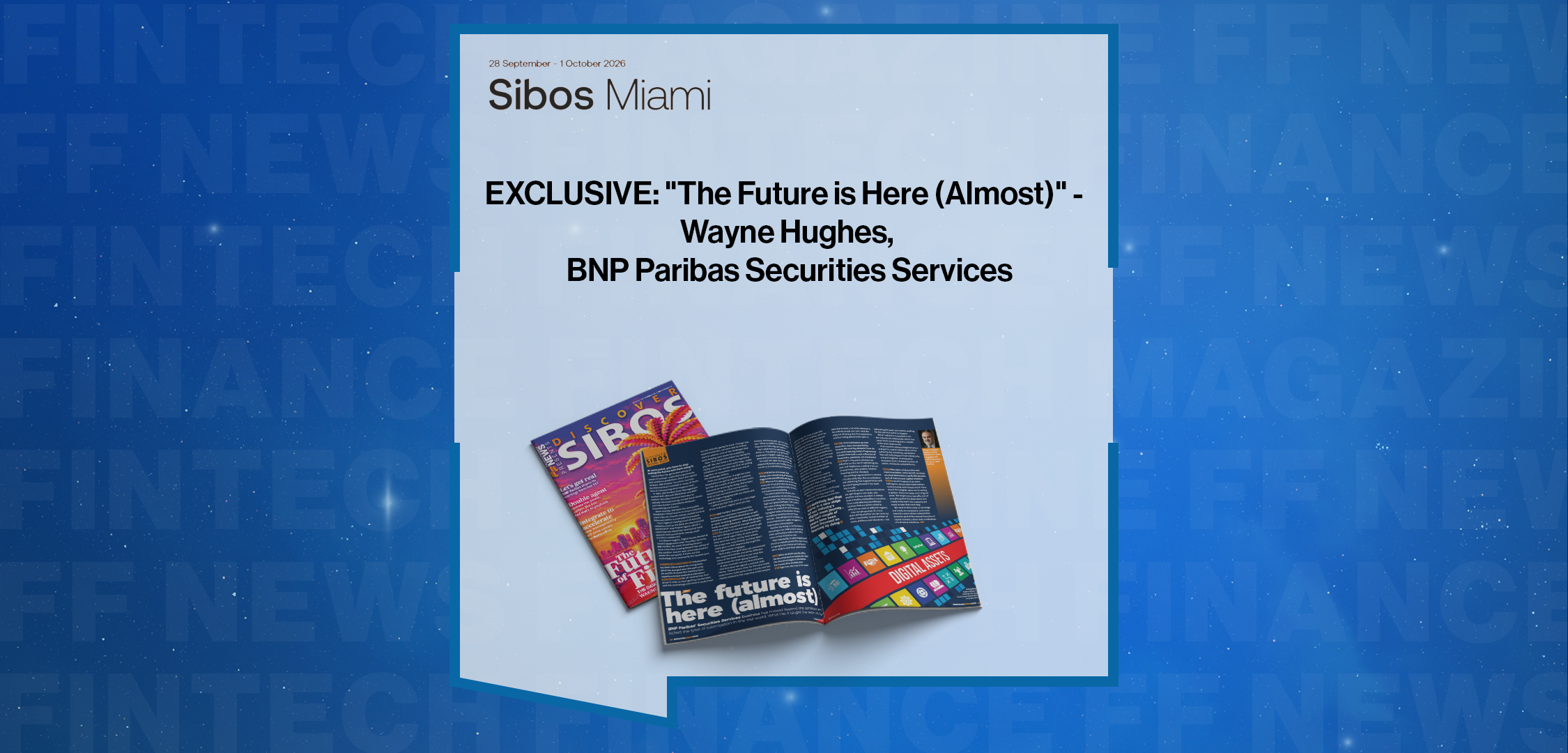
BNP Paribas’ Securities Services business has moved beyond the sandbox and kicked the tyres of tokenisation in the real world. What has it taught the team so far?
At some point, you have to stop testing the future and start using it. Tokenisation has generated plenty of proofs of concept, controlled experiments and ambitious predictions about the capital markets. BNP Paribas’ Securities Services business has been involved in many of them. Now it’s discovering what happens next.
In 2025, BNP Paribas Asset Management worked with Allfunds Blockchain and BNP Paribas’ Securities Services business on natively tokenised money-market fund share and cross-border transactions between Luxembourg and France. More recently, the bank has used public blockchain infrastructure to issue a tokenised share class of a French money-market fund on Ethereum within a controlled framework.
That’s against a background of industry initiatives such as the Bank for International Settlements’ new Project Agorá, which is exploring how tokenised commercial bank deposits and central bank money could transform settlement. For Wayne Hughes, Digital Assets Market & Client Engagement Lead, Securities Services, BNP Paribas, the most revealing lessons have come from moving beyond the safety of the sandbox. And he says, once tokenisation enters the real world, it turns out the technology isn’t necessarily the hardest part.
DISCOVER SIBOS MAGAZINE: Tokenisation has been talked about for a long time. What has changed over the past 12 to 18 months to move the industry from experimentation towards production?
WAYNE HUGHES We all needed that first phase in order to start getting comfortable with this technology and what it could mean for our industry going forward. Through that experimentation, we were able to at least start to address a lot of the challenges that were holding back potential scalability. Now, that experimentation has started to pay off. We also have a lot more regulatory clarity and there are some quite large, visible initiatives in the market now that are pulling together an ecosystem, which was one of the challenges before.
From our perspective, it might be some time before we get to significant volumes, but the last couple of years have been more focussed on learning by doing. We’ve been experimenting in a live environment, both to test our technical foundations and to begin engaging with our clients an market counterparts. I definitely feel that we’re in a new stage of our industry’s digital asset journey/
DSM: BNP Paribas’ Securities Services business has now been involved in live initiatives with Allfunds Blockchain as well as work involving tokenised money-market funds on public Ethereum. What did going live teach you that a proof of concept could not?
WH The proofs of concept were great to get the ball rolling and test out the technology, but you could argue that, at some point, they were too easy. Just by their nature, the scope was very limited, and they didn’t really give us that opportunity to get the full organisation engaged.
That really changed when we commenced live experimentation and all the different areas of the bank started to see what this could mean for them going forward. A clear example was our first initiative – the first time we signed a contract with clients. That process, even for this very simple experiment, took quite a few months and was clearly related to the expertise of the lawyers involved. The first question I got from them was: “What is a blockchain, and what does it mean for me from a legal perspective?”
That’s what these live experiments reallydid for us. They allowed us to get the full organisation engaged, start to get people up to speed and comfortable with this technology. You could also argue that it gave them an opportunity to raise some healthy concerns and for us to start working through that.
DSM: Did the live environment also change your understanding of where the biggest risks and difficulties actually lie?
WH: When we first started work on this there were a lot of concerns about the technology, about the risk it could potentially introduce and topics around scalability. This wasn’t where the concerns were concentrated when we went into a production environment. They were much more around legal and operational topics. That is part of the value of doing these things live.
Earlier on, much of our work was about laying the technical foundations for what we believed would become our future services – everything around connectivity to distinct blockchains, wallet management, tokenisation and compliance. Now the day-to-day is a combination of executing on our initial product roadmap while continuing to explore some of the newer or less mature use cases.
Most importantly, it's about engaging with clients to understand what the requirements are going to be in future and making sure we’re ready to cover those requirements.
DSM: What are clients actually asking the Securities Services business for today? Has demand changed as tokenisation has moved closer to production?
WH: Right now, the noise in the market concerning use cases is especially around collateral mobility, which we believe is one of the promising use cases going forward. But for our existing client base, most of the demand we’re seeing is for tokenised money-market funds. And it’s mainly still a very straightforward distribution play, normally into their retail channels.
So, real demand right now is mostly to do with the cash side – we see real interest for extended operating hours for cross-border corporate payments, for example. A lot more clients are ready to consider doing something in a live environment. Most of those are considering what could be their first experience in production.
They’ve probably done a lot of proof of concepts, but they haven’t yet jumped into something in production. With that in mind, a lot of the demand is for relatively simple use cases, with the objective of having that first experience and then being able to build upon it.
DSM: As more institutions go into production, does interoperability become the next big obstacle? How do you avoid replacing today’s fragmented infrastructure with a new collection of blockchains, platforms and standards?
WH: That’s a key point, because we definitely run the risk of replicating the past, and maybe even making it worse in some ways, with another solution becoming another standard. The existing fragmentation is normal – it’s very early days. But consolidation and addressing that fragmentation will be critical going forward if we want this to scale.
That said, we don’t necessarily believe the right target is one chain, one platform and one standard. A certain level of healthy competition is positive. There could definitely be different solutions that are better suited to different use cases or different regions. From our perspective, it’s more about seeing whether we can come up with a reasonable, limited number of chains, platforms and standards – not replicating the past, but neither waiting for this perfect world to happen.
What I believe is important is for the industry to collaborate, which has never been our strong point, maybe, in the post-trade world. If we want to address fragmentation and get to a point where there is true potential for scalability, we believe that will only happen if we collaborate and pull together an ecosystem around at least a limited number of chains, standards and platforms.
DSM: After years of discussion and experimentation, what would convince you that tokenisation had finally become part of mainstream capital markets?
WH: It would be great if we were talking less about what tokenisation could provide and instead much more about the tangible value we’re seeing it deliver. There has been a lot of good work. We’ve got some benefits out of everything that has been done, but I really think we in the industry are ready to take that next step.
We need to find a way to converge and create an ecosystem, and move towards a point where tokenisation becomes part of the normal function of capital markets, rather than a collection of individual initiatives.