EXCLUSIVE: "No More Yesterday’s Numbers" - Nick Botha, AutoRek in 'The Fintech Magazine'
By Lauren Towner · 28 September 2026
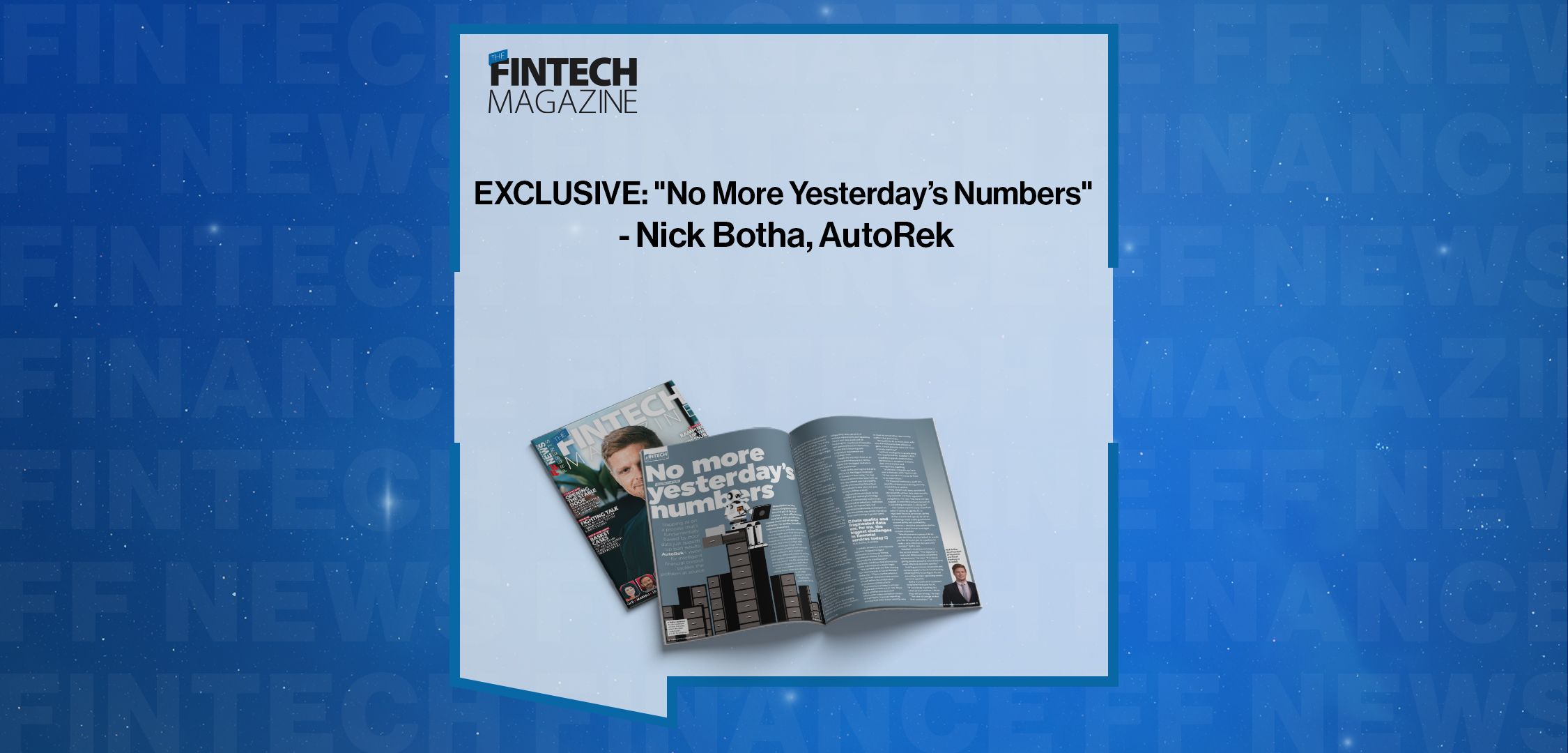
Slapping AI on a process that’s fundamentally flawed by poor data just speeds up bad results. AutoRek’s vision for intelligent financial control tackles the problem at source
Reconciliation has long been an unglamorous but essential part of financial services – a back-office function associated with spreadsheets, manual checks and retrospective validation. For decades, innovation happened elsewhere.
But with financial institutions now operating across a complex web of real-time payment networks, Cloud platforms, embedded finance ecosystems and emerging digital asset markets, that model is no longer viable. Transactions pass through multiple organisations, jurisdictions and technologies before settlement. Data volumes are exploding, settlement windows are shrinking, and regulators increasingly expect firms to demonstrate not only the accuracy of their records but the governance behind them. In this environment, reconciliation is shifting from a hidden operational necessity to a strategic enterprise capability.
“Traditionally, reconciliation has had very manual processes built around it,” says Nick Botha, VP of Payments and Retail Banking at AutoRek. “That is why it has been considered almost a cost centre. What’s changing is the power of automation and technology brought into these functions.”
Automation reverses the traditional operating sequence. Instead of skilled employees spending hours collecting data, reformatting files and preparing information for analysis, modern systems ingest, condition and reconcile data continuously, so teams can properly investigate the exceptions that matter.
“This means they are now seen as strategic teams driving true value for executives and senior management,” explains Botha.
The operational gains can be dramatic. Botha recalls a recent implementation where AutoRek replaced a legacy reconciliation product, which meant a process that previously required 48 hours could be accomplished in just 12 minutes.
“Imagine what you could do with the additional 47 hours and 48 minutes,” he says. “That’s time being returned to key resources and subject matter experts.”
Reconciliation grows up
UK-based AutoRek has spent more than 30 years in financial controls, serving institutions across banking, payments, insurance, asset management and capital markets. Today, it is repositioning itself as far more than a reconciliation provider.
“We do reconciliation very well,” Botha says. “But we identify ourselves more as an end-to-end financial data control platform.”
This broader definition encompasses data management, transformation, reconciliation, exception handling, management information and the processes that follow the identification of a discrepancy.
“We don’t want to add value only as a matching engine,” he explains, “but as a full end-to-end financial controls partner.”
This shift reflects the changing demands facing financial institutions. Real-time payments, stronger safeguarding rules, operational resilience requirements and regulatory concern over data quality are all increasing the importance of traceable, well-governed financial information. Trusted data is becoming both a regulatory requirement and a strategic asset.
Despite the industry’s focus on AI and modern infrastructure, Botha argues that the biggest obstacle is more fundamental.
“Data quality and fragmented data are, for me, the biggest challenges in financial services today,” he says. “Financial services have been built up over time around poor data quality, and the processes that follow have been tailored to deal with that poor quality to deliver a result.”
Legacy systems contribute to the problem, but replacing technology does not automatically resolve years of inconsistent definitions, duplicated records, incomplete fields and operational workarounds. AI deployed on such foundations may simply reproduce those shortcomings at greater speed. AutoRek’s answer is a data-agnostic approach, designed to ingest information in its source format, regardless of volume, frequency or complexity. Its transformation capabilities condition that information before matching and analysis begin.
“We can work with the data coming from these sources in its raw format,” Botha says. “Clients can transform it into the most comprehensive version of itself before the analysis and reconciliation process starts.”
The intended outcome is not just a higher automated match rate. More highly detailed and consistent information makes exceptions easier to investigate, improves reporting accuracy and helps teams identify why an issue occurred rather than merely confirm that one exists.
“Being able to do so much more with data translates into time efficiency gains, a more granular view and more accurate reporting.”
Artificial intelligence is accelerating this transformation. AutoRek’s ARIA capability supports reconciliation development, exception analysis, data interpretation and management reporting.
“In the last 12 months we have seen a dramatic shift,” Botha says. “AI has moved from a nice-to-have to an expectation.”
Yet financial institutions want AI’s benefits without surrendering security, traceability or control.
“They expect us to have considered the sensitivity of their data, their security requirements and their regulatory obligations,” he says. “We have not just slapped AI onto the platform because it is something everyone is asking for.”
This caution is particularly important when it comes to agentic AI. In regulated financial processes, giving AI the unrestricted agency to act on its findings could create governance, accountability and auditability concerns; a sensitive area where Botha believes expert human oversight remains essential.
“Would you want a piece of AI to make decisions on your behalf or would you like AI to put you in a position to make a very effective decision very quickly?” Botha asks.
AutoRek’s emphasis is firmly on the second model.
“The objective is not to let ARIA become completely autonomous,” he says. “It is about giving people powerful information to make effective decisions quickly.”
Existing permission structures and controls apply to the AI functionality, allowing firms to configure its use according to their operating model and risk appetite. Botha is sceptical of confident long-term forecasts for AI.
“If somebody is giving you a five-year prediction, I think they will be wrong,” he says. “The rate of change makes that unrealistic.”
But he identifies several areas where it is already creating value: analysing data, generating matching logic, supporting exception management, producing management information and accelerating the construction of new reconciliations.
“What is particularly exciting is building new reconciliation processes extremely quickly,” he says. “You can go from a blank slate to a fully automated, very complex, high-volume reconciliation in days rather than months.”
Keeping control in real time The requirement for continuous control isbecoming particularly clear in payments and digital finance.
“The software you use has to match the frequency and volume of the services and products you are offering,” Botha says.
A firm providing real-time payments can’t rely on a control process that reveals discrepancies days later. AutoRek is embedding reconciliation into straight-through processing environments, receiving and exporting data through APIs and other integration mechanisms.
“Embedding the application into the process provides real-time insight and allows investigation activity to happen in real time,” Botha says. “Otherwise, you are offering real-time payments to a client but establishing that there are gaps or issues on a T+1 basis, T+2, or sometimes even a week later.”
The same principle could help firms explore tokenised assets, digital currencies and new payment models, enabling them to launch products they previously considered too difficult or risky to support.
“We want to support all of the activity our clients are looking to undertake, not just what they are doing today,” Botha says.
Building for scale
AutoRek’s ability to process high transaction volumes depends partly on its relationship with Microsoft and the Azure Cloud platform.
“Our clients are processing billions of transactions,” Botha says. “The relationship we have with Microsoft Azure provides the infrastructure that supports and enhances what our application can do.” AutoRek teams have also worked alongside Microsoft specialists during the development of ARIA. “There is a reputational advantage,”
Botha adds. “It provides clients with comfort that they are receiving the best technology, security and performance.”
The partnership forms part of a wider expansion strategy. AutoRek has increased its international presence, including in the United States, and sees payments regulation and safeguarding as major areas of opportunity. Botha also points to the convergence of traditional finance and newer payment businesses, with established institutions seeking partnerships, acquisitions and renewed access to markets once ceded to challengers.
AutoRek has grown by approximately 30 per cent year-on-year for the past four years and intends to maintain that trajectory. “To achieve it, we need the right framework, partners, resources and support,” Botha says.
The human element
“We’re not just a piece of software,” he adds. “We’re a partner, asking clients to let us walk with them on their journey.”
That begins with reconciliation, but its destination is broader: an operating model in which data is continuously controlled, exceptions are identified while they still matter, and finance teams help shape strategy rather than simply explain yesterday’s numbers – because automation does not remove the need for people, rather it changes the work they perform, insists Botha.
Financial control teams will become less dependent on large numbers of employees carrying out spreadsheet-based preparation.
“The skills will shift from hiring people who are effective at building expressions in Excel, towards skilled subject matter experts who understand the business processes, can analyse the results and make recommendations,” he says.
“The human still has a key role. The shape of that role changes because the machines are doing the heavy lifting.”
And he believes this transformation will happen far sooner than many institutions anticipate.
“The world of financial operations is going to look and feel completely different,” he says. “In two years, or perhaps even one, I do not think these processes will be run in the same way as they are today.”
AutoRek intends to be close to the centre of that change, combining three decades of financial control knowledge with AI, Cloud infrastructure and an increasingly global presence.