EXCLUSIVE: "A New Rail Journey" - Stuart Bailey, Lloyds Banking Group in 'The Fintech Magazine'
By Lauren Towner · 1 October 2026
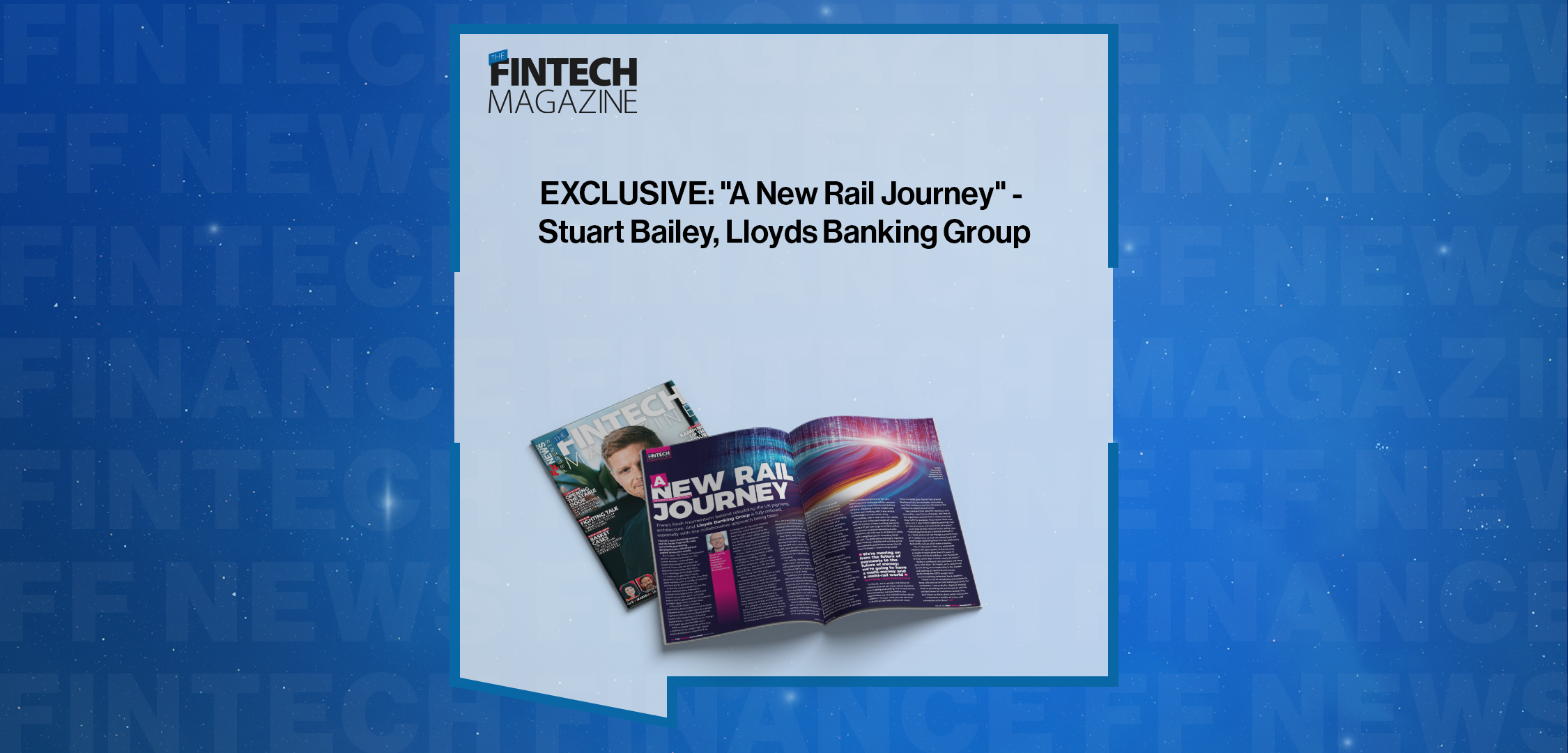
There’s fresh momentum behind rebuilding the UK payments architecture. And Lloyds Banking Group is fully onboard, especially with the collaborative approach being taken
The UK’s open banking system and its Faster Payments rails were both pioneering developments, admired and copied across the world. But in 2023, The Future Of Payments Review – popularly known as The Garner Review – warned that longer-term progress couldn’t be assured. There was no shortage of payments innovation, but there was a shortage of strategic vision – a roadmap to give those ideas direction, a structure to make sure they were realised, and, crucially, a modern architecture to build them on.
It was the shock needed to put the much-criticised New Payments Architecture programme, which had limped along since 2017, out of its misery and for government and industry to begin again from a clean slate. A Payments Vision Delivery Committee (PVDC) duly arrived in 2024, followed a few months later by a Retail Payments Infrastructure Board (RPIB), tasked with designing a technical blueprint for a new architecture. Things have sped up considerably since. With renewed impetus at the top, a coalition of 31 major high-street banks and fintechs responded by forming the UK Payments Initiative (UKPI) Ltd, which immediately took the open banking bull by the horns.
UKPI is now rapidly realising pay-by-bank’s potential to become a scalable, everyday alternative to traditional debit cards and Direct Debits – as it was intended to be.
In June, UKPI made commercial variable recurring payments (cVRPs) using open banking a reality – initially for low-risk payees, such as utility companies, with merchant subscriptions and one-off, one-click ‘bank on file’ ecommerce payments due to follow later this year. While making A2A payments as easy for consumers to use online as card payments, pay-by-bank also brings down transaction costs for merchants.
Open banking payments platform GoCardless estimates that British merchants currently pay an estimated £1.5billion in annual transaction fees, driven almost entirely by the near-duopoly of Visa and Mastercard. The growth of these services could have ramifications beyond the UK, too, as merchants downgrade their reliance on US card schemes. And, in that, the UK is in lockstep with the EU, which is rolling out its universal A2A wallet, Wero, also in an attempt to reduce itsdependence on US-based payments service providers and improve the payment experience for the 400 million people in Europe with a bank account.
Stuart Bailey, Head of Payments Industry and Regulation at Lloyds Banking Group, which has a seat on the new RPIB and is a member of the UKPI, hopes the rapid removal of open banking roadblocks is a sign that the system in the UK is indeed entering a new phase.
“The industry – that’s both banks and non-banks – has come together with a series of regulators to get the foundations right for the [pay-by-bank] scheme to succeed,” he says. “Sometimes these participants have different incentives, but we’ve been able to identify how value is recognised across the chain and created a rule book so everyone knows how to participate. We’re working on customer protections so that customers can really trust in using the payment. That’s a standout example of collaboration.”
More broadly, Bailey believes that ‘we’re moving on from the future of payments to the future of money; we’re going to have a multi-money world and a multi-rail world behind that’.
Building the multi-money world The Bank of England-chaired RPIB, which includes big banks as well as challengers, building societies, Amazon and the Post Office, launched a consultation earlier this year on how the core clearing and messaging infrastructure that sits beneath retail payments should support next-generation transaction methods – from tokenised deposits swapping the moment a house sale completes, to a single merchant using stablecoins to pay an international supplier.
The expectation is that the new rails will route and settle not only traditional fiat bank deposits, but also tokenised deposits, regulated stablecoins, and potentially a digital pound. Phase 2 of the Bank of England’s experimental Digital Pound Lab, involving a wide cross-section of public bodies, researchers, identity verification providers and fintechs, took place this summer.
Lloyds, meanwhile, is one of a number of banks supporting the Great British Tokenised Deposits (GBTD) project, a collaborative industry pilot coordinated by UK Finance to execute the UK’s first live transactions using tokenised commercial bank deposits. A real world tokenised marketplace payment, house purchase and wholesale asset settlement are all due to take place this autumn.
While the UK architecture takes shape to support this new world of instant transactions, the existing Faster Payments System (FPS) will continue to be upgraded. The successful reinvention of the UK’s instant payments landscape will be overseen and delivered by a new industry-led delivery company – following a similar model used to deliver open banking, which was widely acknowledged as a UK success story. Pay by Bank, after a slow start, has rapidly picked up pace in the past couple of years, with the number of open banking payments seeing a 57 per cent surge to hit 351 million. The system’s technical robustness is also impressive: API calls rose to 24 billion in 2025, with a weighted uptime exceeding 99.50 per cent.
The RPIB will be looking to replicate open banking’s stability and security as the new payments architecture moves the UK closer to Bailey’s ‘multi-money world’.
“In the UK, we’re seeing a real focus on resilience, how we can keep critical business services going and looking end-to-end across those processes, not only within the organisation but also outside to the critical suppliers,” he says. “And you can see that in the EU as well with a focus on trust, focus on DORA [the Digital Operational Resilience Act], for example, and making sure that resilience and security behind the scenes are really front of mind.
“We combine that need for resilience with innovation, new forms of money, and look at the regulation around that to make sure that they’re fit for purpose. That means some new rules, but it also means applying existing rules to new processes and new forms of money.“
As to how all this impacts banks, Bailey says: “Instant payments are a default method for us. I think where we see change is around more 24-7 settlement, so that the central bank will have longer operating hours for the settlement behind the scenes of all these schemes.
“So, in two years’ time, our settlement scheme will open earlier in the morning, a couple of years after that it’ll move to Sundays and bank holidays, and thereafter it’ll be seven days a week, nearly 24 hours.”
Bailey is confident that providers will keep pace with that: “At Lloyds, we’re very proud to be taking some leadership in the market and looking at new forms of money, particularly the GBTD project and commercialising tokenised bank deposits.
“There’s a lot of complexity and systems to keep safe and secure and working properly for customers. I see a role for Lloyds in leading that, in providing the access points and the orchestration for customers so that they don’t have to think about what rails to use.
“It becomes a matter of choice and convenience for them.”