Fraud Has a Shape: Stop Scams UK and Persona on Closing the Gaps Before Criminals Find Them
By Matthew Burls · 19 November 2026

By Matthew Burls
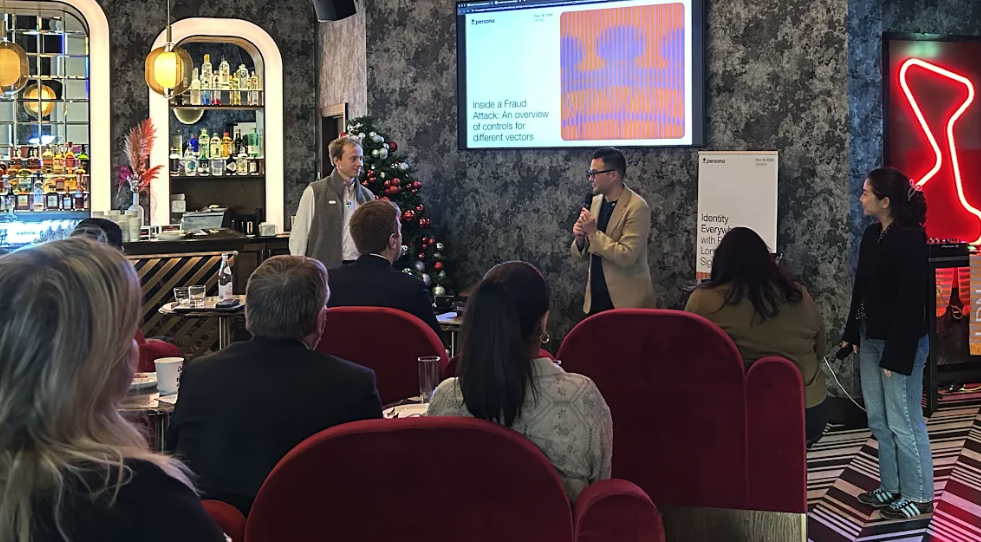
Fraud and risk leaders gathered at F1 Arcade London on 18 November for "The Signal Exchange", the inaugural event in Persona's Identity Everywhere roadshow. The identity verification platform, which has verified more than a billion identities for over 4,000 customers, brought in Mark Tierney, CEO of Stop Scams UK, and Rachael Tiffen, Director of Cifas Learning & Public Sector, alongside its own fraud and product specialists. The roadshow moves on to Paris in February 2027, on the EU's digital ID rollout, and Mexico City in March, on deepfakes and injection attacks.
Between the racing simulators and the bar, the message from the stage was consistent: fraud doesn't respect sector boundaries, so the defences against it can't either.
It started with a box of SIM cards
Tierney described how one of the UK's most effective anti-fraud collaborations began with a box of UK SIM cards seized at the Thai border and passed to the National Crime Agency. On the surface, nothing looked wrong: the numbers weren't making calls or sending messages. The obvious response was simply to shut them down.
Stop Scams UK took a different route. It put BT and Meta in a room together and asked them to work it out. What they found was that the SIMs existed for one purpose only: receiving one-time passcodes. Those passcodes were used to open bank accounts and to set up social media, dating and messaging accounts that looked like they belonged to UK users. Shutting the numbers down stopped nothing, because the accounts they had created were still live and still running romance, job and investment scams.
The fix came from both sides. BT went on to find several million pay-as-you-go SIMs in the supply chain. Operators now look for numbers that only ever receive one-time passcodes and close them, some have changed their terms so that an OTP-only number counts as a breach, and SIMs must now be topped up by card before they can receive texts, removing what had been a free way into the market.
What began with two companies is now Stop Scams UK's Blocked SIMs programme. It moved from pilot to full operation in March 2026, has shared more than 20 million records, and this month won Best Private/Third Sector Initiative at the Tackling Economic Crime Awards. Eighteen organisations take part, including BT, Virgin Media O2, VodafoneThree, Meta, TikTok, LinkedIn, Barclays, Lloyds, Monzo, NatWest, Revolut and Wise, with the NCA in support.
Tierney noted that the first banks to join weren't the biggest, but smaller firms with less to lose and an appetite to lead. His advice for anyone trying to build something similar: find a coalition of the willing, a few people in each organisation prepared to pioneer, test it, and let the results build the case.
From one signal to a whole network
Tierney also discussed FIRE, the Fraud Intelligence Reciprocal Exchange, which started as Meta's threat-intelligence sharing programme with banks. He argued it now needs a new name, because it is no longer just Meta doing the work. A single phone number, URL or email address goes in, Meta identifies linked profiles, numbers and addresses, and those are fed back to the telecoms and banking sectors, who find more and feed that back in turn. He likened it to lifting a stone and finding a whole city underneath. Its pilot with NatWest and Metro Bank alone helped remove around 20,000 scammer accounts.
Certainty, not verdicts
Asked how the group decides when a signal is strong enough to count as fraud, Tierney was clear that Stop Scams UK never makes that call. A signal that crosses one telco's threshold may not be enough for a bank or a tech platform. What the collaboration provides is certainty: overlaying data from different sectors raises confidence in each signal, and that also protects consumers, because nobody wants to shut down an innocent person's phone number or a legitimate business's Facebook page by mistake. Each member sets its own threshold and keeps that decision in-house.
Stop Scams UK is not a statutory body, he added, but a membership organisation of around 40 firms that want to do good. Between them, its members cover every UK mobile network operator and almost all UK retail banking. Showing one member what another has achieved with shared data tends to bring the rest of the ecosystem along.
KYC is the backstop, not the front line
On onboarding and KYC, Tierney was blunt. Fraud is now the most common crime in England and Wales, with 4.5 million incidents in the year to June 2026 out of 9.7 million crimes measured by the ONS crime survey. A problem that size won't be solved by even the best verification at the front door. Being the safest platform doesn't make the ecosystem safe; it just pushes criminals somewhere else.
Strong KYC remains essential, he said, and customers need to feel they can trust the platforms they use. But the friction should be applied to criminals, not customers, and Stop Scams UK's members are working to close gaps much earlier in the fraud journey, at the channels criminals use to reach victims in the first place. By the time a fraudster reaches onboarding, KYC should be the last line of defence rather than the first.
Bots talking to bots
On AI, Tierney pointed to Stop Scams UK's scam-baiting work, which uses AI chatbots to engage the criminals behind "Hi Mum, Hi Dad" texts. The conversations have revealed a surprising amount about scam operations, including the bank accounts criminals use to collect money. Stop Scams UK says the programme identified more than 1,500 money mules in its last reporting year. Reading the transcripts, Tierney said, it's sometimes obvious that it's simply a bot talking to a bot.
The group is now looking at voice. As SMS and email channels are increasingly blocked, voice calls risk becoming the cheapest and easiest way for criminals to reach victims, and voice data is far less used than message and URL data. His wider point: the industry shouldn't get drawn into an AI arms race, but should focus on using insights that nobody else is using.
Share the data you think nobody needs
Tierney's closing advice was about unexpected partnerships. He pointed to LinkedIn, a Stop Scams UK member and a Persona customer, which is exploring how its verification insights can be shared with Adobe, and to Amazon, whose online marketplace data has proved valuable to a payment processor. Insight that looks irrelevant to your own business may be exactly what someone else needs once it is overlaid with their data.
Persona's team echoed the point, noting that new clients often ask who else Persona works with that looks like them. The more useful question, they said, is what can be learned from companies that look nothing like you, because fraudsters test the same techniques across every sector.
The same thinking runs through Cifas, which in July joined the Global Signal Exchange, an international fraud-intelligence network of nearly 800 organisations. Its latest Fraudscape figures show why: more than 220,000 fraud-risk cases in the first half of 2026, with identity fraud making up 59% of them and unauthorised SIM swaps up 402% year on year.
Fraud has a shape
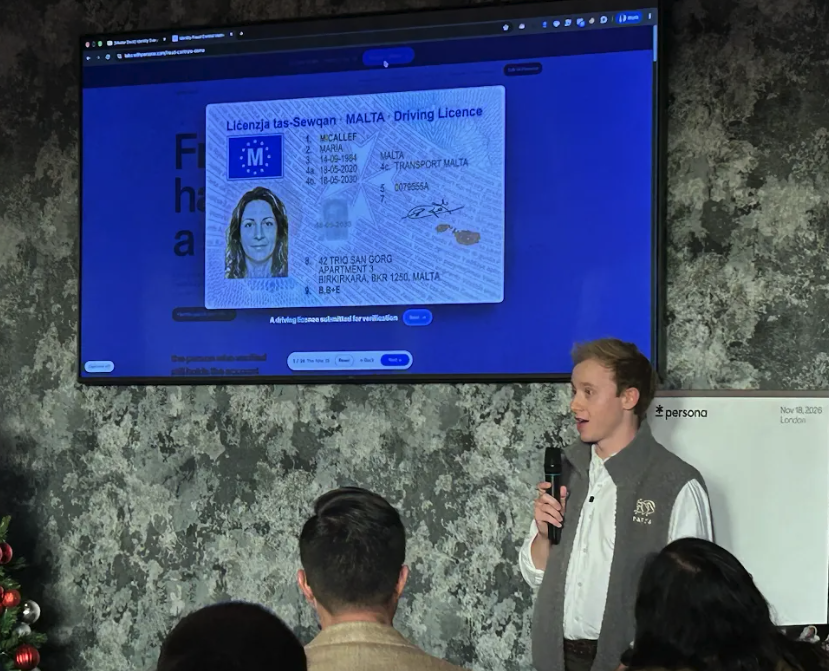
Persona solutions engineer Will Forster then turned to the mechanics of identity fraud, opening with a Maltese driving licence and asking the room what was wrong with it. The answer: it had been generated with AI. Persona is seeing growing use of generative AI to create documents submitted during verification.
It isn't all AI, though. Persona's H1 2026 selfie fraud report, which analysed more than 27 million fraudulent selfie attempts, found that 76.5% involved no AI-generated content at all. Most were simple presentation attacks, such as holding a photo or screen up to the camera, and more than 80% of injection attacks used free virtual camera software.
To make sense of the threat, Persona has built the Identity Fraud Control Matrix, a free tool at labs.withpersona.com/fraud-controls. Its premise is that every verification rests on six assumptions, and every attack breaks one of them:
Session: the device and session are what they claim to be
Presentation: the face or document in front of the camera is real
Capture path: the image is what the camera saw
Transport: what arrives is what this session captured
Evidence: the evidence is genuine, and it belongs to the person
Lifecycle: the person who verified still holds the account
The matrix maps 31 attack techniques across those six stages against 24 controls. Some of the findings are sobering. Fourteen of the 31 techniques take little effort or skill, from emulated devices and screen replays to stolen genuine documents and identity muling. Only nine show up in the image itself; the rest are visible only across many submissions, only in the capture path, or leave no face or camera trace at all.
No single control is enough
Forster walked through how controls stack up. Starting from a fabricated document, checks such as document authenticity analysis (fonts, holograms) and encoded data validation (does the MRZ or barcode match what's printed?) catch some attacks. Adding guided capture improves image quality and links to further controls. Risk and link analysis then helps uncover the coordinated rings behind multiple fabricated IDs, which in turn exposes further attack types.
Persona's own numbers make the case. The three widest controls (platform attestation, liveness and presentation attack detection, and device and network context) together address 21 of the 31 techniques. Covering all 31 takes at least seven. A typical document-and-selfie flow leaves 17 of the 31 with no control at all, including every session and environment attack and every post-decision lifecycle attack.
The tool also challenges headline claims such as "99.9% accurate liveness", pointing out that liveness addresses only eight of the 31 techniques, and listing the questions buyers should ask about how any accuracy figure was tested.
As Forster put it in closing, the point isn't any one control, but putting them together to protect every stage of the journey.