A Good Board Adds a Little, a Bad One Can Take a Lot: What We Heard at the FINTECH Circle Board & CEO Summit
By Matthew Burls · 18 November 2026
By Matthew Burls, FF News, FINTECH Circle Board & CEO Summit
Less than three weeks before FINTECH Circle's Board & CEO Summit, hackers walked out of Binance with $6.3 billion, and they got in through a fake job interview. Five days before it, Nvidia appointed the first chair in its history. So when around 150 founders, chairs and headhunters filled Deloitte's auditorium at New Street Square on 16 November, the theme of the afternoon was already set. Fintech's most expensive failures don't start in the code. They start in the boardroom.
The invitation-only summit was fully booked with a waiting list. It brought together the CEOs running fintechs, the chairs and non-executive directors who help them grow, and the headhunters who fill those board seats. FF News was in the room, and caught up with two of the keynote speakers afterwards.
[PHOTO 1: Susanne Chishti opening the summit]
"It was governance controls which were missing"
Susanne Chishti, founder and chair of FINTECH Circle, opened with both stories. The Binance theft, believed to be the largest crypto heist on record, didn't need anyone to break the cryptography, she said. It began with one engineer, a genuine job site and a recruiter who wasn't genuine. Binance has since said around $2.85 billion of the stolen assets had been frozen or intercepted, and that it had replenished the affected funds.
"It was not the cryptography which was broken," Chishti told the room. "It was governance controls which were missing."
At Nvidia, Jensen Huang's resignation after 33 years left CFO Colette Kress as interim CEO and Harvey C. Jones as the company's first-ever board chair. Chishti pointed out that Huang had been running some 60 direct reports. For boards, she said, the lessons are succession planning, key-person risk and chair independence. Hiring processes and privileged AI tools have also become attack surfaces, and the clock is ticking on quantum computing's threat to today's encryption.
The UK has more than 3,000 fintechs and more than 30 fintech unicorns, Chishti said. What many of them lack is ambitious, independent board members. When a board is made up only of venture capital and private equity appointees, it often misses the independent judgement a scaling company needs. That is the gap the FINTECH Circle Board Programme is built to fill.
"A good board adds a little. A bad board can take a lot"
Husayn Kassai, who co-founded identity verification firm Onfido and is now founder and CEO of ollo, gave the keynote on what founders want from their boards. Speaking to FF News afterwards, he said many founders get the answer wrong.
"Many would say they want advice and help. That's a mistake," he said. "What you really want is for them to play their role in either supporting the founder or CEO, or replacing the founder or CEO, and not much else."
Kassai splits a board's job into the brake and the accelerator. On the brake, meaning compliance, governance and conduct, he sees "frankly no limit". Board members should see the general counsel's reports, outages and incidents, and they should grill the whole executive team, not just the CEO. Any internal whistleblowing line should run to an independent director. "That's better than a journalist," he said.
The accelerator is a different matter. Directors are not the visionary, and they made their choice when they joined. "If you can't find yourself supporting the CEO until the very end, then you shouldn't jump on that ship," he said.
His lesson for first-time founders was short: "A good board adds a little. A bad board can take a lot." He was also frank about the other side. The startup world can encourage fake it till you make it, and boards exist partly to check that. A founder should ask, he said, "what am I going to say on LinkedIn, knowing that my board members are going to read that?"
On AI, Kassai's view is that most corporate projects stall after the pilot for two reasons. Companies lack "crystal clarity" on the problem they are trying to solve, and they lack the right tooling. His advice is to drop the list of 20 use cases, pick the top three, make them work, then expand. ollo is built around that idea. It is an enterprise context layer that connects a company's knowledge to models from Anthropic, OpenAI and others, so AI agents understand how the business works. It also runs proactive agents that email staff each morning with their priorities and offer to handle some of them, with consent.
Get ready, because the IPO window won't wait
Simon Olsen, Equity Capital Markets Partner at Deloitte and the afternoon's host, has worked on more than 200 IPOs over 24 years in equity capital markets. London saw 128 IPOs in 2021 and fewer than 30 last year. Major macro events, from the war in Ukraine to Liberation Day, have kept landing just as IPO windows opened.
But, he said, "it's not as bad as you might read in the papers", in London especially. Deloitte is seeing a decent pipeline for 2027. The catch is that windows "will be good, but they will probably be quite short". One reason for the low numbers is that companies were not ready when good windows did open. Asked when markets will return to normal, he said: "I've never seen anything that I would characterise as normal."
Talking to FF News after his keynote, Olsen said being ready means two things. First, investors and analysts should already be engaged, "so you've got the city ready to want to buy you". Second, the IPO process itself should be well advanced: the prospectus, the diligence, a listing-ready board, and the governance and controls a public company needs.
Founders, he said, can be "quite easily sold on the monetary aspects of an IPO", including the liquidity and the photo on the balcony of the London Stock Exchange. Boards should move the conversation on early to what listed life means day to day. A listing need not change a company's culture, he said, but it does change things at the top.
On London versus New York, his advice was to decide based on your own circumstances, "not based on headlines". Where is the business today, and where is it heading? Most major markets are deep pools of capital compared with the size of a fintech, so the real question is whether investors in that market will buy your shares. Other factors are where your sector is best understood by analysts, whether you will qualify for index inclusion (roughly half of the money now sits in passive funds), and what a listing means for tax, governance and pay. He also warned against SPACs. Around 850 listed in the US in 2020 and 2021, and the average performance after a deal has been worse than minus 70%.
His message on exits was to be structured, not reactive. Boards often chase whichever buyer or adviser turns up first. Instead, they should weigh trade sales, private equity, a listing and secondary sales side by side, looking at likely buyers and valuation ranges for each. "The people knocking at your door might not be the best option," he said.
PISCES: Britain's world first
Olsen saved his strongest words for PISCES, the Private Intermittent Securities and Capital Exchange System, which he has worked on for Deloitte since it was just a concept. "It is a British first. It is a world-class secondary platform. And we should be massively proud of it," he said.
PISCES lets a company stay private while holding periodic share auctions on a licensed platform, such as the London Stock Exchange's Private Securities Market. The company controls how often auctions happen, who can buy and sell, the price range and the volume. For now it is a secondary market, used for employee and founder liquidity, tidying up complicated cap tables, and as a stepping stone to an IPO. The government also hopes it will help keep growing businesses in the UK.
Eight deals have completed so far, across three platforms. Olsen said companies have been slow partly because nobody wanted to be "a guinea pig", and partly because a company only comes to PISCES when it actually needs a secondary sale and has the management time for it. He expects more in 2027. The tax treatment helps: EMI and CSOP share schemes can be amended retrospectively to allow PISCES sales while keeping their tax advantages, PISCES trades are exempt from stamp duty, and HMRC generally accepts the auction price as fair market value.
[PHOTO 2: Scaling Across Borders panel]
Ring-fence 70% of the agenda for growth
Charles McManus co-founded ClearBank in 2016 and handed over as CEO a year ago. He stays on the ClearBank board and co-chairs the Unicorn Council. He took aim at the idea that governance kills innovation. "You can have, and you need both," he said.
His fix starts with the questions directors ask. Instead of "do we comply?", ask "what needs to be true?" McKinsey data he presented shows European boards split their time roughly 50-50 between strategy and governance, while US boards lean closer to 60-40 towards strategy. His prescription is to delegate routine governance to committees and ring-fence 70% of the board agenda. That means around 35% on talent and culture, 25% on strategy across customers, product and technology, and the rest on international growth and partnerships. He wants boards looking 36 months ahead, with metrics that point forward, not just back.
McManus started his career around the Barings collapse and cited Silicon Valley Bank as a more recent warning. "How could you sit on the SVB board when an unrealised loss was bigger than their capital base?" he asked. He also told the room that ClearBank, as the UK's first cloud-native clearing bank, once spent 12 months rebuilding its tech stack, because nobody could yet check the CTO's work. Having the right expertise on the board, now including AI, matters. What founders want from a chair, he said, is a sparring partner: "Give me something I haven't thought about."
Scaling across borders
The first panel, chaired by Kate Grussing CBE of Sapphire Partners, asked what it takes to build a global fintech. Ann Cairns, chair of CAB Payments, oversaw entry into 19 new markets as Mastercard's head of international. She said the first step is the competitive landscape and your moat, warning that a "build it and they will come" approach is very dangerous.
Mike Walters, co-founder and CEO of Form3, said the big market-scoring spreadsheets give "this veneer of science" to decisions that come down to judgement. Form3 won't enter a market without knowing how important it is to its existing customers. He also advised boards to write down why they are entering a market and what would make them leave, which takes the emotion out of an exit decision later on.
Isabel Naidoo, Chief People Officer at Wise, described how Wise sends experienced "pioneers" into new countries and pairs them with local hires, so the culture travels without forcing a one-size-fits-all model. On regulation, she said every route, from licensing to partnering to M&A, has trade-offs. Wise has mostly chosen licences and direct access to local payment systems.
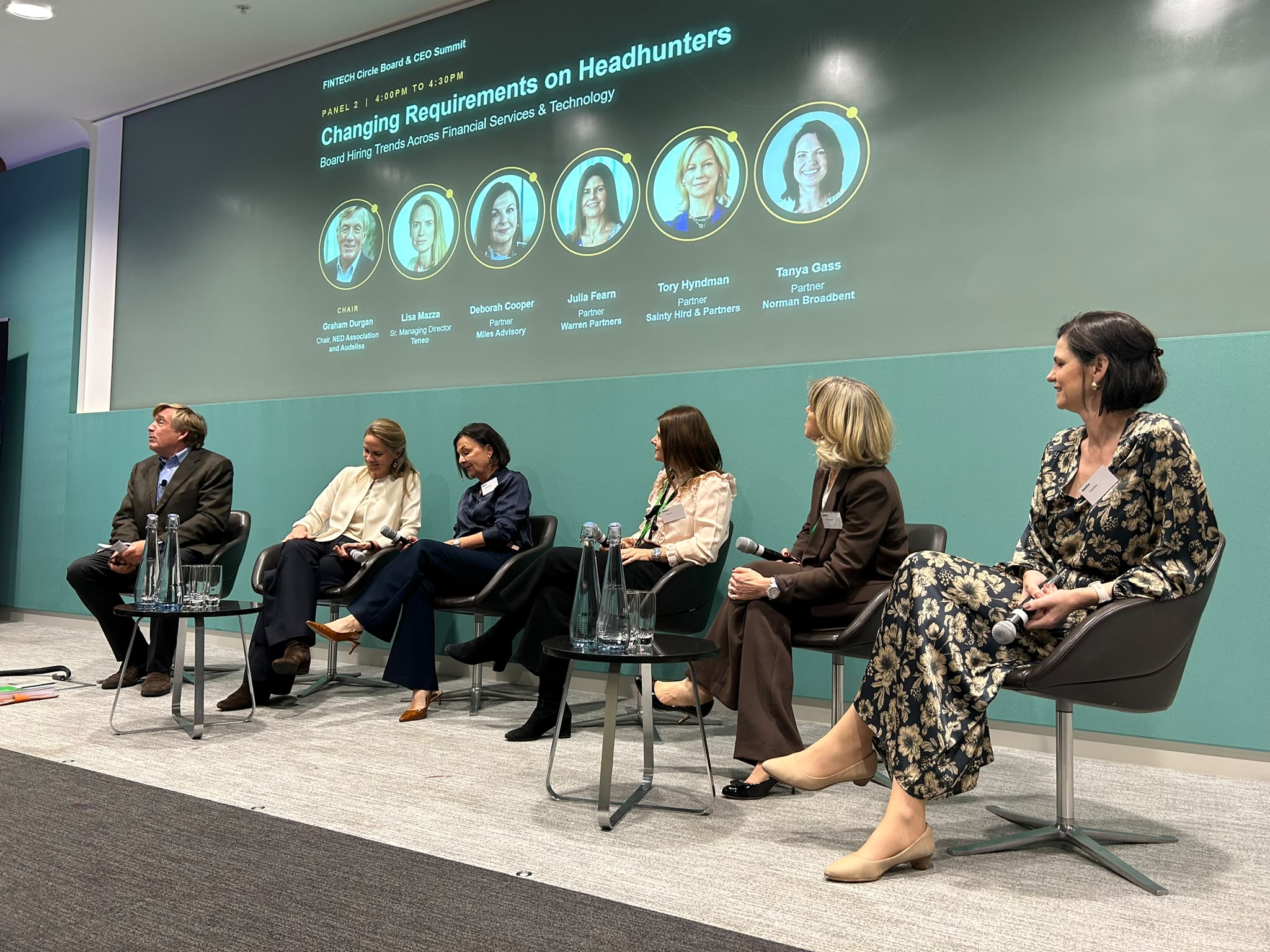
The rest of the afternoon covered how board hiring is changing, in a headhunter panel chaired by Graham Durgan, chair of the Non-Executive Directors' Association, with Lisa Mazza (Teneo), Deborah Cooper (Miles Advisory), Julia Fearn (Warren Partners), Tory Hyndman (Sainty Hird & Partners) and Tanya Gass (Norman Broadbent). A panel on leading human and AI intelligence together followed, and the day closed with a fireside chat between Patrick Dunne OBE, author of Boards, and Jenny Knott, a non-executive director at the British Business Bank. Every attendee went home with a signed copy of Dunne's book.
[PHOTO 3: Changing Requirements on Headhunters panel]
The verdict
For a room full of governance people, the mood was not defensive. Every speaker came back to the same point. The best boards don't slow ambitious founders down. They make sure the brakes work, so the founder can push harder on growth. As this month's Binance and Nvidia headlines showed, the alternative is far more expensive.