The Six Best Translation Partners for Organisations Going Global
By Ali Paterson · 20 August 2026

Six global language service providers compared across specialist expertise, technology, security, linguistic review, and international delivery
International expansion turns language into an operational issue. A product launch may involve software strings, contracts, and training materials. Other frequent tools are patent filings, technical manuals, and customer support content, with each asset carrying different risks. Direct translation alone offers limited protection against inconsistent terminology, local formatting errors, or language that feels misplaced in the target market.
The best translation partners combine skilled linguistics with localisation planning, secure technology control, and project governance. Their value depends on scale. A provider may need to coordinate several markets, content formats, and review teams while keeping language consistent across the organisation.
When it comes to providers, each option has different strengths. Depending on a company’s needs, they can all serve as a translation partner for international expansion. The right fit depends on the type of content, internal systems, regulatory exposure, and pace of delivery.
Translation Providers at a Glance
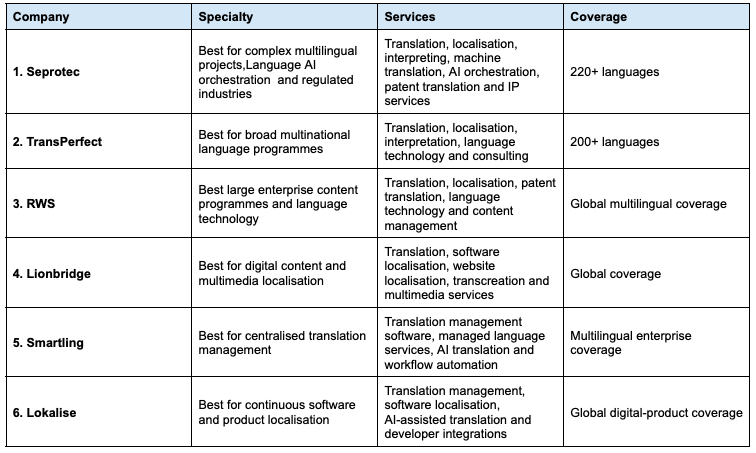
Assessing the Providers
The comparison considers issues that commonly shape enterprise translation services: specialist industry knowledge, quality processes, security controls, language coverage, and the ability to coordinate high-volume work.
Technology also carries weight. Translation management systems, machine translation, AI translation platforms, APIs, and workflow integration can improve delivery. Yet human review remains essential for sensitive, technical, or public-facing material.
1. Seprotec: Best for Complex Multilingual Projects, Language AI orchestration and Regulated Industries
Seprotec suits organisations handling material where accuracy, confidentiality, and subject knowledge carry particular weight. A company filing patents in several countries may need one supplier for written documents and another for conversations with local teams.
Seprotec brings those requirements together through services offered in more than 220 languages, drawing on an operating history that dates back to 1989. Documented quality and security procedures sit behind that delivery. The relevant certifications address translation practice, post-editing, and information protection. Medical-device quality systems and environmental management can also play a part.
AI supports selected stages of the work, with human specialists making the linguistic decisions that require professional judgment. Routine internal content may be suitable for machine-translation services or AI translation, while patent documents, legal agreements, and scientific material usually call for closer human oversight.. Seprotec’s translation services extend to technical, legal, life sciences, patent, and intellectual property content.
This mix is particularly suitable for organisations running multilingual programmes with several levels of sensitivity. A single international project may involve live interpretation, regulated documentation, and localised digital content. All are managed through the same quality and terminology processes.
Seprotec can also act as a Language AI orchestration partner for organisations looking to modernise multilingual operations. Its technology-agnostic approach brings together AI-driven language solutions, workflow automation, integrations, governance and human linguistic expertise within a coordinated ecosystem, allowing different workflows to be applied according to content type, risk and quality requirements.
2. TransPerfect: Best for Broad Multinational Language Programmes
TransPerfect serves organisations seeking one supplier across numerous departments and formats. Its portfolio covers document translation, localisation, interpretation, and language technology in more than 200 languages.
That range can suit multinationals whose requirements cross marketing, legal, finance, training, customer service, and digital products. Rather than creating separate vendor relationships for every function, an enterprise can place several language activities within a common programme.
The company also supports industry-specific work across fields like technology, financial services, life sciences, legal services, and travel. Its scale may appeal most to businesses with ongoing international demand across many regions.
TransPerfect’s broad model may feel larger than necessary for a narrowly defined project. For an organisation seeking extensive coverage and central supplier management, it remains one of the more comprehensive options in the market.
3. RWS: Best for Enterprise Content and Language Technology
. RWS supports organisations managing multilingual content across multiple markets, combining language services with translation technology and content management solutions. Its portfolio includes translation and localisation, intellectual property services, interpreting, and technology for managing enterprise content.
Its enterprise offering is relevant to organisations that create large volumes of technical documentation or maintain content across many products.
The company's content management tools also distinguish it from providers centred primarily on linguistic delivery. Connectors and structured authoring systems can link translation to existing publication processes, helping global teams control versions and reuse approved material.
RWS is particularly suitable for legal documents, patent teams, and manufacturers handling extensive technical content. It can therefore be a suitable option for large organisations looking to connect language services with established content and technology environments.
4. Lionbridge: Best for Digital Content and Multimedia Localisation
Lionbridge stands out for digital experience involving websites, software apps, multimedia, and customer-facing content. Its services cover localisation, content testing, accessibility, and multimedia adaptation across formats and devices.
Website localisation involves more than translating visible text. Things like navigation and imagery can influence how a digital product performs in another market. Lionbridge supports several production approaches based on content value and required quality, including combinations of automated and human-led work.
Lionbridge is best suited to companies whose international growth depends heavily on digital content and customer experience.
5. Smartling: Best for Centralised Translation Management
A global content programme can quickly become scattered. Smartling replaces that arrangement with a central translation management platform designed to track work from intake through approval.
Translation memories and glossaries go alongside things like reporting and linguist access. The software also connects with more than 50 business platforms, using pre-built integrations, APIs, and proxy technology to move content into and out of the system.
Production can be adjusted by risk. Smartling works best for organisations that need a clear operational view across many digital assets.
6. Lokalise: Best for Continuous Software and Product Localisation
Lokalise is built around the release cycles of software and digital product teams. It integrates with tools including GitHub, GitLab, Figma, Jira, and continuous integration pipelines. That allows translation work to move alongside product development.
The structure can reduce the delays created when localisation begins at the end of a release. New interface strings can enter a project automatically, while approved translations may return to the development environment without long email chains or manual file exchanges.
The platform also provides AI-assisted translation, contextual information, glossaries, and review controls. Automation can handle routine content, while flagged strings receive closer attention from reviewers.
Lokalise is particularly suitable for software companies, SaaS businesses, and product teams releasing frequent updates. Organisations centred on legal documents, interpreting, or broad corporate communications may need wider services alongside it.
How to Choose a Translation Partner
A provider comparison becomes useful only after the organisation defines what is being translated and what could happen if the language fails. Marketing copy, internal messages, software interfaces, and patent applications carry very different levels of risk.
Content is often classified by complexity, audience, and sensitivity. That exercise helps determine where human translation is essential and where machine translation with post-editing may offer a suitable balance of speed and control.
Many buyers are looking to confirm whether projects will be assigned to linguists with direct industry experience.
ISO certifications and security controls usually warrant close review. That helps determine where confidential data or regulated content is involved. Organisations may want to ask where information is stored, who can access it, and whether subcontractors follow the same requirements.
Buyers want to understand which tools are used, how output is checked, and whether confidential material enters public models. Human review requirements can then be set according to the content.
Terminology management is equally important. Technology integration could become a deciding factor for high-volume work. APIs, content connectors, and automated handoffs can reduce manual file handling. That’s particularly relevant for websites and software products.
A pilot project using representative material provides a stronger test than a generic sample. The exercise can reveal how the supplier handles terminology, questions, formatting, review comments, and deadlines. Price remains only one part of the decision.
FAQs
When does a project need localisation as well as translation?
They serve related purposes, though the scope is different. Translation deals with language, while localisation adjusts the surrounding details so that the content feels appropriate for a particular country or audience. Digital products often need both processes working together.
Should enterprises use machine translation?
Machine translation can support speed and scale for high-volume or lower-risk content. The appropriate level of human review depends on the material. Legal, scientific, technical, and public-facing content usually requires closer linguistic control.
Why are ISO certifications important?
ISO certifications offer evidence that a provider follows documented processes for areas like quality management, translation workflows, information security, and machine-translation post-editing. Buyers still often need to examine how those processes apply to the proposed project.