EXCLUSIVE: "Knowing Me, Knowing You" - Philippe Serres, G+D and Clive Bourke, Daon in 'The Fintech Magazine'
By Lauren Towner · 20 October 2026
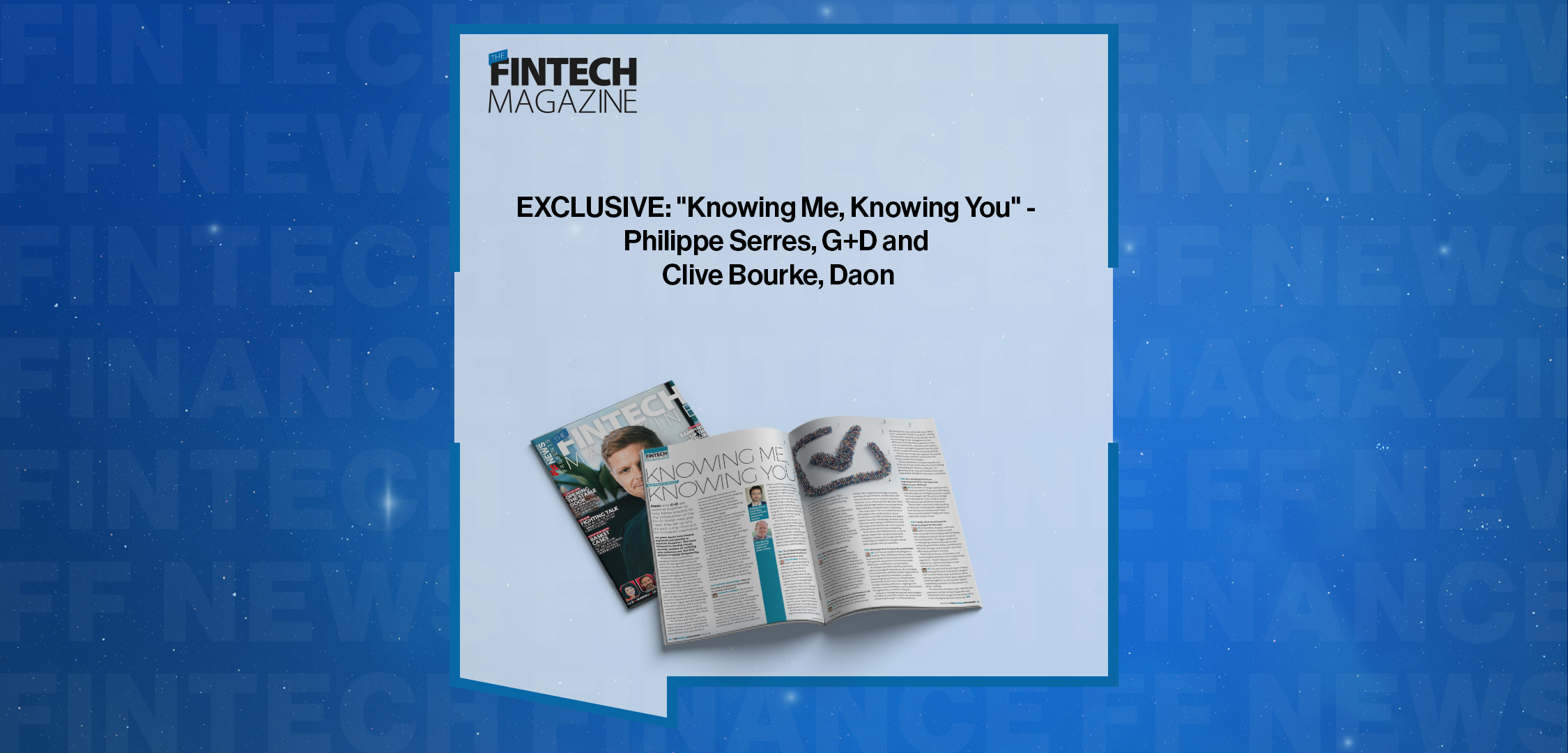
Daon and G+D are working together to help banks prepare for the introduction of the EU DI Wallet next year. Here, they tell us why it’s such a big moment for European payments
For years, banks have treated payments and identity as separate disciplines. One team focussed on moving money securely, another on verifying who customers are. But that division is rapidly disappearing. Driven by sophisticated fraud, changing customer expectations and a wave of new regulation, financial institutions are discovering that every payment has become an identity event.
Every account opening, authentication request and digital interaction now depends on proving not just that a transaction is legitimate, but that the person initiating it is exactly who they claim to be at that moment in time. Nowhere is that convergence more evident than in Europe. By December 2027, all regulated organisations in the EU will be required to accept credentials from the EU Digital Identity Wallet for know your customer (KYC) and strong customer authentication (SCA). It represents one of the most significant changes to digital identity since online banking became mainstream.
The initiative will allow every EU citizen to carry a government-issued digital identity on their smartphone, enabling them to prove who they are across borders. For consumers, it promises greater convenience and control. For banks and fintechs, preparing for that future requires more than regulatory compliance. Institutions need technology capable of supporting customers wherever and however they choose to engage.
Those challenges explain why security technology specialist G+D and identity assurance leader Daon announced a strategic partnership last year. By combining G+D’s expertise in secure payments, tokenisation and government-grade identity technologies with Daon’s platform for digital identity, authentication and customer onboarding, the two companies aim to help financial institutions navigate an increasingly complex landscape.
We sat down with Philippe Serres, Chief Sales Officer of G+D’s ePayments division, and Clive Bourke, President of EMEA and APAC at Daon, to discuss why identity and payments are converging, what the EU Digital Identity Wallet will mean for financial services, and how banks can turn regulatory change into a competitive advantage.
THE FINTECH MAGAZINE: Why are identity and payments becoming so closely connected?
PHILIPPE SERRES: What we’ve witnessed over recent months is what I’d describe as a double convergence. The first is the convergence of payments and identity. Historically, these have been treated as separate disciplines, but they’re becoming one. That happens at two critical stages. The first is during customer onboarding, where KYC processes establish who someone is. The second is during authentication, where every payment relies on confirming a customer’s ID.
The second convergence is between the physical and digital worlds. Banks today need to support customers who walk into a branch just as effectively as those opening accounts entirely through a mobile device. Whether someone presents a passport across a desk or scans its biometric chip using NFC on a smartphone, institutions need confidence that they’re dealing with the genuine individual.
It isn’t simply about security – it’s also about conversion. Banks want to onboard as many legitimate customers as possible without introducing unnecessary friction. If somebody starts opening an account digitally before visiting a branch, or begins in a branch before completing the process online, the transition needs to be effortless.
TFM: The EU Digital Identity Wallet has attracted enormous attention. Why does it matter so much?
CLIVE BOURKE: The scale of what’s happening shouldn’t be underestimated. There’s enormous international interest because Europe is creating something genuinely transformative. Every EU member state will issue citizens with a government-backed digital wallet that contains trusted credentials. Initially, that means every citizen will have a secure digital identity they can use instead of repeatedly presenting a passport or national identity card.
For banks and fintechs, that changes the KYC process significantly because customers will increasingly use their digital wallet to prove their identity. By the end of 2027, banks and regulated financial institutions need to be ready to accept those wallets. That’s a substantial operational change, but it’s also a huge opportunity to simplify onboarding while improving trust.
How the wallet will change customer authentication is perhaps the less talked-about aspect, but it’s equally significant. Today, banks typically issue the credentials customers use to access their banking applications. Going forward, citizens will be able to use their EU Digital Identity Wallet to authenticate.
So, we’re moving from a model where banks manage every authentication credential towards one where trusted government-issued digital identities play a central role. That’s a major evolution in digital banking.
TFM: What opportunities does this create for cross-border banking?
CB: This is one of the most elegant aspects of the entire initiative. Every member state will issue compatible digital wallets using common European standards. In theory, that means somebody in Ireland should be able to open an account with a bank in Germany just as easily as someone living there.
Of course, there will still be work around interoperability and ensuring every institution trusts credentials issued by different member states, but the common framework makes genuine cross-border digital banking much more achievable than it has ever been.
TFM: Where does the partnership between G+D and Daon fit into this changing landscape?
PS: G+D has always operated at the intersection of security, payments and identity. We’re a global technology company working with governments, central banks and commercial banks across multiple industries.
That puts us in a unique position because we’re already helping organisations secure payments, digital identities and government credentials. Over recent years, we’ve invested heavily in technologies such as tokenisation, secure remote commerce (SRC), passkeys and digital payment security. Increasingly, however, our customers were asking us whether we could also support the identity side of the journey – particularly around KYC and onboarding.
That’s where Daon became such a natural partner. Rather than trying to build every capability ourselves, we recognised that combining our respective strengths would deliver greater value to customers.
TFM: What does Daon bring to the partnership?
CB: G+D has an exceptional pedigree in security. They understand what it takes to protect governments, financial institutions and payment ecosystems at enormous scale.
What Daon contributes is orchestration. As Philippe described, identity, payments, physical and digital channels are all converging. Our orchestration platform allows organisations to manage identity verification, customer onboarding and continuous authentication consistently across every interaction. That includes identity verification, ongoing trust decisions, device intelligence and authentication throughout the customer’s lifecycle.
Instead of managing separate technologies for different channels, banks can orchestrate everything through a unified platform. And the partnership works both ways. While G+D’s customers benefit from Daon’s identity orchestration capabilities, we also gain access to technologies that strengthen our own offering. G+D brings deep expertise in areas such as tokenisation, payment confirmations, 3-D Secure and digital payment security, all of which complement what we already provide.
They’re also recognised experts in document authentication, passport verification and border control technologies. Those capabilities translate naturally into financial services, particularly for branch-based onboarding and identity verification. It’s genuinely a two-way partnership where each organisation strengthens the other’s proposition.
TFM: AI is changing fraud at an unprecedented pace. How does that influence your thinking?
PS: Fraudsters no longer operate within neat boundaries. They move effortlessly between physical and digital channels, exploit new technologies quickly and increasingly use AI themselves. That’s another reason why identity has become so important. Banks need a consistent understanding of who they’re dealing with, regardless of how that person interacts with them. Disconnected systems simply can’t keep pace with modern fraud.
TFM: Finally, what should banks be doing to prepare for this now?
CB: Preparation shouldn’t wait until 2027. Institutions need to ensure they can accept the EU Digital Identity Wallet, but compliance should only be viewed as the starting point. The bigger opportunity is redesigning customer journeys so that onboarding becomes simpler, authentication becomes stronger, and customers can move effortlessly between channels.
Banks that embrace orchestration and trusted digital identities won’t simply satisfy regulation – they’ll improve customer experience, reduce fraud and increase conversion at the same time.
PS: Our partnership with Daon is about helping financial institutions navigate that transformation with confidence. We’re already seeing teams from both organisations working together across multiple regions, supporting customers as they prepare for what’s coming.
The direction of travel is clear. Identity and payments are becoming inseparable, and institutions that recognise that today will be in the strongest position tomorrow.