


Breaking News
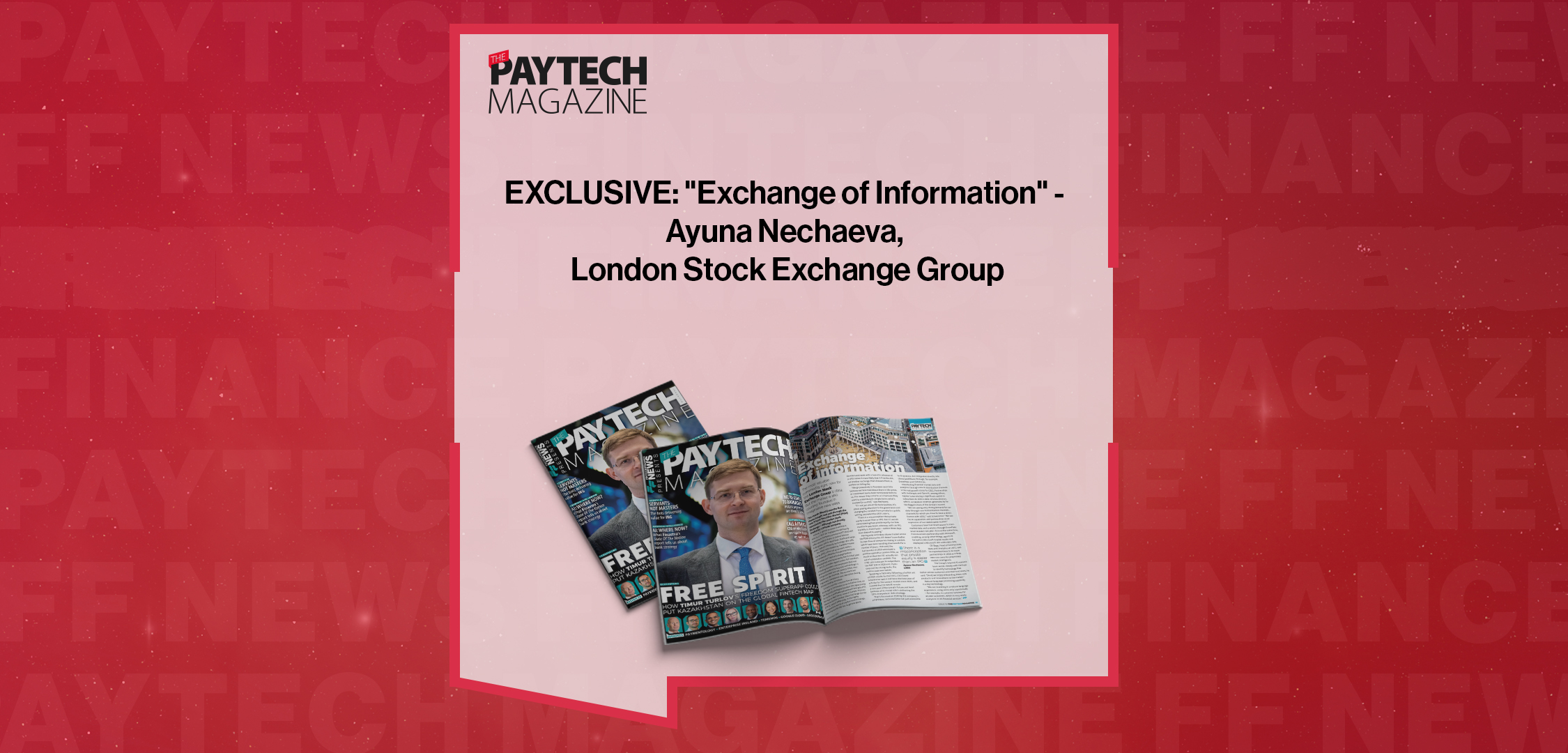
EXCLUSIVE: “Exchange of Information” – Ayuna Nechaeva, London Stock Exchange Group in ‘The Paytech Magazine’
The most valuable commodity right now for the London Stock Exchange Group is data. But the market is also courting founders in imaginative new ways
This month (March) sees the first shares bought and sold through the new Private Securities Market (PSM) operated by the London Stock Exchange – although not directly traded by a private company.
Instead, a special purpose investment vehicle, a TPEIC (or Tradable Private Equity Investment Company, pronounced T-pick) will offer secondary shares in Oxford Science Enterprises, which itself finds, funds and helps scale Oxford University technology spin-offs. The TPEIC was created by Tradable Private Equity (TPE), a firm set up to work within a framework called the Private Intermittent Securities and Capital Exchange System (PISCES) that was launched by the FCA last year.
PISCES provides opportunities for investors, including founders and employees (but not general investors) to buy and sell holdings in companies that are not publicly listed, over platforms like the PSM. The auctions are regulated, transparent and take place during limited trading windows. It seems counterintuitive for a primary exchange to be involved in an initiative that, on the face of it, could give founders the opportunity to run for a profitable exit without having to IPO.
But Ayuna Nechaeva, Head of Europe, Primary Markets for the London Stock Exchange Group (LSEG), sees it differently. In the highly competitive world of capital market listings, any chance the LSE has to get alongside founders and work with a board in advance of an IPO makes it more likely that it’ll be the LSE, not another exchange, that showers them in confetti on listing day.
“We go proactively to founders and CEOs because we have read about them in the press, or investment banks have mentioned them to us. The reason they come to us is because they want to understand in simple terms what’s involved [in an IPO],” says Nechaeva. “It’s not just about the technicalities. It’s about paying attention to the governance and changing the mindset from private to a public setting, and what the CEO’s role is.
“There is a misconception that private equity is easier than an IPO. But it’s worth remembering that private equity can take months to pay down, whereas, with an IPO, liquidity is much faster – within three days from deposit to paying.”
Having only secondary shares traded across the PSM ensures the LSE doesn’t cannibalise its own flow of companies listing in London, which have been trending downwards for a number of years. That said, the last quarter of 2025 witnessed a positive updraft in London IPOs, so much so that the LSE actually ran out of celebration confetti. The FTSE 100 continues to outperform the SNP 500 in 2026 and, if you strip out the US big-techs, the metrics look even better.
“There is a misconception that private equity is easier than an IPO “
Speaking in February, following a bullish set of 2025 results for the LSEG, CEO David Schwimmer said it had been the best year of activity for the London market since 2021, and insisted the LSE would remain a core part of the Group’s future, not least because of its crucial role in delivering the LSEG Everywhere’ data strategy.
That’s focussed on making the company’s proprietary, historical data not just accessible to AI systems, but integrated directly into client workflows, through, for example, Snowflake and Databricks.
Distributing financial market data and analytics through new AI distribution channels is the real growth story for LSEG. Partnerships with Anthropic and OpenAI, among others, appear to be driving a significant uptick in subscribers to LSEG’s data services division, which, at £4billion revenue, generates by far the biggest share of the Group’s income.
“We are seeing very strong demand for our data through new AI distribution channels… channels for which you have to have a direct licence with LSEG,” said Schwimmer. “We see the AI capabilities and partnerships as an expansion of our addressable market.”
Customers have had direct access to LSEG market data and analytics through Snowflake since October last year. Around the same time, it announced a partnership with Microsoft, enabling, among other things, agents to be built in Microsoft Copilot Studio and deployed in Microsoft 365 with LSEG data.
Oli Bage, Head of Architecture, Data and Analytics at LSEG, said he expected there to be more partnerships in 2026 as it finds new use cases for proprietary market intelligence.
The Group’s internal AI research team works closely with startups to identify technology that better serves customers and their end users, he said. “[And] we enjoy onboarding those new products and innovations to the market.”
Natural language processing capability is a key technology.
“We are investing in a natural language experience, using voice-only intentionally – for example, in customer services for 45,000 customers, which is very nearly everyone in UK financial services.”
This article was published in The Paytech Magazine Issue #18, Page 18
Companies In This Post

- EXCLUSIVE: “Exchange of Information” – Ayuna Nechaeva, London Stock Exchange Group in ‘The Paytech Magazine’ Read more
- Bank of Ireland: How Data Is Shaping Smarter Banking Read more
- When Will AI Replace Your Job? Read more
- Black in Fintech Launches Speaker Index as Community Expands With Senior Advisory Board Read more
- Revolut Reports Record Profit of $2.3bn for 2025 as Revenue Surges to $6bn Read more

EXCLUSIVE: “Exchange of Information” – Ayuna Nechaeva, London Stock Exchange Group in ‘The Paytech Magazine’
Share this post: Share on LinkedIn Share on X (Twitter) Share on Facebook Share on […]
EXCLUSIVE: “Irish Eyes on London” – Enterprise Ireland in ‘The Paytech Magazine’
Share this post: Share on LinkedIn Share on X (Twitter) Share on Facebook Share on […]
EXCLUSIVE: “Staying Real” – Ramon Caracas and Debra LePage, Payment Spayce in ‘The Paytech Magazine’
Share this post: Share on LinkedIn Share on X (Twitter) Share on Facebook Share on […]

EXCLUSIVE: “Leaning In and Stepping Up” – Radha Suvarna, Finastra in ‘The Paytech Magazine’
Share this post: Share on LinkedIn Share on X (Twitter) Share on Facebook Share on […]
EXCLUSIVE: “Travelling Light” – Heman Daswani and Sairam Rangachari, Temenos in ‘The Paytech Magazine’
Share this post: Share on LinkedIn Share on X (Twitter) Share on Facebook Share on […]

EXCLUSIVE: “Smart Moves” – Renat Tukanov, Freedom Holding Corp in ‘The Paytech Magazine’
Share this post: Share on LinkedIn Share on X (Twitter) Share on Facebook Share on […]

EXCLUSIVE: “Freedom Calling” – Timur Turlov, Freedom Holding Corp in ‘The Paytech Magazine’
Share this post: Share on LinkedIn Share on X (Twitter) Share on Facebook Share on […]
EXCLUSIVE: “Exchange of Information” – Ayuna Nechaeva, London Stock Exchange Group in ‘The Paytech Magazine’
Share this post: Share on LinkedIn Share on X (Twitter) Share on Facebook Share on […]

Bank of Ireland: How Data Is Shaping Smarter Banking
Share this post: Share on LinkedIn Share on X (Twitter) Share on Facebook Share on […]

When Will AI Replace Your Job?
Share this post: Share on LinkedIn Share on X (Twitter) Share on Facebook Share on […]
Black in Fintech Launches Speaker Index as Community Expands With Senior Advisory Board
Black in Fintech has launched a speaker index to increase the visibility of Black professionals across financial services and fintech
Revolut Reports Record Profit of $2.3bn for 2025 as Revenue Surges to $6bn
Revolut released its Annual Report for the year ending 31 December 2025 is delivering record profitability and global scale as it transitions into a truly global bank
HSBC Announces David Rice as its First Chief AI Officer
HSBC Holdings plc today announced David Rice will be appointed as HSBC’s first Chief AI Officer, effective 1 April.
200 Million More Friends on Venmo – Send Money to PayPal Users Around the World
Venmo announced a major expansion that brings the app's peer-to-peer payment experience to a global audience