A visual and evolving map of 300+ companies and sectors you should know in fintech.
By FF Newsroom · 12 March 2015
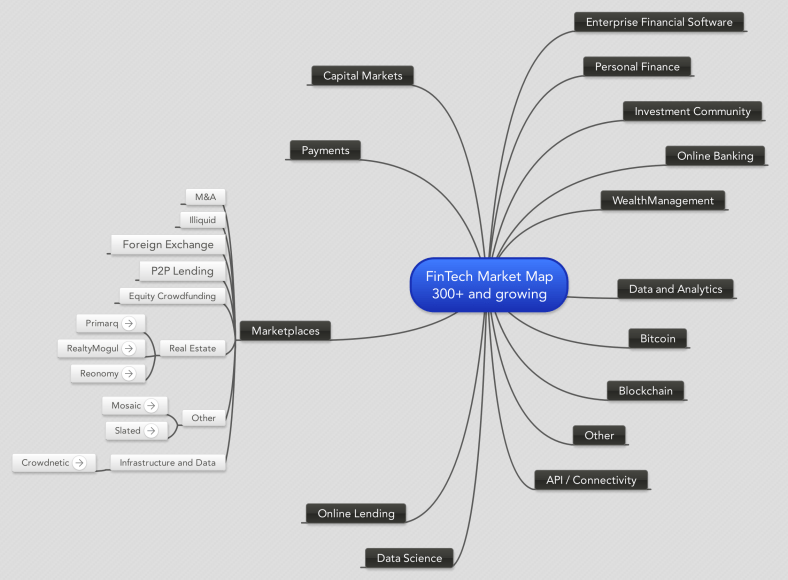
Reuben Levy, a strategist and investor at Bloomberg, has released a comprehensive market map designed to categorize the rapidly evolving fintech landscape. For fintech professionals, this taxonomy provides a necessary framework to navigate a sector that saw venture capital funding double to $5.3 billion last year, signaling a significant shift toward mature, disruptive financial technologies.
What was announced
The new sector map aims to organize a fragmented industry where the term "fintech" is often applied inconsistently. The project defines the sector broadly as technology that either enables or delivers financial services, a definition intended to encompass everything from back-office CRM tools for traditional wealth advisors to consumer-facing robo-advisors. This categorization comes at a pivotal moment for the industry, following the high-profile initial public offerings of Lending Club and OnDeck.
The map highlights several key sub-sectors currently challenging established business models. These include online marketplaces that disintermediate traditional banks, low-cost investment platforms that are attracting assets faster than traditional managers, and branchless banks that provide services at a lower cost. Additionally, the map tracks the rise of new payment technologies focused on enhancing security and customer loyalty. The project is intended to serve as a guide for investors to identify crowded spaces versus emerging opportunities, while helping entrepreneurs find "blue ocean" areas where disparate technologies could be combined into new solutions.
The release notes that traditional financial institutions have already begun to react to these innovations. Some have restarted venture funds or innovation labs to make strategic investments, while others have opted for partnerships. Examples of this trend include RBS referring clients to Funding Circle and Jefferies securitizing loans for CircleBack. The map is presented as an evolving taxonomy that will be updated as the sector matures.
"Fintech is technology that either enables or delivers financial services."
Reuben Levy of Thinking FinTech Blog
The companies involved
Reuben Levy, the creator of the market map and author of the Thinking FinTech Blog, is a strategist, investor, and business leader currently at Bloomberg. His professional background is rooted in corporate strategy and the incubation of new business units, both through organic growth and strategic acquisitions. During his tenure at Bloomberg, Levy played a key role in the launch of the firm’s corporate treasury business and has led several strategic investments and acquisitions.
Prior to his current role, Levy worked in investment banking at Credit Suisse. In that capacity, he executed a variety of initial public offerings, acquisitions, and capital transactions on behalf of technology companies. This dual experience in both traditional investment banking and corporate strategy provides the foundation for the map’s taxonomy. While the map includes notable companies across the fintech spectrum, it is presented as a subjective and evolving view of the most significant players currently operating in the global market.
What this means
The release of this map underscores a growing need for structural clarity as fintech transitions from a niche interest to a systemic force in global finance. The doubling of venture capital funding and the emergence of successful public exits suggest that the industry is moving past its initial "disruption" phase and into a period of institutional integration. As traditional banks move from observation to active participation through innovation labs and strategic partnerships, the pressure is on startups to prove they can scale beyond early adopters. The map highlights that the real competition lies in which business models—particularly marketplaces and branchless banks—can achieve long-term sustainability in a crowded market.