The Architecture of Invisible Compliance: Real-Time Operating Models, Modular Ecosystems, and Risk-Mitigated Core Modernisation | Mambu, ClearBank | The Paytech Show #87
By Ali Paterson · 15 July 2026
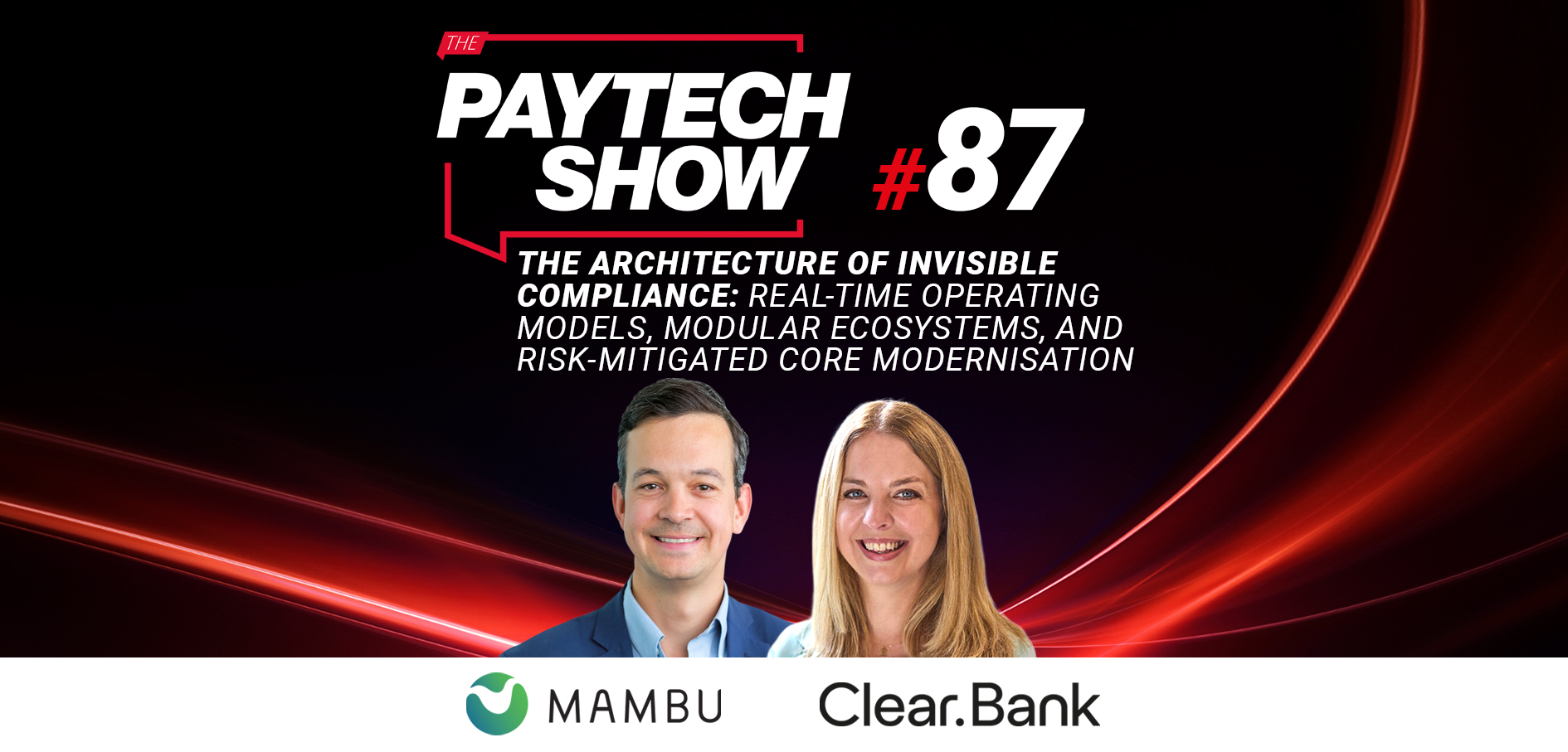
At the FF News Paytech Show, the comprehensive dialogue surrounding global payment infrastructure focused on shifting compliance from a costly operational bottleneck into a commercial differentiator. Emma Hagan, UK Chief Executive Officer at ClearBank, and Victor Mithouard, Senior Strategy & Delivery Director at Mambu, discussed how the modern regulatory landscape serves as an architectural catalyst. By embedding rich data standards and automated clearing protocols directly into cloud-native ledger environments, the collaboration between core engines and clearing rails allows legacy institutions and fintech challengers to scale securely without accumulating technical debt.
1. Reframing Regulation: Evolving Mandates as Operational Catalysts
Financial institutions historically view incoming regulatory updates and structural infrastructure changes as costly compliance hurdles or restrictive operational burdens. However, reframing these legislative mandates through a strategic lens transforms them into massive opportunities to upgrade customer service and lower transaction risk across the financial ecosystem.
When properly leveraged, structural regulatory shifts establish unified baseline standards that directly reduce customer friction, minimise the need for redundant information reporting, and accelerate transaction execution. This systemic transformation mirrors past macro shifts in the UK market, such as the initial rollout of the Faster Payments Service (FPS).
While the radical shift to real-time execution initially triggered widespread operational anxiety, the framework ultimately proved to be completely transformative, fundamentally changing customer expectations regarding transaction velocity. Introducing shared data and connectivity rules helps traditional banks and fintech challengers compete on an equal footing while maximising back-office efficiency.
2. The Multi-Rail Transition: ISO 20022 and Real-Time Operating Overhauls
The ongoing global migration to the ISO 20022 messaging standard represents far more than a routine front-end payment processing patch. It forces an absolute, fundamental transformation of a bank’s core financial operating model.
Before the rise of instant payments, pre-existing legacy networks functioned entirely within a batch-processing paradigm. Transaction files were stacked in message queues throughout the working day and cleared all at once during end-of-day operations.
Because modern clearing schemes demand instant, real-time execution, institutions can no longer depend on these delayed, end-of-day batch processing frameworks to perform anti-money laundering (AML) and compliance checks.
As a result, banking networks must completely rebuild how they orchestrate their compliance and risk tracking workflows. Because transactions settle in milliseconds, verification checks must occur instantly.
The primary business benefit of this overhaul is data enrichment. By standardising financial language worldwide, the ISO 20022 format provides the financial system with highly structured, rich transaction data. This uniformity enables banks and fintechs to jointly build lower-risk customer experiences because the system has deep, clear knowledge of both the sender and the payment payload.
3. Explaining Invisible Compliance: Eliminating Platform Tech Debt
To keep pace with instant payment expectations, modern financial infrastructure relies on the concept of invisible compliance. Traditional software setups treat regulatory compliance as a complex, manual "bolt-on" application that runs beside primary banking activities. This approach drains innovation budgets, as internal IT teams must constantly build custom patches whenever industry guidelines change.
The combination of Mambu’s composable core engine and ClearBank’s clearing rails eliminates this operational friction by embedding compliance directly into the primary integration layer. The underlying infrastructure handles the heavy lifting of compliance tracking automatically, keeping it entirely invisible to daily banking operations.
When regulatory requirements or industry practices evolve, the cloud-native ecosystem absorbs the updates automatically without interrupting user services. This continuous, out-of-the-box maintenance allows financial institutions to move away from rigid, single-vendor banking suites and focus their energy entirely on delivering great digital client experiences.
4. Reclaiming Innovation Budgets: Demolishing Legacy IT Cost Centres
Two decades ago, massive banking conglomerates dominated the financial landscape. Backed by multi-billion-dollar global IT budgets, these massive entities possessed the capital required to build complex payment rails and maintain shifting regulatory compliance. However, their immense scale often resulted in a slow status quo that failed to prioritise consumer needs or drive digital innovation.
Modern market metrics show that traditional banks still divert over 40% of their total IT budgets purely into maintaining basic, ongoing compliance. This massive spending acts as an innovation barrier, particularly for smaller, community-focused institutions like regional building societies and mutual lenders. These smaller firms are often the primary drivers of local financial inclusion, but they can easily be crushed by rising regulatory overhead.
The ClearBank and Mambu partnership addresses this capital imbalance by providing a fully managed, "evergreen" compliant software platform. Instead of maintaining expensive, custom compliance code bases, organisations invest in a shared infrastructure once, allowing trusted partners to handle ongoing maintenance and freeing up capital for customer-facing innovation.
To ensure operational security, this multi-vendor approach protects institutions with strict Service Level Agreements (SLAs). By managing exception workflows transparently and resolving production issues under clear parameters, the partnership delivers a secure, flexible platform that helps modern fintech challengers safely disrupt the status quo.
5. Proactive Scale Stabilisation: Securing Fast-Growing FinTech Infrastructure
For fast-growing fintech platforms, maintaining high operational resilience is a core business necessity. When a consumer-facing application expands rapidly, its underlying clearing bank and core ledger must support surging transaction volumes without experiencing performance drops or unexpected system outages. A major system crash damages a fintech's reputation and causes real commercial disruption for consumer and SME accounts.
ClearBank and Mambu prevent these infrastructure strains by building proactive capacity and scale monitoring directly into the foundation of their networks. Rather than treating growth spikes as an operational hurdle, the partnership uses a systematic scalability framework to support expanding networks:
Pre-Emptive Capacity Balancing: Continually analysing system performance levers and transaction metrics ahead of time to expand processing capacity well before future traffic peaks hit the network.
Pre-Configured Interoperability: Designing and testing core integrations for new ISO data formats, tokenised deposits, and stablecoins long before they go live in the mainstream market.
Seamless Shared-Responsibility Scaling: Managing back-end infrastructure updates, network capacity changes, and clearing rules invisibly, keeping system expansions completely transparent to the end user.
By identifying and resolving system blockages in advance, the platform ensures that infrastructure limitations never slow down a fintech's expansion. This invisible stability allows scaling institutions to focus entirely on their community market segments while their infrastructure safely handles the rest.
6. Real-World Modernisation: Phased Migrations in the UK Marketplace
The United Kingdom continues to serve as a mature global benchmark for real-time payment innovation, demonstrating that comprehensive ledger modernisation is entirely achievable for even the most traditional financial institutions. This leadership began over a decade ago with the rollout of the Faster Payments Service (FPS), which continues to handle over 40% of all instant payments globally, significantly outperforming early adoption metrics across the European Union.
This advanced regulatory environment sparked a wave of digital innovation, as native neobanks used these real-time settlement rails to completely redefine the consumer experience. The rapid client adoption of these platforms has placed severe operational pressure on traditional, incumbent financial institutions to modernise their core infrastructure to maintain market relevance.
The next phase of regional growth is centred on a coordinated National Payments Strategy, with both traditional banks and fintech innovators investing heavily in upcoming transformative frameworks to ensure the UK marketplace maintains its competitive edge.
To help traditional institutions transition smoothly without triggering catastrophic system failures, Mambu and ClearBank advocate for a parallel digital sidecar migration methodology. Attempting a traditional "big bang" core overhaul introduces extreme operational risks, as changing a deeply embedded ledger all at once can cause widespread system disruptions and alienate existing clients.
Launching an isolated digital sidecar brand allows legacy institutions to safely capture next-generation demographics while progressively testing modern workflows in a sandboxed environment. Once the new cloud-native infrastructure is completely validated under strict compliance guardrails, the institution can systematically migrate its legacy accounts and decommission older databases step by step.
Key Highlights from Emma Hagan and Victor Mithouard:
Compliance as a Growth Driver: Evolving regulations and unified data baselines should be viewed as strategic commercial opportunities that lower client processing friction and increase transaction velocity.
The Operating Model Overhaul: The ongoing migration to ISO 20022 messages requires institutions to completely replace legacy end-of-day batch processing with real-time, instant anti-money laundering screening.
Eradicating Tech Debt Via Embedded Core Software: Combining top-tier clearing rails with advanced core logic delivers an invisible compliance layer that automatically absorbs regulatory changes, saving the 40% of IT budgets typically consumed by legacy maintenance.
Proactive Capacity Balancing: To protect scaling fintechs from disruptive system outages, the platform tracks infrastructure levers ahead of time to expand processing capacity in advance of market growth.
The Digital Sidecar Migration Path: Deploying an isolated, parallel neo-core allows traditional brands to roll out next-generation mobile banking services safely, eliminating the systemic threats of a single-day core overhaul.