Fintech versus Bank? Not on This Rooftop
By Matthew Burls · 18 September 2026
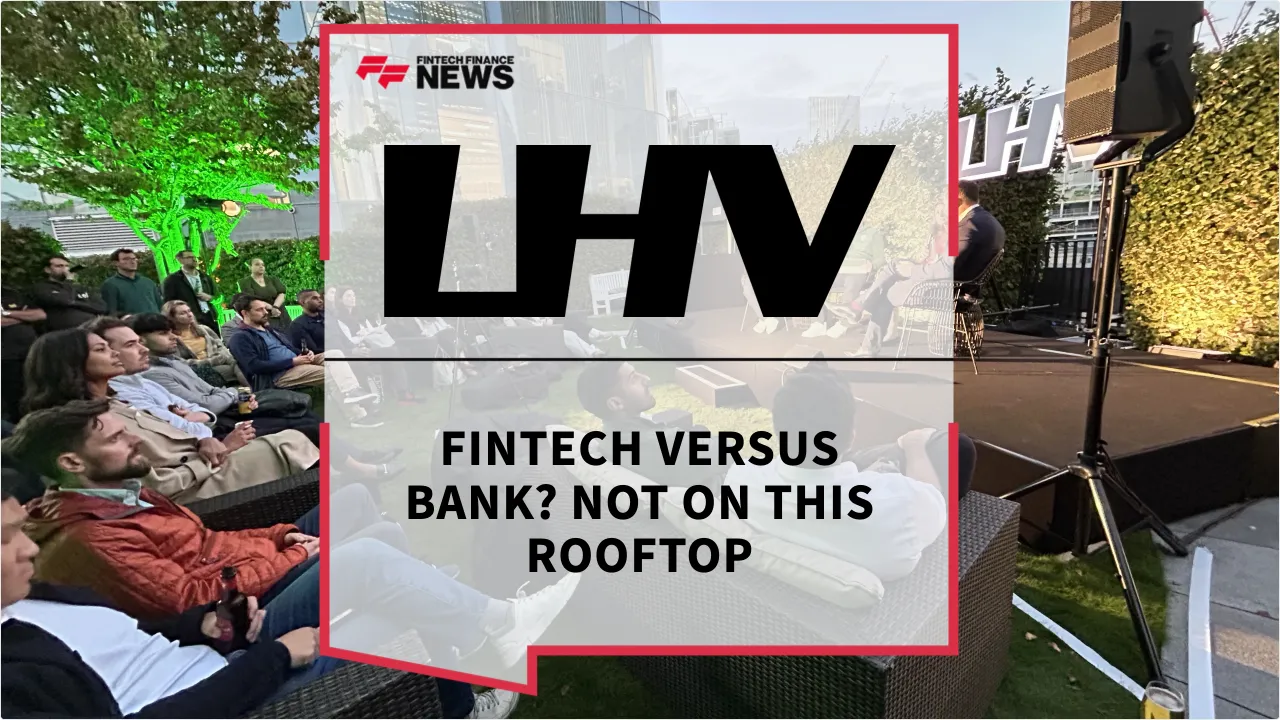
By Matthew Burls, Producer, FF News
LHV Bank's first Match Made in Fintech evening brought Wise Platform and The Payments Shed together to ask whether banking infrastructure is ready for what comes next.
About 24 minutes into Thursday evening's fireside chat at LHV Bank, moderator Grant Evans paused to point out something unusual. Nobody had yet said "stablecoin", and nobody had said "AI". For a payments panel in 2026, that must be close to a record.
The streak ended almost as soon as he mentioned it. That tells you a lot about the evening. The conversation was relaxed and honest, and far more interested in how things actually work than in the latest buzzwords.
The event was LHV Bank's first Match Made in Fintech, the opening night of what the bank plans as a series of partnership-focused gatherings in London. Tom Ronayne, LHV's Director of Banking Services, welcomed the crowd on the roof and made clear what the evening was for.
"It's not a plug for LHV or Wise, although we're both on stage tonight," he said. "It is a very incestuous industry and, you know, it's an opportunity to network."
On stage with him was Roisin Levine, Head of UK and Europe Bank Partnerships at Wise Platform. Wise is a long-standing LHV partner. Grant Evans and Justin Hanna of The Payments Shed recorded a live, panel-style edition of their podcast. The theme was simple: today's banking infrastructure, and whether it is ready for what comes next.
Everyone falls into payments
Evans started by asking both guests how they got into the industry. Levine came from tech sales and the comparison site Uswitch, then moved through lending and retail banking before spending the last five years at Wise working on cross-border payments. Ronayne began at American Express in international payments, spent time in open banking, and joined LHV two years ago.
"Like everyone, I've fallen into payments by accident," he said. When Evans asked the room whether anyone had joined payments on purpose, one hand went up near the front, and even that looked uncertain.
When do you outgrow your bank?
The first segment covered the journey from fintech to e-money institution (EMI), and the point at which relying on someone else's rails starts to hold a business back.
Levine used Wise as the example. The company has spent years getting direct access to payment schemes around the world, including licences with central banks. The reason is control over the customer experience. That doesn't mean Wise has stopped needing banks. "It's more about doing what you're good at and still using partners when it's right," she said.
Ronayne gave the bank's side of the story, and it was refreshingly frank. LHV only banks regulated entities, and both sides invest a lot when an EMI is onboarded. He also noted that the people buying banking services have changed. Decisions are moving from commercial teams to engineers and product leads, who care more about how the service works than about a sales deck.
"Within banks, people can actually go to jail," he said. "So risk appetite is a critical feature which has to be solved for." LHV's response is to be transparent early: showing prospects what onboarding, transaction monitoring and risk appetite actually look like before anyone signs.
Asked when a client has outgrown the relationship, he said it usually comes down to payment volume, which means cost. "We're not a tier one like Citi," he added.
What's standard now, and what's still missing
Ronayne said the bar for what counts as standard keeps rising. Safeguarding, payment rails and APIs are now expected. Instant payments are going the same way, particularly in Europe, where regulation has pushed them hard. He estimated that instant payments have gone from roughly 10 to 15 per cent of volumes to over 30 per cent in the last year alone.
FX is where he sees the biggest gap. "FX is the one piece that's just so underserved," he said, pointing to how hard it is to open up markets such as Japan or Brazil.
Levine said what Wise looks for in a partner is much the same as what it looks for anywhere: reliability, scalability, speed and transparency. She said Wise Platform tries to share more than its infrastructure. It passes on a decade of lessons from its consumer business about what customers actually want, which she said makes the relationship "much more collaborative" than a back-end service.
Build it or partner for it?
Both speakers agreed that banks trying to build everything themselves is a losing strategy. Ronayne expects an interconnected system where banks rely on fintechs and fintechs rely on banks. Levine said many banks are excellent at domestic banking. International payments, with all their regulatory and scheme complexity, are exactly where a specialist partner earns its place.
The conversation then turned to embedded finance, and the risk that consumers start treating platforms like banks. Levine said trust in established banks is still underrated. "I would never downplay that importance of a bank that's been around for many years," she said. She suggested the real winners may be the infrastructure providers that serve both the platforms and the banks.
Ronayne, admitting his bias, backed the banks. "Safeguarding funds and FSCS protection sits with the bank," he said, and the regulation isn't going to change that. If he could change one thing about the industry, it would be the old core systems that still run batch payments and next-day reconciliations. "For me, core banking platforms are the key to the castle."
Levine's one change was international payments that still take days, when customers are used to instant payments at home. About 75 per cent of Wise's payments now arrive instantly, she said, "but that's really difficult to do."
The Shelf of Shame
The Payments Shed always ends with the Shelf of Shame, where guests nominate one thing to banish from the industry. This time the audience voted with a show of hands.
Levine chose the "fintech versus bank" narrative, which fitted the evening's theme. The room was split on it, but Evans declared it banished anyway.
Ronayne went for hype around new payment methods. He said open banking went through it, and stablecoins and agentic payments are going through it now. "They all have very significant and tangible use cases," he said. "But let's not pretend they're going to solve every problem and everyone's mum and granny can buy bread and milk with it." That one passed easily.
Ronayne then sent everyone off to eat and drink. He promised plenty of food and drink but, unlike some previous LHV events, no Europop. If the rest of the series is as candid as this first night, it will be worth getting back up on that roof for.