

Breaking News
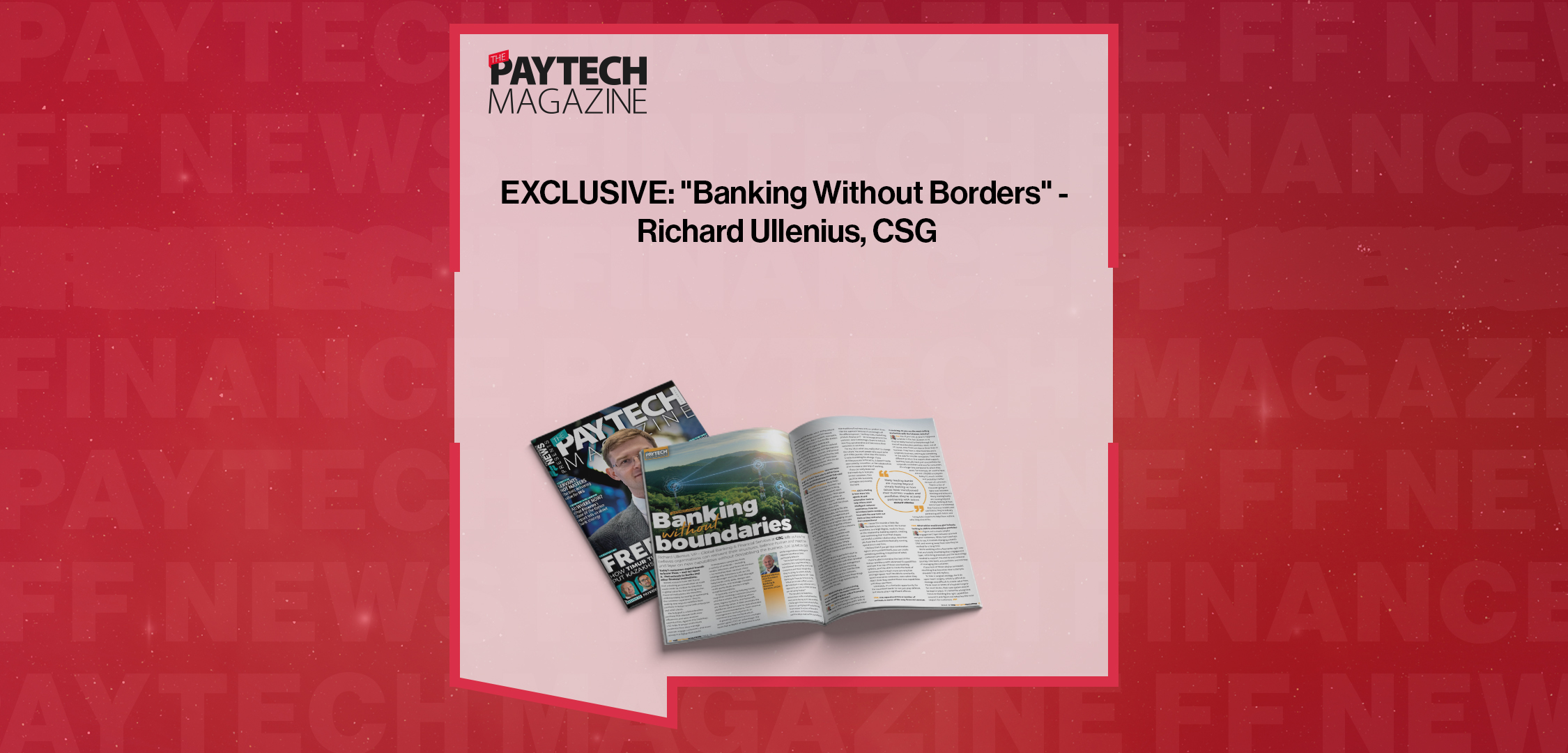
EXCLUSIVE: “Banking Without Borders” – Richard Ullenius, CSG in ‘The Paytech Magazine’
Richard Ullenius, VP – Global Banking & Financial Services at CSG, tells us how he believes organisations can reinvent their structures, balance human and machine, and layer on new capabilities without destabilising the business… just as telcos did!
Today’s customers expect brands to know them – and act upon it. That extends to banks and other financial institutions. Recent research from SBS found that unlocking personalisation at scale could create $1.7trillion to $3trillion in global value for the banking sector. Financial institutions are therefore understandably focussing on optimising the customer experience; they’re seeking new ways to redefine their portfolio to better serve both enterprise and retail clients.
The holy grail is a boundaryless portfolio that releases both new efficiencies and new revenue opportunities. Against this backdrop, CSG helps financial institutions modernise how they manage revenue, engage customers, and move money in a digital-first world.
It empowers companies from a variety of verticals – including media, telecoms, and financial services – to monetise their services more intelligently. Solutions such as CSG Data Manager and CSG Deal Manager help banks unify data, design new= propositions, and manage complex, multi-party deals across a single, simplified portfolio.
It typically starts by helping banks map their existing customer journeys and data estate, identifying where silos, legacy systems, and hand-offs are blocking value. It then provides the platforms and services to operationalise those recommendations, from revenue management and payments to real-time journey orchestration.
A growing footprint across multiple sectors gives CSG an advantage; the team has a depth of experience with similar organisational challenges in adjacent industries to banks, particularly telecoms.
“We’ve been working with various industries for a long time as they’ve transformed the way they service their customers and think through what they’re doing, for whom, and why,” explains Richard Ullenius, VP – Global Banking & Financial Services at CSG. “What we’ve seen is that success is derived from a truly customer-centric approach, and this is where the banks are certainly headed.”
The parallels between telco reinvention as the market liberalised and banks facing up to new neobank challengers have been drawn before. Now, it’s going beyond banks learning from telcos to active collaboration with them, as illustrated by recent partnerships such as the one between Verizon and Santander, which revolves around a co-branded savings account that rewards Verizon customers. Brazil’s Nubank, meanwhile, has teamed up with telco Claro to offer wireless service through its digital banking app.
In a fascinating interview, Ullenius explored how banks can bypass data and organisational silos – across products, channels, and business units – while harnessing AI to deliver the best possible customer journey and move closer to banking without boundaries. Here are the highlights of an absorbing discussion.
THE PAYTECH MAGAZINE: How can banks begin to break down silos to deliver those holistic, personalised experiences that retail and enterprise customers are seeking?
RICHARD ULLENIUS: Many banks say they’re ‘customer-focussed,’ but that’s fundamentally different to being customer-centric. [As a consumer] I don’t think about banking products; I think about experiences. If you’re going to deliver an extraordinary service to anyone – whether company or consumer – you must start there.
The second thing in terms of the transformation journey is bringing the data together. Unified, actionable, real-time data helps banks with revenue management and cost-to-serve, but also with managing risk and compliance. If banks can bring this clean data to the front lines – to the fingertips of those who really need it – they can service customers in a speedier, more proactive manner.
They can design new capabilities with regulation in mind and an emphasis on customer-centricity that will help those customers grow their finances. Simply throwing all the data into one place and hoping that it will transform operations is rarely successful. The third thing you’ve got to do is start to unify the different groups within the bank, which often compete with each other. Whether it’s the lending side or the cash management side, you have to start with harmonising these portfolios. You can then free the data required to properly service customers.
Banks that can combine these three things successfully have a huge opportunity to outcompete the rest.
TPM: What examples of restructuring are you seeing in the market? How are banks reimagining their culture to provide better customer outcomes?
“Many leading banks are moving beyond simply looking at how telcos have transformed their business models and portfolios; they’re actively partnering with telcos”
RU: We’re starting to see banks (and one or two have gone public with it) organising across customer journeys rather than traditional business units or product lines. I like this approach because it encourages all the different groups – be they sales, marketing, product, finance or IT – to converge around the customer. And it encourages them to rethink how they operationalise and best serve their customers in real time.
For me, this is when you really start to change the culture. You want people who want to be part of this journey, rather than the bank’s C-suite mandating the change. If you do it because you’re forced to, it doesn’t really spur curiosity, innovation, or the collaborative drive to create a new way of working.
If you can really tease out that creativity in how you service customers, then you’ll be able to entirely reimagine and revamp the bank.
TPM: CSG is starting to lean more into agentic AI and automation tools to help inform more intelligent customer experiences. How can incumbent banks combine trust with the new tools out there as they restructure their propositions?
RU: I know this sounds a little like The Matrix, but, in my mind, the human workforce, to a large degree, needs to focus on the relationship-building aspects; creating and maintaining that trust that shapes successful customer relationships. And then you have the AI workforce basically running operations in real time.
I believe that if you get that combination right in an incumbent bank, you can create something exciting, irrespective of what customers you serve. If you’re able to combine the best of the human workforce with advanced AI capabilities and layer it on top of those core banking systems, you’ll be able to create the bank of tomorrow that is much more pre-emptive and high-speed. You’ll be able to constantly launch and serve customers, even when they didn’t think they needed these new capabilities until they saw them.
Ultimately, it’s a fantastic opportunity for the incumbent banks to not just play defence, but also to play a significant offence.
TPM: CSG operates across a number of verticals. In terms of the way financial services is evolving, do you see the most striking similarities with the telecoms industry?
RU: Yes. If you look at what’s happened to telcos in the last 10 years or so, they’ve really started to think through that kind of boundaryless portfolio. Most, not all of course, now have just two or three lines of business. They have a retail business and a corporate business, and maybe something on the side for smaller companies. They have different product line experts that support, but they basically have just one portfolio for corporate customers and one for consumers.
It’s a huge step compared to where they were. For example, BT used to have around 150,000 employees; today it’s much nimbler and probably a better servant of customers. There’s a ton of crossover going on right now between banking and telecoms. Many leading banks are moving beyond simply looking at how telcos have transformed their business models and portfolios; they’re actively partnering with telcos and hiring telco experts to help them rethink who they should be.
TPM: What advice would you give to banks looking to shift to a boundaryless portfolio?
RU: Figure out a much simpler engagement layer between yourself and your customers. While that’s perhaps easy to say, it involves changing a bank’s DNA and moving away from how they’ve worked for a long time.
We’re working with a few banks right now that are totally revamping their engagement layer, rethinking processes and the technology needed to support the end-to-end customer journey. One bank, one portfolio, and one way of managing the customer. If you look at those who’ve succeeded, one thing that becomes clear is that you shouldn’t rip and replace.
To take a surgical analogy, don’t do open-heart surgery, which is difficult to manage and difficult to create value from. Think more in terms of a keyhole surgery: for most banks, their core system should be kept in place. It’s lasted for a long time. Focus on building the right capabilities around it and figure out what has the most impact for customers.
This article was published in The Paytech Magazine Issue #18, Page 20-21
People In This Post

Companies In This Post

- EXCLUSIVE: “Banking Without Borders” – Richard Ullenius, CSG in ‘The Paytech Magazine’ Read more
- AutoRek & Microsoft: Reconciliation Becomes Strategic Read more
- ReceiptHero Partners with Peach Payments to Enable Digital Receipts on Printer-Less Payment Terminals Read more
- Aviva Launches Insurance App on ChatGPT Read more
- Clip Now Offers Tap to Pay on iPhone for Merchants to Accept Contactless Payments Read more

EXCLUSIVE: “Banking Without Borders” – Richard Ullenius, CSG in ‘The Paytech Magazine’
Share this post: Share on LinkedIn Share on X (Twitter) Share on Facebook Share on […]

EXCLUSIVE: “Exchange of Information” – Ayuna Nechaeva, London Stock Exchange Group in ‘The Paytech Magazine’
Share this post: Share on LinkedIn Share on X (Twitter) Share on Facebook Share on […]

EXCLUSIVE: “Irish Eyes on London” – Enterprise Ireland in ‘The Paytech Magazine’
Share this post: Share on LinkedIn Share on X (Twitter) Share on Facebook Share on […]

EXCLUSIVE: “Staying Real” – Ramon Caracas and Debra LePage, Payment Spayce in ‘The Paytech Magazine’
Share this post: Share on LinkedIn Share on X (Twitter) Share on Facebook Share on […]

EXCLUSIVE: “Leaning In and Stepping Up” – Radha Suvarna, Finastra in ‘The Paytech Magazine’
Share this post: Share on LinkedIn Share on X (Twitter) Share on Facebook Share on […]

EXCLUSIVE: “Travelling Light” – Heman Daswani and Sairam Rangachari, Temenos in ‘The Paytech Magazine’
Share this post: Share on LinkedIn Share on X (Twitter) Share on Facebook Share on […]

EXCLUSIVE: “Smart Moves” – Renat Tukanov, Freedom Holding Corp in ‘The Paytech Magazine’
Share this post: Share on LinkedIn Share on X (Twitter) Share on Facebook Share on […]
EXCLUSIVE: “Banking Without Borders” – Richard Ullenius, CSG in ‘The Paytech Magazine’
Share this post: Share on LinkedIn Share on X (Twitter) Share on Facebook Share on […]

AutoRek & Microsoft: Reconciliation Becomes Strategic
Share this post: Share on LinkedIn Share on X (Twitter) Share on Facebook Share on […]
ReceiptHero Partners with Peach Payments to Enable Digital Receipts on Printer-Less Payment Terminals
ReceiptHero has announced a partnership with Peach Payments to introduce digital receipt functionality on the latest generation of Digit Go payment terminals

Aviva Launches Insurance App on ChatGPT
Aviva, is launching an app on ChatGPT, helping new customers to obtain an initial home insurance quote in only a couple of minutes

Clip Now Offers Tap to Pay on iPhone for Merchants to Accept Contactless Payments
Clip now enables its customers to seamlessly and securely accept in-person contactless payments with Tap to Pay on iPhone
Mastercard Advances Agentic Payments in Latin America and the Caribbean With Live Transactions Completed Across the Region
Mastercard announced the successful execution of live, end-to-end agentic payment transactions across Latin America and the Caribbean

payabl. Launches Tap to Pay, Helping More Merchants Accept Payments on the Move
payabl. has launched Tap to pay, allowing businesses to accept contactless card payments directly from their smartphones