

Breaking News
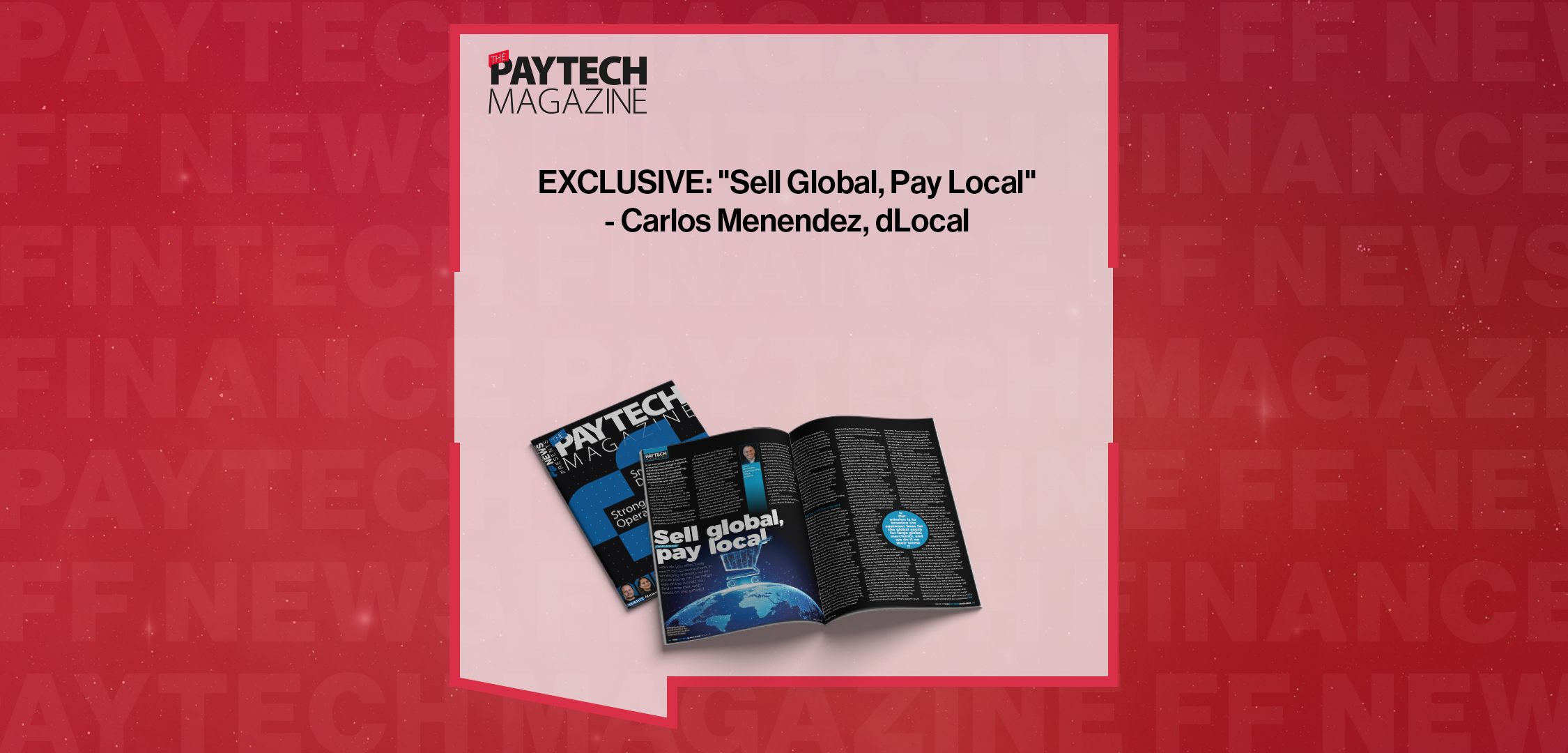
EXCLUSIVE: “Sell Global, Pay Local” – Carlos Menendez, dLocal in ‘The Paytech Magazine’
How do you effectively reach out to consumers in emerging markets when you’re sitting on the other side of the world? You find a provider with boots on the ground
In an ecosystem where Western economies face sluggish growth, shrinking populations, and tightening consumer spending, merchants are increasingly looking beyond traditional markets for new opportunities. The economic vitality that once defined Europe and North America is waning, giving way to emerging markets rich in youth, ambition, and expanding middle classes. At the same time, geopolitical tensions and trade barriers – from tariffs to Brexit – have reshaped global commerce, forcing businesses to rethink where and how they grow.
For merchants seeking the next wave of expansion, the question is no longer why explore emerging markets, but how quickly they can seize the opportunity.
It’s no wonder that those who can, are looking elsewhere. The so-called emerging markets, many of which have enjoyed rapid economic growth, are driven by a younger, expanding population that’s increasingly connected to the global marketplace through their smartphones. For merchants, this combination of youth, technology, and rising disposable income represents a compelling opportunity. And these markets are not just growing and innovating quickly. One of the defining features of many emerging economies is their readiness to adopt new payment methods.
In some cases, this innovation is being steered from the top, with governments actively promoting digital payments as a means to modernise economies and expand financial inclusion. In others, it’s a grassroots revolution, born out of necessity and frustration with limited access to traditional banking. From mobile money in Kenya, to instant payment systems in India and Brazil, new financial rails are transforming the way people shop, save, and move cash.
Payment platform dLocal operates very much in this ‘bottom-up’ space, helping global companies operate and accept payments in emerging markets by handling local payment methods, currencies, and regulations. Through a single API, it allows businesses to sell to consumers in countries in Africa, Asia, and Latin America, simplifying cross-border payments, compliance, and payouts. Founded in 2016, dLocal is a Uruguayan company with offices in London, Madrid, Montevideo, Sao Paulo, San Francisco and Shenzhen, and operates in more than 40 countries.
Its Chief Operating Officer, Carlos Menendez, explains that whilst it is very much a global enterprise, the solutions it offers are, as its name suggests, centred on understanding local markets at a micro level.
“It’s really about how one becomes local and serves global customers,” he says. “We emphasise collaboration with local regulators, embark on local partnerships and ensuring that the right global merchants appeal to local consumers.
“We effectively figure out not just what networks but also what the local payment methods are, which the majority of the country really holds and how we get that connected to the various merchants’ e-commerce sites so consumers in these markets can buy what they want.
“We have more than 700 different integrations around the world and are constantly adding new ones, based on changing consumer and regulatory behaviours.”
Opening an API door on the world
Emerging markets, however, often have fragmented payment ecosystems with unique regulations, currency controls, and a variety of non-traditional payment methods. dLocal’s single platform API allows its clients to bypass the hassle of setting up local entities and integrating with different payment providers in every country. Put simply, merchants can access distant consumers via the payment methods most relevant to them locally – all through a single mechanism.
“We’ve built this extremely powerful global platform and API where once a merchant connects with us in one market, effectively all other markets become available. So, by maintaining the core of the network the same, we can serve everyone through one door,” explains Menendez. “And we know that we also need the local expertise, so we hire local teams, local regulatory experts, local compliance experts, local payments experts to ensure the nuances of a particular market are adapted and served through that API interface.
“When a merchant comes to us, it’s one contract. They sign on to the global API and then they roll out markets as they want. The critical part of our offering is that we are in these markets where the core merchants are located. So, if you’re in China, we’re serving you from a Chinese team. If you’re in Europe, we’re serving you from a European team, etc. And really, it’s about being close to the customer, understanding their needs, understanding their culture and how they want to be communicated with, and then we adapt to them so that merchants can focus on their core business.
“Our mission is to broaden the customer base for the global south for large global merchants, and we do it on their terms”
“Payments are really after the main transaction. And that’s really the value we bring to them. We solve complicated problems and make their life easier so they can sell more.”
Menendez cites Saudi Arabia as an example of the opportunities that exist in the younger, growing economies – what’s often referred to as the ‘global south’. E-commerce revenue in the kingdom is expected to grow at an annual rate of 13.5 per cent through 2027, outpacing the global average. That growth is being fuelled by a tech-savvy population, widespread smartphone use, and a government eager to diversify the economy away from oil.
Stablecoins, says Menendez, offer a powerful bridge to help merchants who are looking to expand into this territory, and overcome long-standing barriers such as high remittance costs, currency volatility, and cross-border payment friction. In September of this year, dLocal joined the Fireblocks Network for Payments, a secure platform that helps large financial institutions and businesses manage and protect their cryptocurrency and other digital assets.
“One of the challenges of cross-border payments – and solving it is actually part of the Saudi Vision for 2030 – is understanding the cost and the time to move money across borders,” says Menendez. “Most merchants are familiar with the one to four working days that Swift can take. Fireblocks and stablecoins provide transfers to get merchants’ money in and out of countries much quicker. And so, we partner with Fireblocks and other companies like the Circle network to facilitate that on-off ramp in local currencies and move the money to merchants.
“Faster payments mean more liquidity. If you run a business, whether large or small, you’re managing your cash flow. Getting paid faster for the goods you’ve sold limits your credit needs, allows you to better manage your balance sheets and effectively makes for a more efficient operation. So merchants are very interested in stablecoin opportunities.”
Payments are indeed evolving faster than ever, and much of the innovation is being driven by necessity in markets where traditional infrastructure simply doesn’t reach everyone. There are proven use cases in card networks around tokenisation, buy now, pay later, and fraud protection – features that many Western consumers take for granted. The next frontier lies in extending that same functionality to local payment methods, effectively democratising financial innovation for the rest of the world.
Take Egypt, for instance. Only a small fraction of the population holds international cards, yet the country has become a hotbed of fintech innovation. Local payment leaders such as Fawry – Egypt’s first ‘zebracorn’, valued at over $1billion, and a dLocal integration partner – have been instrumental in transforming the economy from one dominated by cash to one rapidly embracing digital payments.
According to Thunes, more than 11.5 million Egyptians registered for digital payment services within just two years – a testament to how quickly consumers shift habits when the right tools are available. This rapid transition is not only unlocking new growth for local businesses but also creating fertile ground for global merchants seeking to tap into a connected, youthful population eager for modern payment options.
“The closeness of our relationship with someone like Fawry is really what enables us to operate well in the Egyptian market,” says Menendez. “From a tech perspective, we are going deeper on our offering but also building the future that our merchants and consumers are asking for.
“We basically answer the questions that merchants ask. If they would like to go into stablecoin, we have that. If they want to use AI for fraud protection, for better customer service, we have that. And if there’s a new geography they want to open, all they have to do is ask.
“We broaden the customer base in the global south for large global merchants, and we do it on their terms. That’s our offering. We will meet their needs in any market, and we’re always looking to the future.
“I’m old enough to remember when stablecoins and fintechs offering instant payments were new. Who knows what the next generation will bring? But I always see that desire for more information in the transaction, quicker access to money, and a passion to explore new things. It’s a very different world. We’re very glad to be part of it and building it along with our customers.”
This article was published in The Paytech Magazine Issue #17, Page 24-25
People In This Post

Companies In This Post

- EXCLUSIVE: “Freedom Calling” – Timur Turlov, Freedom Holding Corp in ‘The Paytech Magazine’ Read more
- Nationwide Launches Teacher Accreditation to Boost Financial Education in Schools Read more
- Ant International Becomes Official Sponsor of The Argentine National Football Team Read more
- DNERO Launches Borderless Neobank Powering the Rise of the Latino Economy Read more
- CV5 Capital Builds the Next Generation of Cayman Fund Infrastructure for Digital Assets Read more


EXCLUSIVE: “Freedom Calling” – Timur Turlov, Freedom Holding Corp in ‘The Paytech Magazine’
Share this post: Share on LinkedIn Share on X (Twitter) Share on Facebook Share on […]

EXCLUSIVE: “Optimising the Payments Stream” – Sandra Alzetta, Spotify in ‘The Paytech Magazine’
Share this post: Share on LinkedIn Share on X (Twitter) Share on Facebook Share on […]

EXCLUSIVE: “Opening the Stable Door” – Itai Turbahn, Dynamic in ‘The Paytech Magazine’
Share this post: Share on LinkedIn Share on X (Twitter) Share on Facebook Share on […]

EXCLUSIVE: “RegTech’s Best-Kept Secret?” – Ivan Stefanov, NOTO in ‘The Paytech Magazine’
Share this post: Share on LinkedIn Share on X (Twitter) Share on Facebook Share on […]
EXCLUSIVE: “Sell Global, Pay Local” – Carlos Menendez, dLocal in ‘The Paytech Magazine’
Share this post: Share on LinkedIn Share on X (Twitter) Share on Facebook Share on […]

EXCLUSIVE: “The Future of Borderless Payouts” – Runa in ‘The Paytech Magazine’
Share this post: Share on LinkedIn Share on X (Twitter) Share on Facebook Share on […]

EXCLUSIVE: “Humanising AI” – Paul Provenzano and Pedro Azevedo, ebankIT in ‘The Paytech Magazine’
Share this post: Share on LinkedIn Share on X (Twitter) Share on Facebook Share on […]
EXCLUSIVE: “Freedom Calling” – Timur Turlov, Freedom Holding Corp in ‘The Paytech Magazine’
Share this post: Share on LinkedIn Share on X (Twitter) Share on Facebook Share on […]

Nationwide Launches Teacher Accreditation to Boost Financial Education in Schools
Nationwide is launching a national accreditation for primary school teachers that aims to boost confidence in teaching financial education

Ant International Becomes Official Sponsor of The Argentine National Football Team
Ant International announced a partnership with the Argentine Football Association (AFA), becoming an Official Sponsor of the Argentine National Football Team
DNERO Launches Borderless Neobank Powering the Rise of the Latino Economy
DNERO, a new borderless Neobank, officially launches March 24 to address this gap with a unified digital platform
CV5 Capital Builds the Next Generation of Cayman Fund Infrastructure for Digital Assets
CV5 Capital is positioning itself as the infrastructure layer for the next generation of digital asset fund managers

BankDhofar Introduces Neo Corporate Internet Banking
BankDhofar has announced the launch of Neo Corporate Internet Banking (Neo CIB), a next-generation digital banking platform

iwoca Launches Credit Compass to Help Millions of SMEs Understand and Improve Their Business Credit Score
iwoca is launching Credit Compass - a free tool designed to give every UK SME clear insight into their business’s credit standing