


Breaking News
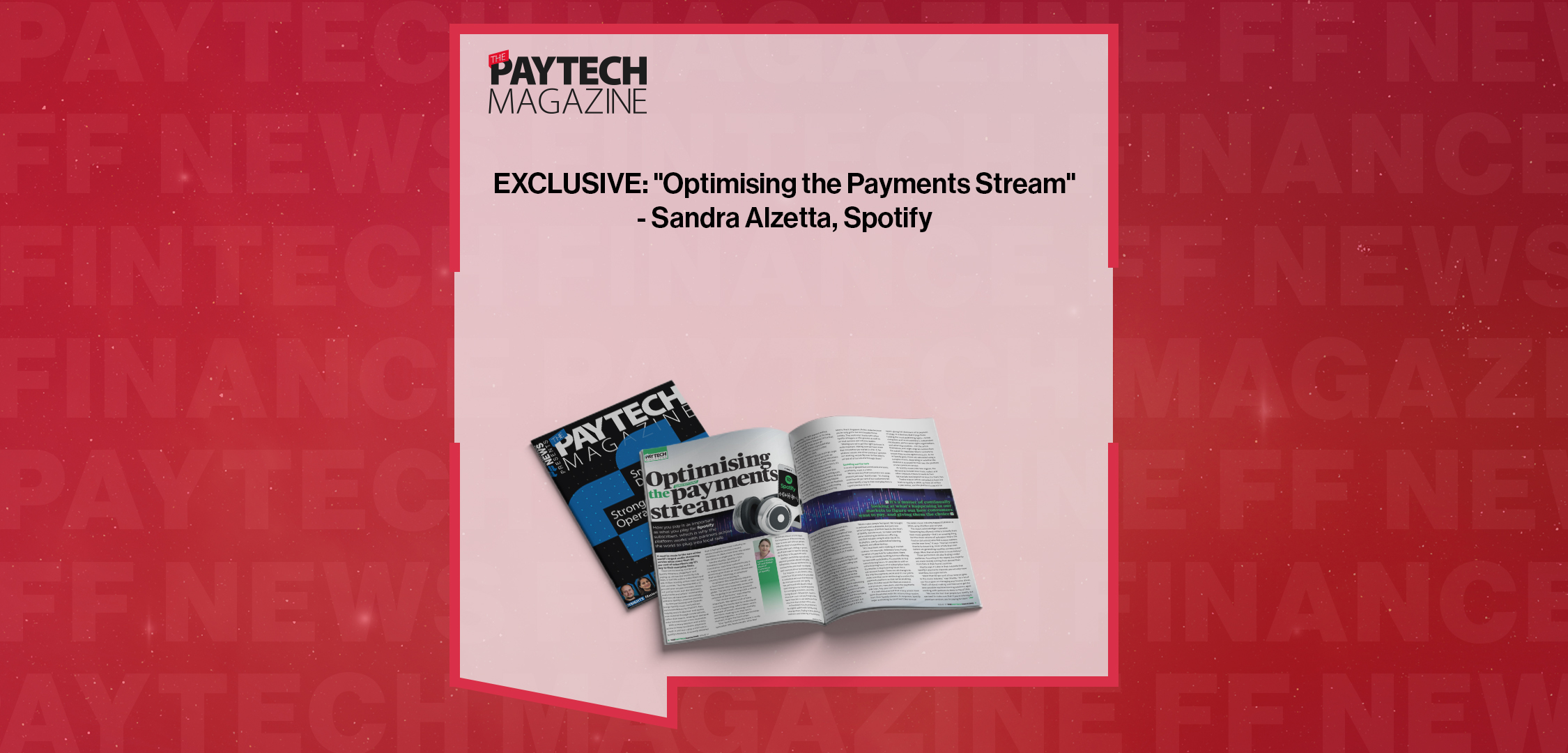
EXCLUSIVE: “Optimising the Payments Stream” – Sandra Alzetta, Spotify in ‘The Paytech Magazine’
How you pay is as important as what you play for Spotify subscribers, which is why the platform works with partners across the world to plug into local rails
It must be music to the ears of the world’s largest audio streaming service when more than 90 per cent of subscribers say it’s key to their everyday lives.
There are increasing numbers of Spotify streamers plugging in and paying up, all over the world. By July 2025, it had 276 million subscribers and 696 million monthly active users across 184 countries. That represented a 12 per cent year-on-year increase, driven not just by music, but also podcasts, audio books and artists’ merchandise that have all have been successfully added to Spotify’s revenue portfolio.
Its new partnership with OpenAI brings Spotify music and podcast recommendations to ChatGPT, too, helping users to discover and queue new material through conversations, rather than search, making on-demand entertainment even more accessible. With so many listeners and artists across so many territories, payments – both in and out – play a vital role in Spotify’s business. It recently declared that it had paid the music industry on which it built its success a record $10billion in 2024, more than any retailer has done in a single year in history.
Sandra Alzetta, Spotify’s Vice President and Global Head of Commerce, says how customers pay is as important as what they play, and it wants to give them as much choice over that as their listening, in whatever country they’re enjoying it.
To achieve this seamlessly requires a ‘laser focus on customer needs’, and those needs vary massively across the globe.
“So you can’t do it by yourself. You’re going to be working with a whole network of partners,” says Alzetta. “The choice of partners is so important. We spend a lot of time scouring the landscape to understand what’s happening, who’s there, who’s the best of breed, choosing carefully, and then making sure that we’re working together, in a true partnership manner, to get the best value.
“Our Spotify payments team is really specialist. We have people who feel passionate about it and totally get the importance of the consumer and how to work well with our partners. Whether they’re in operations, the partnership team, strategy, or product, all of them need to have that desire to be the best in the payments world.”
Spotify’s partnership approach with payment providers started with global behemoths Visa and Mastercard but has evolved to become much more layered and nuanced, driven by customer needs. For instance, in Latin America, where more than 60 per cent of the population is unbanked and more than 90 per cent do not have a credit card, Spotify has partnered with dLocal, a fintech specialising in cross-border payments for emerging economies, since 2020.
Using dLocal’s 360 platform, Spotify’s Premium users can pay through online bank transfers or use cash to purchase vouchers that contain online codes. In Southeast Asia, the preference is for digital wallets with Spotify using, among others, PayPay in Japan, Momo in Vietnam and Kakao Pay in South Korea.
Onboarding the right payment method can significantly drive adoption, as can being flexible about payment frequency, be it annual, monthly, weekly, or pay-as-you-go. In India, subscriptions skyrocketed after Spotify enabled the country’s Unified Payments Interface (UPI).
“Initially, we used it for pay-as-you-go, single transactions. But, as soon as we could, we switched on autopay for recurring transactions. Now, the vast majority of our volume is over UPI,” says Alzetta. “Our Indian users love it. It’s really helped us to expand our market.
“Over in Brazil, we have Pix for one-time payments with Pix Automatic launching soon. We’re working very closely with Banco do Brasil [to enable that] as part of the Early Adopter Programme, providing them with our feedback as we go along, so that they’re really making sure that they’ve got the right recurring solution. We know that, without question, it’s going to help us expand our market.
“UPI and Pix are two great examples of new ways of payments that our consumers love. But others include M-PESA in Kenya, which is responsible for the vast majority of our volume there. And in Nigeria, we use Verve, the local card payment method. Consumers love that. When we switched it on, it made a big difference to us.
“So it’s a matter of continually looking at what’s happening in our markets to figure out how consumers want to pay and making sure that we’re giving them the choice.”
It is not surprising that Spotify is so keen to keep customers happy. Unlike its streaming rivals YouTube and TikTok, which derive the lion’s share of their incomes from advertising, Spotify pulls in almost 90 per cent of its turnover from subscriptions, with its advertising income actually falling slightly in Q2 2025. Acknowledging the huge importance of both retaining and growing its subscription base, Alzetta says it is fundamental that the company stays close to the markets it’s operating in.
“It’s a matter of continually looking at what’s happening in our markets to figure out how consumers want to pay, and giving them the choice”
“Most of my team is based in Europe, but in addition to that, we’ve people in the US, Mexico, Brazil, Singapore, Dubai, India because you’ve really got to live and breathe those markets. They work very closely with other Spotify colleagues on the ground, as well as our local partners and industry bodies.
“Making sure we’ve got the right partners is really important. Making sure we have more than one partner per market is vital. If, for whatever reason, one of our partners’ services isn’t working, we just flip over to the other’s and put all of our volume through there.”
Sounding out the tech
In an era of geopolitical unrest and economic uncertainty, music is a tonic.
“We’re conscious that consumers are under pressure just now,” Alzetta says. “So, having more than 90 per cent of our customers tell us that Spotify is key to their everyday lives is a great position to be in.
“Music makes people feel good. We brought in podcasts and audiobooks, but just now we’re turning our attention back to the heart of Spotify, back to music, to make sure that we’re continuing to evolve our offering, and that includes using AI with the AI DJ, AI playlists, Jam [a collaborative listening feature], and offline backup.
“At a local level, we’re looking at market nuances. For example, Indonesia loves K-pop. So we’ve a K-pop hub for subscribers there.
“We’re constantly building out our offering. So now with audiobooks, it’s possible to buy extra listening hours. It’s possible to add on extra listening hours on a subscription basis. It’s possible to buy listening hours for a sub-account holder. These are all changes to the way the payments work and it’s our job to make sure that we’re continuing to evolve the payments platform so that we’re enabling them. Disaster would be that we invest in new products, new plans, and the payments side says, ‘hey, you can’t do that!’.”
It is well-documented that many artists have been dissatisfied with the returns they receive from their Spotify streams. In response, Spotify began publishing its Loud and Clear annual report, giving full disclosure of its payment strategy. It underlines that it pays those holding the music publishing rights – record companies and music publishers, independent distributors, performance rights organisations, and collecting societies – not the artists themselves, and urges original creators from the outset to negotiate robust contracts to ensure they receive agreed amounts. As far as Spotify goes, those are calculated using a complex matrix, depending on whether the material is accessed for free over the platform or via a premium service.
As Spotify moves into new regions, the demand to include local music makers and other creatives means it needs to find appropriate local payout services for them, too. Twelve million artists uploaded at least one track to Spotify in 2024, up from 10 million a year earlier, and the platform’s payouts to the wider music industry topped $10billion in 2024, up by $1billion year-on-year. The report acknowledges a paradox.
“Streaming has allowed millions to easily share their music globally – that’s an amazing thing. But the sheer volume of uploaders means the fraction [of artists] who find success appears smaller over time,” it says. “The fact remains: thanks to streaming, more artists than ever before are generating royalties at every career stage. More than at any time in music history.”
Those performers are also finding a wider audience. According to the report, the majority see more money coming from abroad than from fans in their home countries. Alzetta says it’s also in their interests that Spotify’s payments channels are not only super seamless, but super secure.
“More than 60 per cent of our revenue goes to the music industry,” says Alzetta. “So a lot of our focus goes on managing any fraud or abuse. That’s all about making sure that we’ve got the best possible machine learning solutions, again working with partners to keep on top of that.
“We love the fact that people love Spotify, but we need to make sure that if you’re listening to premium services, you’re paying for them.”
This article was published in The Paytech Magazine Issue #17, Page 06-07
People In This Post

Companies In This Post

- MPE 2026: Torus on Solving the $13 Billion Card Scheme Fee Problem Read more
- Fire’s Strategy for the Future of Embedded Payments Read more
- Gold IRA “Account Executive” Salesman Tactics Leaked Read more
- NatWest Accelerator Announces New Commitments to Build an Inclusive Entrepreneurial Economy Read more
- Revolut Locks in Paris Headquarters for Western Europe Read more


EXCLUSIVE: “From Philosophy to Production” – Marco Li Mandri, ING in ‘The Paytech Magazine’
Share this post: Share on LinkedIn Share on X (Twitter) Share on Facebook Share on […]

EXCLUSIVE: “Harvesting Trust” – Marnix van Stiphout, ING in ‘The Paytech Magazine’
Share this post: Share on LinkedIn Share on X (Twitter) Share on Facebook Share on […]

EXCLUSIVE: “Beyond The Cloud” – Karen Zhang, Google Cloud in ‘The Paytech Magazine’
Share this post: Share on LinkedIn Share on X (Twitter) Share on Facebook Share on […]

EXCLUSIVE: “Islands in the Real-Time Sun” – George Thomas, Sagicor Bank in ‘The Paytech Magazine’
Share this post: Share on LinkedIn Share on X (Twitter) Share on Facebook Share on […]

EXCLUSIVE: “Line of Vision” – Jeff Parker, Paymentology in ‘The Paytech Magazine’
Share this post: Share on LinkedIn Share on X (Twitter) Share on Facebook Share on […]

EXCLUSIVE: “Banking Without Borders” – Richard Ullenius, CSG in ‘The Paytech Magazine’
Share this post: Share on LinkedIn Share on X (Twitter) Share on Facebook Share on […]

EXCLUSIVE: “Exchange of Information” – Ayuna Nechaeva, London Stock Exchange Group in ‘The Paytech Magazine’
Share this post: Share on LinkedIn Share on X (Twitter) Share on Facebook Share on […]

MPE 2026: Torus on Solving the $13 Billion Card Scheme Fee Problem
Share this post: Share on LinkedIn Share on X (Twitter) Share on Facebook Share on […]

Fire’s Strategy for the Future of Embedded Payments
Share this post: Share on LinkedIn Share on X (Twitter) Share on Facebook Share on […]

Gold IRA “Account Executive” Salesman Tactics Leaked
Share this post: Share on LinkedIn Share on X (Twitter) Share on Facebook Share on […]

NatWest Accelerator Announces New Commitments to Build an Inclusive Entrepreneurial Economy
The NatWest Accelerator Female Founders Community and new strategic partners will help unlock growth for diverse founders across the UK

Revolut Locks in Paris Headquarters for Western Europe
Revolut today announced it has signed a ten-year lease for its Western Europe headquarters at the crossroads of the Bourse district, the historic heart of French finance

Mastercard and Krungthai Card Complete First Live Agentic Transaction in Thailand
Mastercard announced the completion of a pilot that delivered its first authenticated agentic transaction in Thailand with KTC

Finastra and Marketnode Transform Credit Agreement Onboarding Through AI
Finastra announced a strategic partnership with Marketnode to digitize and automate the credit agreement onboarding process for corporate lenders