


Breaking News
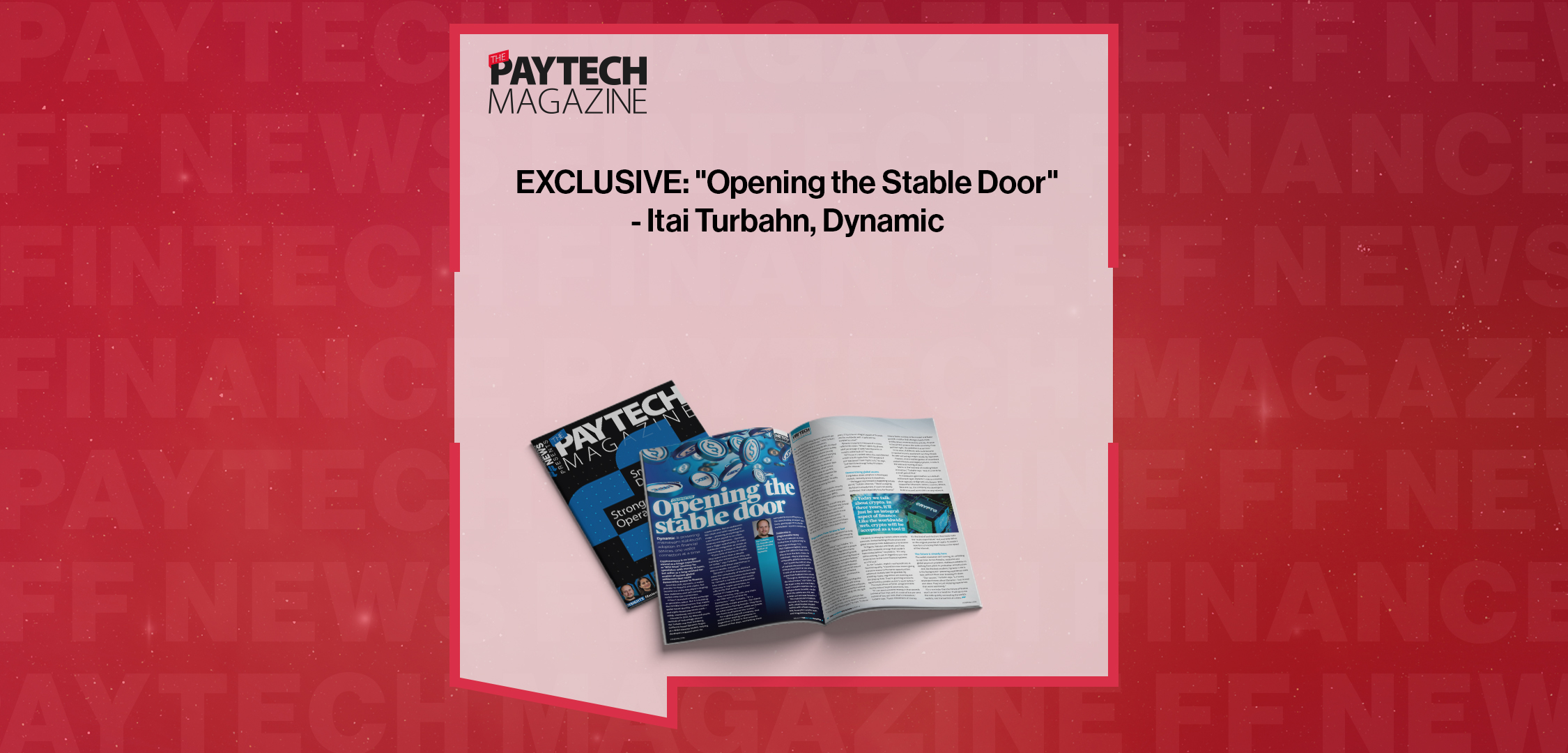
EXCLUSIVE: “Opening the Stable Door” – Itai Turbahn, Dynamic in ‘The Paytech Magazine’
Dynamic is powering mainstream stablecoin adoption in financial services, one wallet connection at a time
Cryptocurrency is no longer viewed as a fringe experiment or ‘Wild West’ territory for speculators with money to burn, but rather as a long-wished-for enabler of instant global settlement that could democratise access to finance. Amid this shift, Dynamic, a wallet provider for fintechs and crypto, has become one of the key players shaping how stablecoins and self-custody wallets enter the mainstream.
It hasn’t launched a flashy exchange or speculative token. But it is building the invisible infrastructure that makes wallet-based identity, authentication and crypto-based payments work – safely, seamlessly and at scale. Founded in 2021 by Massachusetts Institute of Technology alumni Itai Turbahn and Yoni Goldberg, California-based Dynamic began as a Web3 identity toolkit, helping developers onboard users via crypto wallets. But as stablecoins like USDC and USDT exploded in usage – powering everything from cross-border payroll to on-chain treasury management – Dynamic saw a bigger opportunity: to make stablecoin integration as simple as connecting to a Stripe or Plaid API.
“If you look at Venmo or PayPal, they spent more than a decade building the infrastructure they rely on today,” says Turbahn. “Developers can now build those experiences in days or weeks, not years.”
Dynamic’s mission is to abstract away the complexity of blockchain rails using its clever translation technology to convert a variety of crypto assets into usable multi denominational fiat currency in super-quick time, so efficiently that users don’t even realise it’s happening.
“Any currency, any coin, any chain – we take care of all that for businesses,” says Turbahn. “It’s a deceptively simple promise. Our clients are consumer-facing brands. They focus on what customers see, while we handle the hard stuff behind the scenes.”
For a global payroll company, that could mean paying employees in Argentina or Brazil in five seconds instead of five days, and letting them earn yield the moment they receive it. The same plumbing can support digital banks, gaming apps or cross-border marketplaces – anywhere money moves.
Stablecoins as programmable money
The rise of stablecoins as a more trusted form of cryptocurrency has been a game-changer. In its 2025 Stablecoin Playbook, Dynamic argues that stablecoins have a role to play as more than faster, cheaper fiat substitutes – they’re programmable, composable, globally accessible money. And Dynamic has built such a level of sophistication around its wallet infrastructure that it can now combine it with all the accoutrements users expect from traditional bank accounts.
“Through us, developers get not just the infrastructure,” says Turbahn, “but the layers on top that make it easy to build a complete experience. We don’t just give clients the wallet – we give them the code to earn yield, issue a debit card and make transactions.”
This evolution led to Stablecoin Accounts v2, Dynamic’s latest product suite, which bundles compliant wallets with software development kits, know-your-customer hooks, and integrated user flows.
“Visit five sites using Dynamic and you’ll see five different user experiences,” notes Turbahn. “That flexibility makes it mainstream. “It’s not just about building the rails; it’s about standardising the developer experience, so they can focus on creating the customer journey – moving money in or out – without worrying whether the infrastructure can support it.”
Dynamic’s growth mirrors the rise of infrastructure companies like Amazon Web Services, Plaid and Stripe, which turned complex systems into easy-to-use APIs.
“Our win is when crypto companies like Kraken or Ondo can build in days, not years. We’re an invisible enabler,” he adds. “The infrastructure powering the next generation of finance.”
As the crypto ecosystem matures, security is non-negotiable. Dynamic’s unique answer lies in multi-party computation (MPC), a cryptographic approach that splits a private key across multiple parties.
“A wallet is a private key, a secret only you know,” Turbahn explains. “The best way to keep that secret safe is if it doesn’t exist at all.” With MPC, the secret never exists in one place; only when two or more parties communicate can a transaction occur. “If I get hacked,” he says, “the secret isn’t there to steal. You can’t lose what doesn’t exist.”
Regulation: from friction to fuel
Crypto’s relationship with regulation has long been fraught, but for Dynamic, the emerging era of compliance oversight isn’t a constraint – it’s an advantage.
“Regulation is a friend,” says Turbahn. “It’s clarity in the market, setting the rules so people can innovate within them. Regulatory clarity and compliance are critical enablers of growth. The more clarity you have, the more big financial companies enter, the more innovation follows.”
The EU’s MiCA (Markets in Crypto-Assets) framework and the UK’s planned stablecoin legislation – imposing rules such as full reserve backing, where each coin must be backed by a real asset of equal value – are viewed as catalysts rather than obstacles. Dynamic’s infrastructure directly integrates with know-your-customer (KYC), anti-money laundering (AML) and fraud prevention software, allowing fintechs to focus on innovation without regulatory risk.
“It’s about building rails the right way from the start,” he adds. Ask Turbahn what the world will look like three years from now, and he doesn’t hesitate. “Today we talk about crypto,” he says. “In three years, it’ll just be an integral aspect of finance. Like the worldwide web, crypto will be accepted as a tool.”
“Today we talk about crypto. In three years, it’ll just be an integral aspect of finance. Like the worldwide web, crypto will be accepted as a tool”
Dynamic’s long-term measure of success reflects this vision: “When I open my phone, what percentage of apps have Dynamic or a crypto wallet built in?” he asks.
He’ll know it’s landed, when the next Revolut or SoFi is built crypto-first. “It’ll be weird if your app doesn’t have crypto in it,” he says, “just like it’d be strange today if it didn’t use the internet.”
Democratising global access
If regulation drives adoption in developed markets, necessity drives it elsewhere.
“The biggest step forward is happening outside the US,” Turbahn observes. “There’s a saying: the future is already here, it’s just not evenly distributed. That’s especially true for finance.”
He points to emerging markets where volatile currencies, limited banking infrastructure and global commerce make stablecoins a no-brainer.
“In Nigeria, Pakistan and Brazil, you’ll see global-first neobanks emerge that couldn’t have existed before,” he predicts. “It’s very democratising. A user in Argentina can now enjoy access to the same financial systems as a US local.”
So, for Turbahn, crypto’s real benefit lies in financial equality.
“Innovation now means giving everyone access to the same opportunities advanced markets take for granted. By enabling crypto, regulators are evening out the playing field. They’re granting access to opportunities people couldn’t reach before.”
The implications of faster, programmable money extend beyond payments, too.
“If I can send someone money in five seconds instead of five days, and at a cost of 0.1 per cent instead of two per cent, that’s innovation,” Turbahn says. “Faster movement of money means faster activity in the market and faster growth. A dollar that changes hands more quickly drives more economic activity. Finance is the oil that powers the wider economy. If we get that right, the potential is enormous.”
In his view, stablecoin rails could become a macroeconomic accelerant and they should be seen as having a major upside by regulators. Finance, once a walled garden of incumbent vested interests and legacy systems, is now in the wild and moving at pace.
“We’re in the business of enabling future innovation,” Turbahn says. “And it’s cool to be a small part of that.”
As stablecoins gain traction as a default settlement layer, Dynamic’s role as a neutral, chain-agnostic bridge will only deepen. With support for Ethereum, Solana, Cosmos, Bitcoin, Base and Sui, the company lets developers build once and serve users on any network.
It’s the kind of architecture that could make the ‘multi-chain future’ real, and help deliver on the original promise of crypto: to create a new form of money that moves at the speed of the internet.
The future is already here
The wallet revolution isn’t coming, it’s unfolding in real time. Across fintechs, neobanks and global payment providers, stablecoin adoption is shifting from pilots to production infrastructure. And, like the best enablers, Dynamic’s role is in the background – powering experiences users love, without them ever knowing it’s there.
“Our success,” Turbahn says, “is if every developer knows about Dynamic – but no end user does. They’re just enjoying experiences that work seamlessly.”
It’s a reminder that the future of finance won’t arrive in a headline. It will do so via the code quietly connecting the world’s wallets, one transaction at a time
This article was published in The Paytech Magazine Issue #17, Page 35-36
People In This Post

Companies In This Post

- WeFi Group CEO Maksym Sakharov: Crypto’s Future Depends on Payments Read more
- nCino Appoints Keith Kettell as Chief Revenue Officer to Lead Next Phase of Growth Read more
- Legacy Payments Are Failing Businesses: 9 in 10 See Commercial Variable Recurring Payments as the Way Forward Read more
- Feather Insurance: From Overwhelm To Resilience, Most Expats Face A Relocation Reality Check Read more
- Insurtech Koala Wins New Airline Partnership With Volotea Read more
EXCLUSIVE: “From Philosophy to Production” – Marco Li Mandri, ING in ‘The Paytech Magazine’
Share this post: Share on LinkedIn Share on X (Twitter) Share on Facebook Share on […]

EXCLUSIVE: “Harvesting Trust” – Marnix van Stiphout, ING in ‘The Paytech Magazine’
Share this post: Share on LinkedIn Share on X (Twitter) Share on Facebook Share on […]

EXCLUSIVE: “Beyond The Cloud” – Karen Zhang, Google Cloud in ‘The Paytech Magazine’
Share this post: Share on LinkedIn Share on X (Twitter) Share on Facebook Share on […]
EXCLUSIVE: “Islands in the Real-Time Sun” – George Thomas, Sagicor Bank in ‘The Paytech Magazine’
Share this post: Share on LinkedIn Share on X (Twitter) Share on Facebook Share on […]

EXCLUSIVE: “Line of Vision” – Jeff Parker, Paymentology in ‘The Paytech Magazine’
Share this post: Share on LinkedIn Share on X (Twitter) Share on Facebook Share on […]
EXCLUSIVE: “Banking Without Borders” – Richard Ullenius, CSG in ‘The Paytech Magazine’
Share this post: Share on LinkedIn Share on X (Twitter) Share on Facebook Share on […]

EXCLUSIVE: “Exchange of Information” – Ayuna Nechaeva, London Stock Exchange Group in ‘The Paytech Magazine’
Share this post: Share on LinkedIn Share on X (Twitter) Share on Facebook Share on […]
WeFi Group CEO Maksym Sakharov: Crypto’s Future Depends on Payments
Share this post: Share on LinkedIn Share on X (Twitter) Share on Facebook Share on […]
nCino Appoints Keith Kettell as Chief Revenue Officer to Lead Next Phase of Growth
nCino, Inc announced the appointment of Keith Kettell as Chief Revenue Officer, effective April 1.

Legacy Payments Are Failing Businesses: 9 in 10 See Commercial Variable Recurring Payments as the Way Forward
GoCardless found that with the upcoming introduction of commercial Variable Recurring Payments in industries such as utilities, financial services, and telcos are poised to significantly reduce lost revenue

Feather Insurance: From Overwhelm To Resilience, Most Expats Face A Relocation Reality Check
Feather's Relocation Reality Check examines the pressure points expats face in their first year abroad

Insurtech Koala Wins New Airline Partnership With Volotea
Koala has partnered with European airline Volotea to deliver a suite of modern, customer-centric insurance and passenger protection solutions
BPC Launches Essential Guide to Help Banks Power Merchant Networks with SoftPOS
BPC has published a comprehensive guide to help banks and financial institutions deploy SoftPOS technology to expand merchant acceptance

Quadient Collaborates with Lush Cosmetics to Transform Accounts Payable Operations with its AP Automation Software
Lush UK has selected Quadient’s Accounts Payable (AP) automation software to modernise and streamline its finance operations