

Breaking News
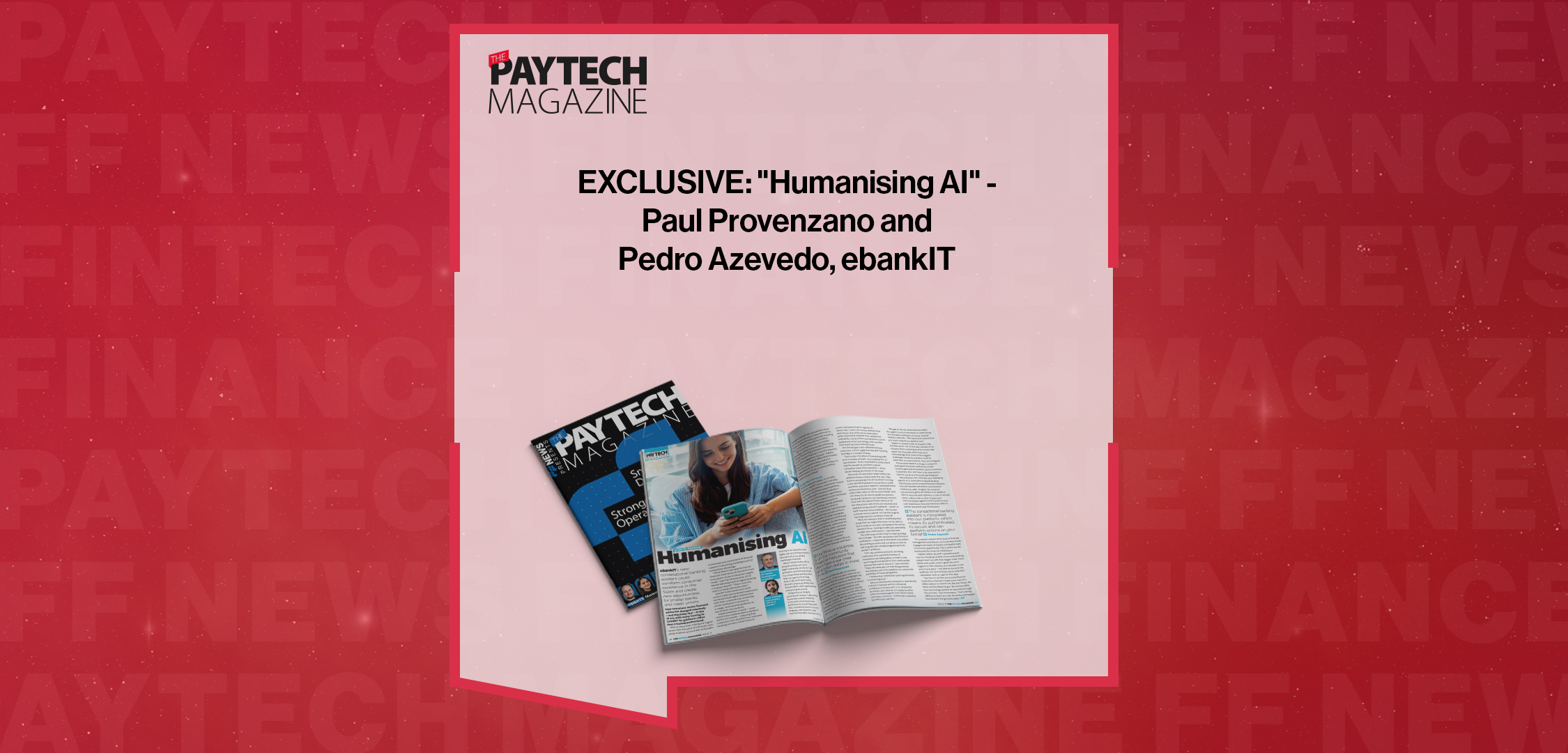
EXCLUSIVE: “Humanising AI” – Paul Provenzano and Pedro Azevedo, ebankIT in ‘The Paytech Magazine’
ebankIT’s new conversational banking assistant could transform consumer experience in the States and create new opportunities for smaller banks and credit unions
How consumers access financial advice has changed massively – and massively fast – in the AI era, with many turning to ChatGPT for guidance rather than a trusted professional. With so many now making the ‘digital human’ their first point of call, banks’ own ability to deliver accountable, actionable humanised and conversational financial support is becoming a battleground for competitive advantage.
“I think there’s the opportunity for financial institutions to transition from transaction mode to financial insights mode,” says Paul Provenzano, VP of Market Development at digital banking company ebankIT. “That’s how this starts to really add more value.”
ebankIT helps banks and credit unions create personalised experiences and build meaningful relationships with their customers by combining all the institution’s services in a single, omnichannel platform on top of their core systems.
Implementation is quick – some clients have implemented a platform within six months – meaning that customers soon benefit from improved banking services, while financial institutions can future-proof their digital sales by launching new products selected from an ever-growing marketplace of partners. ebankIT’s latest solution, offered alongside existing tools such as digital onboarding, security and fraud prevention, and marketing and sales, is a conversational banking assistant that uses agentic AI technology, built on Microsoft Azure running ebankIT’s proprietary Model Context Protocol (MCP), which together provide enterprise-grade security.
Designed to run alongside conventional chatbots, it offers a more humanised customer experience in line with increasing consumer preference for AI tools that provide fast, summarised answers in natural language, over traditional online searches that often require the user to navigate multiple links and websites; 68 per cent of users now rely on these platforms for research and information gathering, according to a recent report from Bain & Company
“We’re moving from more of a reactive paradigm, where you’re basically automating things like providing information based on a script, to something that’s a lot more proactive, a lot more engagement-focussed,” explains ebankIT’s Chief Product Officer Pedro Azevedo. “The transactional banking assistant is integrated into our platform, which means it’s authenticated, it’s secure and can perform actions on your behalf.”
Integrated and secure
While traditional chatbots run on static datasets, ebankIT’s AI Assistant uses data from across the platform, understands context and intent, and delivers bespoke guidance, while adhering to a financial institution’s specific rules and compliance requirements. It can, for instance, respond to voice commands to move money between accounts, or set up recurring billing; identify redundant subscriptions and advise on which to terminate; and, importantly, help consumers identify potential fraud and take action to protect them while the bank investigates.
“The transactional banking assistant is integrated into our platform, which means it’s authenticated, it’s secure and can perform actions on your behalf”
“Since we’re integrated into the financial institution’s core system, the data that we have access to is dynamic, and because it’s integrated in real time, there’s a lot more financial insight specific to an individual account holder,” Provenzano explains. “So each experience is personalised, based on that customer’s relationship and interaction with their financial institution.”
There are multiple benefits for business customers, too. A user can ask it ‘show me our cash flow for the last quarter and highlight any concerning patterns’ and the AI Assistant can provide insights and relevant business products to support them. Larger organisations with multiple account users can also use it quickly and easily to manage access and set restrictions. ebankIT stresses that the customer remains in control at all times – something which is essential amid ongoing discussion and debate over issues of autonomy and accountability around, and lack of trust in, agentic AI.
Indeed, PwC’s 2025 CEO Survey showed that while 49 per cent of the senior executives polled expected AI to boost their companies profitability, nearly a third reported low trust in deployment of the technology, with another third reporting only moderate trust. This AI trust gap is also reflected among consumers, and it’s a gap that ebankIT is trying to bridge in a number of ways.
“Trust really is the basis of everything with AI on a number of levels, and certainly for us,” says Azevedo. “So it’s important to understand that the ebankIT AI assistant is about instruction rather than execution – we’re always keeping the human in the loop.”
Permission for any action taken within the platform always remains with the user. Take fraud as an example: the AI Assistant can help a user identify fraudulent transactions, prefill any forms required to report it, and point them to where to block their card – but the final action taken relies on the account holder. And if it’s time for the user to speak to a person, the ebankIT platform can seamlessly connect them with the relevant team. Because all the interactions with the AI are retained and auditable on the ebankIT platform – which, in itself, improves accountability – the human customer service adviser can see the original exchange and pick up where it left off.
“What the assistant does is essentially find things that we might otherwise not be able to find so easily on our own, and prepare the entire operation for us – leaving us with just, potentially, a single-click confirmation,” says Azevedo.
The other aspect that is key to helping bridge the trust gap – for both consumers and financial institutions – is that the AI Assistant runs within the existing business and compliance rules as well as guard rails already programmed into ebankIT’s platform.
“Let’s say, excessive amounts are being transacted, or an excessive number of transactions are taking place, or there is any sort of significant deviation from what would be expected with an account,” says Azevedo. “They will eventually run into the guardrails that already exist in the platform to control the possibility of fraud taking place.
“I believe that contributes quite significantly to enhancing trust.”
“Our focus as a business is on the community financial institutions that don’t have a war chest of a billion dollars to invest in AI”
Because the ebankIT assistant is specifically trained to operate within a financial compliance environment, it is inherently bound by rules that do not apply to other voice-prompted agents over which there have been concerns – some even raised by OpenAI’s Sam Altman.
“We get to decide what remains within the agent’s control and where it needs to say, ‘we should be talking to a human instead’,” explains Azevedo. “We have more control than you have using AI as a general tool.”
Speed to market is one of ebankIT’s key benefits as an ‘out of the box’ solution in an industry that’s evolving at often break-neck speed. But Azevedo and Provenzano acknowledge that some of the biggest challenges ahead for vendors could be described as more societal, than technological. Provenzano expects a longer runway for testing for financial institutions to feelcomfortable and competent with AI solutions.
Customers, too, will have to be educated on how to use AI as a financial planning tool. Nevertheless, the ultimate prize offered by agentic AI is more personalised banking experiences and increased financial inclusion, that will benefit consumers and financial institutions alike. Imagine, for instance, you are among the 40 million or so adults in the US who live with dyslexia, or one of around seven million with a vision impairment. Voice-prompted agents could transform your user experience. And any bank that offers it, will be rewarded, says Provenzano.
“It’s created a whole other level of financial management and there’s a formula that shows engagement leads to loyalty and loyalty leads to business opportunity. This is where we see the benefit for financial institutions.”
Indeed, where ebankIT’s greatest power may lie is helping smaller community banking players level up with their bigger rivals. These banks and credit unions, given the trust hygiene in this industry, are between a rock and a hard place – not able to stand on the sidelines, but also anxious not to sully their reputation with an agentic mis-step.
“Our focus is on the community financial institutions that don’t have a war chest of a billion dollars to invest in AI, like the Chases, the BoAs and the Wells Fargos. We are their R&D, their technology partner to help them through this journey,” says Provenzano. “That’s the big difference when you talk about the technologies that ebankIT brings to the table.”
This article was published in The Paytech Magazine Issue #17, Page 28-29


Companies In This Post

- MPE 2026: Würth on Unified Commerce and the Necessity of Frictionless Payments Read more
- MPE 2026: Wolt on Achieving An Invisible Checkout Read more
- How Fintech-Powered Fuel Cards Are Overhauling Fleet Expense Management Read more
- Why Stablecoins Don’t Work Without Boring Infrastructure Read more
- Chubb Names Kevin Rampe Global Head of Claims Read more


EXCLUSIVE: “From Philosophy to Production” – Marco Li Mandri, ING in ‘The Paytech Magazine’
Share this post: Share on LinkedIn Share on X (Twitter) Share on Facebook Share on […]

EXCLUSIVE: “Harvesting Trust” – Marnix van Stiphout, ING in ‘The Paytech Magazine’
Share this post: Share on LinkedIn Share on X (Twitter) Share on Facebook Share on […]

EXCLUSIVE: “Beyond The Cloud” – Karen Zhang, Google Cloud in ‘The Paytech Magazine’
Share this post: Share on LinkedIn Share on X (Twitter) Share on Facebook Share on […]

EXCLUSIVE: “Islands in the Real-Time Sun” – George Thomas, Sagicor Bank in ‘The Paytech Magazine’
Share this post: Share on LinkedIn Share on X (Twitter) Share on Facebook Share on […]

EXCLUSIVE: “Line of Vision” – Jeff Parker, Paymentology in ‘The Paytech Magazine’
Share this post: Share on LinkedIn Share on X (Twitter) Share on Facebook Share on […]

EXCLUSIVE: “Banking Without Borders” – Richard Ullenius, CSG in ‘The Paytech Magazine’
Share this post: Share on LinkedIn Share on X (Twitter) Share on Facebook Share on […]

EXCLUSIVE: “Exchange of Information” – Ayuna Nechaeva, London Stock Exchange Group in ‘The Paytech Magazine’
Share this post: Share on LinkedIn Share on X (Twitter) Share on Facebook Share on […]

MPE 2026: Würth on Unified Commerce and the Necessity of Frictionless Payments
Share this post: Share on LinkedIn Share on X (Twitter) Share on Facebook Share on […]

MPE 2026: Wolt on Achieving An Invisible Checkout
Share this post: Share on LinkedIn Share on X (Twitter) Share on Facebook Share on […]

How Fintech-Powered Fuel Cards Are Overhauling Fleet Expense Management
Share this post: Share on LinkedIn Share on X (Twitter) Share on Facebook Share on […]

Why Stablecoins Don’t Work Without Boring Infrastructure
Share this post: Share on LinkedIn Share on X (Twitter) Share on Facebook Share on […]

Chubb Names Kevin Rampe Global Head of Claims
Chubb announced that Kevin Rampe has been named Senior Vice President, Chubb Group, Global Claims Officer, responsible for global claims management
BPC Launches BPC Payments to Power Digital Commerce and Real-Time Money Movement Across Latin America
BPC has launched BPC Payments, a new business line focused on helping merchants move money instantly across Latin America

PayPal Brings Payment Links to Canva Creators
PayPal Payment Links is now available directly in Canva, enabling 265 million monthly users worldwide to turn any design into a checkout experience