

Breaking News
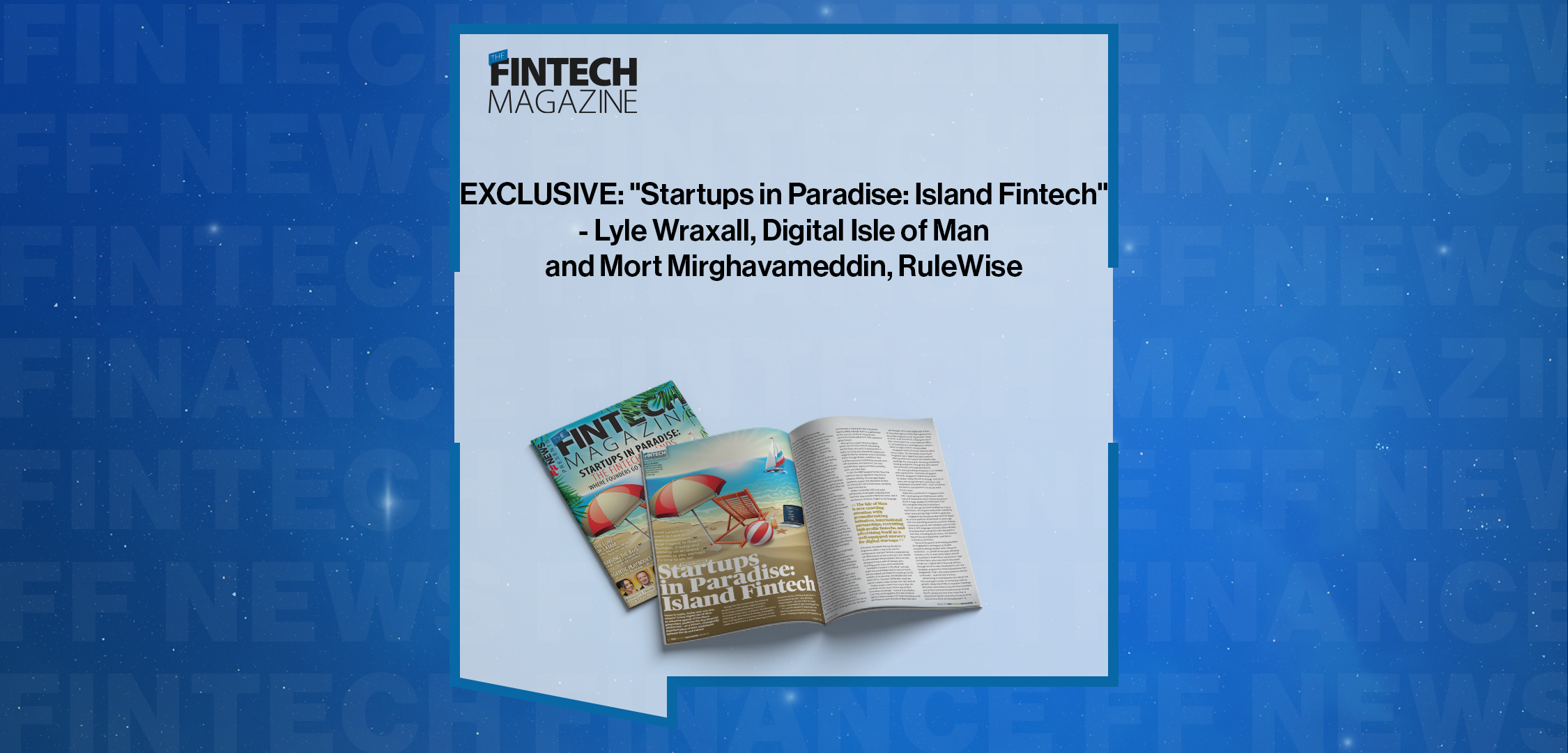
EXCLUSIVE: “Startups in Paradise: Island Fintech” – Lyle Wraxall, Digital Isle of Man and Mort Mirghavameddin, RuleWise in ‘The Fintech Magazine’
Small jurisdictions seem to have a disproportionately large interest in fintech founders. If living and working on an island appeals to you, perhaps it’s time to set sail
‘Home to myths, fairies and, one day, unicorns’ is how Digital Isle of Man, an executive agency of the Manx government, positions this tiny financial services hub – on a historic, strategically important piece of land, equidistant between the UK and Ireland
Flying into the windswept Ronaldsway Airport on a twin-prop Loganair plane, munching complementary Tunnock’s chocolate wafer bars, it doesn’t feel like you’re entering an international money metropolis. But, having taken a conscious decision in the 1980s to shift from a then-faltering economy, based on tourism, fishing and agriculture, to one powered by data – and specifically financial data – the Isle of Man has indeed made a remarkable (if well-camouflaged) shift.
It’s one of a handful of independent isles that have pinned their future to a fintech mast – floating ecosystems with regulatory and fiscal frameworks that encourage outside-the-box thinking. That has led – perhaps inevitably – to some being sanctioned by the international community for a lack of compliance, while even those that work hard to be on the right side of global regulators have struggled to overcome a reputation for opaqueness. ‘Offshore’ has become a shorthand for ‘off limits’.
Increasingly, though, these territories are tempting entrepreneurs to forge their destiny there, not as outliers but as pioneers of a new financial system. That’s particularly, but not exclusively, in the areas of digital assets, cryptocurrency, and blockchain. Many of the new generation of island fintechs are also related to wealth management and life insurance, sectors that have tended to gravitate towards sympathetic island tax regimes and are now creating strong demand for back-office and regulatory tools: onboarding, KYC, workflow automation and reporting solutions.
“Guernsey was a natural fit. The tax environment is helpful for a growing company, but what really made a difference was the regulatory approach”
While the Isle of Man shuns the descriptor ‘tax haven’, the still growing number of family offices, and the discrete presence of more than 70 licensed trust and corporate service providers is a tell-tale sign that extreme wealth is not only welcomed but protected here. It would be foolish to turn capital away today, especially as there is likely to be a lot more of it looking for a home as high earners continue to leave the UK in record numbers. But, like many other jurisdictions whose appeal was once their anonymity, the Isle of Man is now actively courting attention with groundbreaking initiatives such as its new Digital Asset Foundations, international partnerships, recruiting high-profile fintechs, and advertising itself as a well-equipped nursery for digital startups.
It’s generally recognised as a respectable place to do business, governed by a globally-aligned regulatory framework. But the presence of edge technologies, and some high-risk sectors, such as eGaming has caused many of its fellow islands to double down on oversight, which, in turn, is creating new opportunities for regtechs.
Take Malta. A shock greylisting in 2021 by the Financial Action Task Force, which had concerns about the robustness of Malta’s anti-money laundering regime, dented investor confidence in the short term and raised the spectre of correspondent banks de-risking. But the long-term consequence has been to build back better. And that created an innovation gap that fintechs filled. Binderr, which coincidentally won the Isle of Man Innovation Challenge this year, has been instrumental in helping the Malta Business Registry (MBR) redesign itself as a gatekeeper for the country’s financial integrity and ensure the country adheres to AML standards going forward.
Moving from a paper-based to digital system has not only reduced onboarding time for those who want to do business in Malta, but it has also allowed the Registry to integrate APIs for corporate service providers (CSPs). Through Binderr, a platform that matches businesses expanding overseas with CSPs and banks, entrepreneurs can now complete their registry on Malta remotely, and in just a few days.
In fact, the MBR has gone further than the minimum that EU regulators required for company mobility. It’s leveraged digital systems to support the relocation of both EU and non-EU native businesses, including those from the UK. Binderr Co-founder, CEO and serial entrepreneur Jacob Appel, originally from Denmark, now considers Malta his home. And it has plenty in its favour. English is the language of business; the Malta Startup Residence Programme offers a way in for non-EU entrepreneurs and their families; corporate tax can effectively be as low as five per cent, thanks to a shareholder refund system; there are also deep government wells of startup cash, including grants, loans and investment.
And Malta’s location in the Med’ not only makes it a comfortable base to live and work, but also a good launchpad for breaking into EU markets on its doorstep, the Middle East and North Africa. Five-year-old Binderr now has clients in Malta, wider Europe, the UAE and UK. Trophy-seekers came from more than 20 countries for the most recent Isle of Man Innovation Challenge – several from Malta, Guernsey and Singapore, the last of which signed a Memorandum of Understanding on AI development with the Isle of Man last year.
Lyle Wraxall, who leads Digital Isle of Man, an executive agency of the Manx government, describes Singapore as its ‘big brother’ when it comes to AI innovation, helping the Isle of Man inform plans for a new National Office for AI Development and Regulation, which is slated to begin work in January 2026. Singapore itself is the tech island to which others aspire. The Monetary Authority of Singapore has a legendary track record of offering extensive support for fintechs who challenge the status quo, including substantial funding and grants through the FSTI scheme for innovation and experimentation.
The startup/scaleup ecosystem is so crowded with opportunity – Enterprise Singapore, Elevandi, Singapore Fintech Association, incubator Tenity, the API Exchange, Startup SG and a raft of big-hitting FIs with their own established innovation hubs – that sometimes it’s hard for entrepreneurs to decide what to turn down. Regulatory sandboxes in Singapore allow safe, rapid testing and deployment, while robust IP protection and a mature ecosystem attracts huge wadges of investment from VCs and global financial institutions.
You can also get yourself certified as a bona fide fintech, which gives newcomers credibility when approaching larger clients in particular. Singapore has already worked well for Staple AI, a trust platform established six years ago and now operating across 58 countries. It helps companies capture and interpret unstructured data in 300 languages and uses fully auditable AI to keep them compliant with standards in real time, including the EU AI Act, the General Data Protection Regulation, and ISOs in multiple jurisdictions.
“Some of the grants and funding available [in Singapore] is contingent on fintech companies doing a project with a financial institution… so, proofs of concepts delivered to banks or FIs. In that sense, there’s kind of an incentive to make these connections,” says CEO Ben Stein, who relocated to the island to take up a regular job in financial services, through which he was introduced to a VC and incubator programme called Entrepreneur First (Singapore). That’s ultimately where he met his co-founder – and the rest is history.
“Because it’s a small island we have the freedom to try new things”
Networking on and between the islands has time and again proven to be the best path to growth. Many Isle of Man Innovation Challenge attendees were there to tap into the ecosystem, and to find commercial partnerships among the FS companies that drive more than a third of the island’s economy and account for around one-third of all employment.
Extending hands across the seas also helps build a sense of belonging to a special island race of innovators. Wraxall believes the fintech islands can not only add value by working together, but also be bell weathers for wider change – safe petri dishes for experimentation.
“Because we are a small island, we have the freedom to try new things,” he says.
What it chooses to explore is uniquely influenced by both its infrastructure and its environment. The island boasts six Tier 3 data centres and it’s just completing a major fibre network rollout. But while that’s an advantage when positioning yourself as a digital financial hub, it creates a problem if you’re also the world’s only UNESCO Biosphere Nation, recognised for its unique landscape, culture, and commitment to sustainability.
Wraxall admits there’s a contradiction at the heart of the island’s strategic goals, but that’s the beauty of being an innovation super cluster: you can fix it. it’s already attracting players whose core offer is reconciling the digital world’s demand for galactic quantities of energy with protecting the planet, offering itself as a living lab for companies such as Earthscope, which aims to put Nature in the boardroom, and Zumo, a green cryptowallet.
“As a nation, the island is incredibly proud of its Biosphere status,” says Wraxall, a former banker who gave up the bright lights of New York to relocate his family, so they could enjoy a better quality of life. “There’s a real commitment and desire to do the right thing.”
With a landmass of less than 572sq km the Isle of Man is almost 10 times the size of another UK crown dependency that has carved a unique place among the fintech islands. The founders of RuleWise, which helps firms automate compliance tasks, manage risk, and adapt to evolving regulations across multiple jurisdictions, chose to base its operations in Guernsey for a combination of reasons.
“Guernsey was a natural fit,” says Co-founder Mort Mirghavameddin. “The tax environment is helpful for a growing company, but what really made the difference was the regulatory approach.
“Guernsey, along with the other Channel Islands, has recognised the importance of AI and is putting it at the centre of its innovation strategy. [And] Guernsey’s financial sector already has deep expertise in banking, funds, Insurance, fiduciary and wealth management, so many of our potential users were here from day one.
“The Isle of Man is now courting attention with groundbreaking initiatives, international partnerships, recruiting high-profile fintechs, and advertising itself as a well-equipped nursery for digital startups”
“Being close to both clients and the regulator meant the island was an ideal test bed for our proof of concept. We were able to meet people in person, iterate quickly and refine RuleWise, based on direct feedback, which accelerated our development far more than working from a larger city would have.
“The lifestyle aspect also plays a role. The island offers a balanced pace of life, (very) short commutes and a strong sense of community, which helps with retaining experienced people long term.
“There are a few obvious challenges. Travel requires more planning and is very expensive, especially for last-minute meetings in London or elsewhere. The tech talent pool on-island is naturally smaller, so we often have to recruit globally and work in a partly remote model.
“In addition, the ecosystem isn’t as dense as a major city, so networking is more intentional than spontaneous. And costs, such as property, can also be higher.”
So, could RuleWise have launched in London or even Paris?
“It could have, but it would not have been the same,” says Mirghawameddin. “Larger cities have bigger talent pools and easier access to events, but they also come with higher overheads and more complex regulatory pathways.”
Spotlight on the Isle of Man: Pros and Cons of island life
Taxation
Like many smaller jurisdictions, the Isle of Man is famous for its favourable tax regime. Most businesses benefit from zero per cent corporation tax, there is no capital gains tax, and founders pocket more of their hard-earned wealth, thanks to low personal tax taxes.
Financial incentives
The government rolls out a red carpet for founders with a generous Financial Assistance Scheme for capital and operating items for both startups and relocating businesses. And there’s more cash available for relocating employees or hiring graduates. It’s worth noting that the island is now a year into an ambitious programme to train and upskill the entire community in AI, building a network of specialists, and supporting local businesses to adopt the technology.
Regulation
The Isle of Man takes a ‘technology-agnostic’ approach – the activity is regulated, not the tech. It developed regulations around the use of distributed ledger technology and crypto as far back as 2015, and has a Blockchain Office to support businesses, and a government-backed blockchain sandbox. The government has just announced that it’s planning a National Office for AI Development and Regulation to co-ordinate AI activity, manage risks and set direction.
But it’s also about to tighten regulations and enforcement around eGaming, following a rocky few months for the sector.
Local infrastructure & ecosystem
The finance industry accounts for 50 per cent of the Isle of Man’s GDP and it’s the second biggest employer. And if you’re a DLT-based business, there’s a positive buzz. Around 30 blockchain projects have emerged over the past 10 years, including CoinCorner, Unikrn and Qadre. It has six Tier 3, ISO-accredited data centres connected to the mainland by five high bandwidth subsea cables with ‘self-healing technology’ that ensures any fault doesn’t interrupt service. And you’re unlikely to go offline: the island’s gas and green fuel sources generate 200 per cent of peak electricity.
This article was published in The Fintech Magazine Issue #37, Page 22-24




- EXCLUSIVE: “Staying Real” – Ramon Caracas and Debra LePage, Payment Spayce in ‘The Paytech Magazine’ Read more
- AutoRek & Microsoft: Building Resilient & Compliant Finance Infrastructure Read more
- From Zero to 12 Million Customers. A Decade-Long Partnership of GoTyme Bank and BPC Drives South African Digital Adoption Read more
- Africa’s Crypto Market Matures: Fraud Rates Drop by 28% – New Sumsub Report Read more
- SymphonyAI AI Platforms Deployed for Compliance Environment at Munich Re Read more

EXCLUSIVE: “Startups in Paradise: Island Fintech” – Lyle Wraxall, Digital Isle of Man and Mort Mirghavameddin, RuleWise in ‘The Fintech Magazine’
Share this post: Share on LinkedIn Share on X (Twitter) Share on Facebook Share on […]

EXCLUSIVE: “Time to Step Up!” – Tom Bianco, Newline by Fifth Third in ‘The Fintech Magazine’
Share this post: Share on LinkedIn Share on X (Twitter) Share on Facebook Share on […]

EXCLUSIVE: “Agents of Change” – Jon Lofthouse, Citi in ‘The Fintech Magazine
Share this post: Share on LinkedIn Share on X (Twitter) Share on Facebook Share on […]

EXCLUSIVE: “A Healthy Approach to AI” – Renato Rocha Souza, RBI in ‘The Fintech Magazine’
Share this post: Share on LinkedIn Share on X (Twitter) Share on Facebook Share on […]

EXCLUSIVE: “Follow the Yellow Brick Code” – Carmela Gómez, BBVA in The Fintech Magazine
Share this post: Share on LinkedIn Share on X (Twitter) Share on Facebook Share on […]
EXCLUSIVE: “Lift-Off in Barbados” – Marilyn Brathwaite and Jonathan Brathwaite, Payment Spayce in ‘The Fintech Magazine’
Share this post: Share on LinkedIn Share on X (Twitter) Share on Facebook Share on […]
EXCLUSIVE: “A Tough Gig” – Dave Glaser, Dwolla and Jay Millard, Ualett in ‘The Fintech Magazine’
Share this post: Share on LinkedIn Share on X (Twitter) Share on Facebook Share on […]

EXCLUSIVE: “Staying Real” – Ramon Caracas and Debra LePage, Payment Spayce in ‘The Paytech Magazine’
Share this post: Share on LinkedIn Share on X (Twitter) Share on Facebook Share on […]
AutoRek & Microsoft: Building Resilient & Compliant Finance Infrastructure
Share this post: Share on LinkedIn Share on X (Twitter) Share on Facebook Share on […]

From Zero to 12 Million Customers. A Decade-Long Partnership of GoTyme Bank and BPC Drives South African Digital Adoption
GoTyme Bank and BPC are marking a decade-long partnership that has taken GoTyme Bank from the start of the project to 12 million customers in South Africa

Africa’s Crypto Market Matures: Fraud Rates Drop by 28% – New Sumsub Report
Crypto platforms across Africa are rapidly improving identity verification performance as the industry moves toward stricter regulation
SymphonyAI AI Platforms Deployed for Compliance Environment at Munich Re
SymphonyAI supports Munich Re, one of the leading reinsurers, and subsidiaries through its financial crime platform

Zocks Launches AI Assistant for Life Insurance to Help Producers Get Policies Issued Faster
Zocks is bringing its AI-automated operational and document intelligence capabilities to the life insurance market

Allica Bank Named Most Recommended Business Bank by Over 4,000 Businesses
Allica Bank, the bank built for established businesses, has been named the UK’s most recommended business bank in the 2026 UK Banking & Finance Awards