

Breaking News
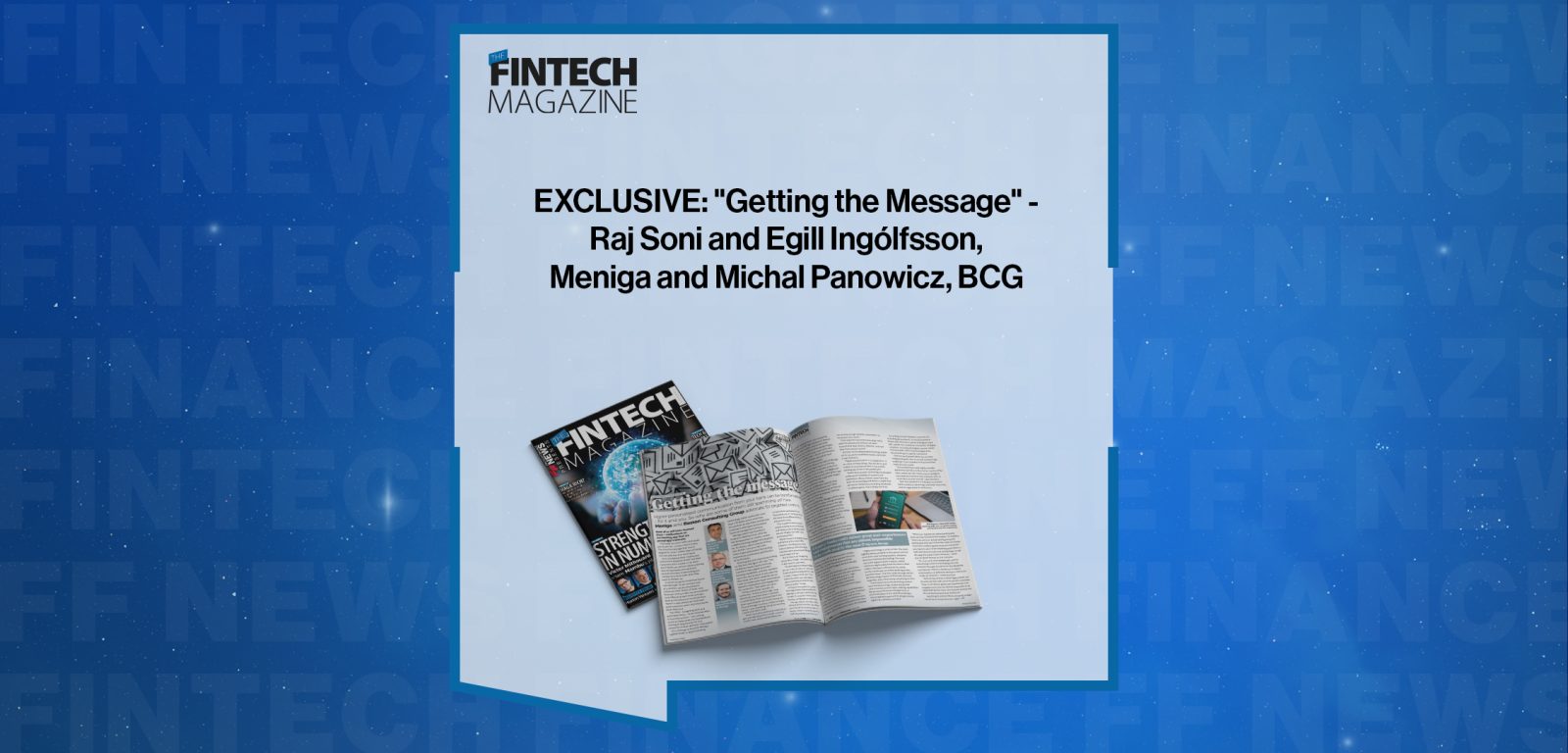
EXCLUSIVE: “Getting the Message” – Raj Soni and Egill Ingólfsson, Meniga and Michal Panowicz, BCG in ‘The Fintech Magazine’
Hyper-personalised communication from your bank can be transformative – for it and you. So why are some of them still spamming us? Here, Meniga and Boston Consulting Group advocate for targeted comms
Most of us will have received them – notifications on our banking app that are annoyingly irrelevant.
The travel insurance offer that lands just as you do… on your return home. The cheerful message that ‘you’re eligible for a loan’ within days of taking one out with the very same bank.
Such unsophisticated, impersonal interactions between banks and their customers don’t endear us to them.
And if banks are serious about evolving from being merely transactional services providers to becoming your money-savvy best mate, then they need to sharpen up. A recent survey by Accenture found that although 72 per cent per cent of customers say personalisation influences their choice of bank, only three per cent actually use personalised tools offered by their main provider, leading the authors to conclude that: ‘there’s a clear disconnect between what customers want and what banks think they want’.
“Too often… budgeting tools and automated alerts – think tailored offers or next-best actions – are coming across as impersonal and standardised, missing an opportunity for true connection in their delivery,” they added.
It’s a message echoed by Meniga, a global leader in digital banking technology, which works with more than 170 banks across more than 35 countries to help them provide their customers with hyper-personalised financial management services.
Meniga, which was founded in Iceland in 2009 but since 2016 has had headquarters in London, created a digital banking engagement playbook for its clients, which consists of three core tenets: turn your data into value; hyper-personalise the banking experience; and harness gamification to build habits.
Stressing the vital importance of doing so, Raj Soni, Meniga’s CEO, says: “The traditional banks need to seriously transform their digital and online banking capabilities, and also capitalise upon the vast amount of user data that they have, and which neobanks do not have, to create super-hyper-personalised dynamic experiences and engagement for customers. That adds real value.”
Citing a personal example, he continues: “A few months ago, I was positively surprised when I received a notification from my bank that I had been spending far too much money on FX and foreign currency-related charges, when I was travelling, using my existing credit and debit cards.
“And I was also positively surprised to get a proposition for a multi-currency credit card, which would allow me to hold various currencies and use that specific card as I commute across the world for my different business and personal needs.
“This is a perfect example where a bank, knowing me as an individual, and having access to my data, added real and tangible value with a very personalised offer.”
Michal Panowicz, Managing Director and Partner at the London office of Boston Consulting Group, which helps its banking clients drive digital transformation and works with Meniga, would agree with that. But he doesn’t see it happening nearly often enough – and certainly not in the countries you’d expect.
“The best digitally developed markets are not in the US or the UK – which are financial and technology centres – but in Spain, Turkey, Poland, India. That’s where the banks have really taken it upon themselves to modernise and execute better,” he says.
In Poland, for example, the country’s first digital bank, mBank worked with Meniga to develop a user-friendly app to help its customers maximise their finances using hyper-personalisation. The app now has 3.6 million active users of which more than two million use it for all their banking needs. It’s clearly a factor in making mBank the fastest-growing in the country. APAC banking leader UOB, meanwhile, has followed Meniga’s playbook to develop a game that enables customers to build a virtual city as they hit their savings targets.
The real-life results were a near 50 per cent rise in monthly users, a 50 per cent reduction in costs per acquisition, and a 60 per cent increase in online transactions.
Egill Ingólfsson, Head of Pre-Sales at Meniga, warns that many legacy banks are missing out on opportunities to sell other products in their portfolios, such as loans, mortgages and savings, because they are not utilising the huge amount of data they hold to get deep insights into their customers’ needs. “Hyper-personalisation is exactly what is missing from a lot of banks and I think incumbent banks can absolutely do more of it to help customers proactively maximise their finances,” he says.
“This is exactly what Meniga’s platform does. It enables banks to create, manage and deliver hyper-personalised information to the right customer in the right context at exactly the right time, in real time. Banks that use it are getting up to 30 per cent increase in cross-selling and a huge boost to their engagement.”
“Legacy banks could deliver great user experiences and engagements that are almost impossible to be replicated by the neos “
But there still appears to be a failure to grasp the nettle. Ingólfsson gives the example of one UK incumbent that recently carried out a trial of the personalisation and sophistication of its digital communications where customers judged to be less financially literate received a simpler dialogue in their banking app and vice versa. But after the trial showed that customer satisfaction barely budged, the bank decided not to pursue it.
“Of course, you must trial a use case before running with it, make sure it fits your customer base and the market that you’re in,” says Ingólfsson. “But make sure that it’s not generic and superficial personalisation,
because that’s going to have minimal impact on the customer.
“Another example of where personalisation is not done well is where banks spam irrelevant offers and information that’s not useful to customers, and particularly to customers who don’t want these push notifications and these insights. At the same time, banks are probably not sending enough valuable information to the people who need it.
“Truly impactful personalisation digs really deep into behavioural patterns of users’ transactional data, historic, forecast, and real time, from various sources.”
Complex and multilayered technology stacks are no excuse for established banks not to do it, says Panowicz.
“Digital transformation is a loaded term. It can mean so many things. But we like to boil it down to one practical test. Is my mobile banking app a bank in the pocket yet? Banks have complex technology landscapes, composed of hundreds of systems and applications. Many of them come from the layers of archaeology and there’s a myth that we need to modernise everything wholesale to make progress. That’s simply not true.
“Legacy technology is a fact of life. The most digitally advanced banks on the planet still run on on-prem core banking systems. However, they have mastered decoupling. The most successful digital transformations, where customers legitimately have the bank in their pocket, have been achieved by focussing on the mobile app and online banking as the transformation. That then pulls through across the technology clusters of the bank, but very surgically, rather than doing everything at once.
“These banks focus on providing modern front-end technology, modernising their omni-channel services layer, adding capabilities like personal financial management, a personalisation stack, and then taking a very pragmatic approach to progressively digitising customer journeys.”
According to both Panowicz and Soni, AI, including generative AI, is transformative in these roles. Panowicz points to Belgium bank KBC, which has created an ‘ecosphere’ of digital solutions, including its hugely popular virtual assistant Kate, which has leveraged AI to become the go-to app for customers. Turkish bank Garanti BBVA has recently integrated genAI into its virtual assistant Ugi, enabling a more intuitive and personalised experience for users.
“The predominant and highly valuable application [of AI] is in the contact centre of the bank, where we can create a very intelligent, very relevant machine that interacts with us much like a human would,” says Panowicz.
Soni also believes AI could give incumbent banks a distinct advantage over their neo rivals, and he urges them to embrace it.
“When you log into an online banking app, there are two fundamental models,” he explains. “One is to carry on doing banking using the dashboards that you’re familiar with, but banks could also create a genAI wrap-around where you log into your online banking application in safe and secure mode and simply begin to ask the app the state of your finances – what you’ve spent money on, for instance.
“As more and more people get used to consuming content and finding info and research through AI platforms like DeepSeek and OpenAI, there’s a tendency to expect consumption of different services in the same mode as ChatGPT,” continues Soni. “And on top of that is what legacy banks can do with all their data around specific customers. They could deliver great user experiences and engagements that are almost impossible to be replicated by the neos who lack the history and the context around that individual.”
Anything to silence those annoying nudges has to be an improvement, right?
This article was published in The Fintech Magazine Issue #35, Page 52-53
People In This Post


- EXCLUSIVE: “Travelling Light” – Heman Daswani and Sairam Rangachari, Temenos in ‘The Paytech Magazine’ Read more
- AutoRek & Microsoft: Unlocking Value from Manual Processes Read more
- 82% of Insurers Say AI Will Define Their Future, But Only 14% Have Integrated It Read more
- Ripple Deepens Commitment to Brazil with Expanded Payments Offering, Growing Customer Momentum and VASP License Application Read more
- Colombian Fintech TumiPay Appoints Karina Sensebé as Regional Country Manager for Latin America Read more


EXCLUSIVE: “Travelling Light” – Heman Daswani and Sairam Rangachari, Temenos in ‘The Paytech Magazine’
Share this post: Share on LinkedIn Share on X (Twitter) Share on Facebook Share on […]

EXCLUSIVE: “Smart Moves” – Renat Tukanov, Freedom Holding Corp in ‘The Paytech Magazine’
Share this post: Share on LinkedIn Share on X (Twitter) Share on Facebook Share on […]

EXCLUSIVE: “Freedom Calling” – Timur Turlov, Freedom Holding Corp in ‘The Paytech Magazine’
Share this post: Share on LinkedIn Share on X (Twitter) Share on Facebook Share on […]

Track Website Traffic When Establishing New Organic Content
Share this post: Share on LinkedIn Share on X (Twitter) Share on Facebook Share on […]
European Fintech Blackcat Launches Multi-Wallet App Combining Euro and Crypto Accounts, Completing Rebrand
Share this post: Share on LinkedIn Share on X (Twitter) Share on Facebook Share on […]

Gamification in Capital Markets: Why Structured Trading Challenges Are Becoming the New Training Ground for Traders
Share this post: Share on LinkedIn Share on X (Twitter) Share on Facebook Share on […]
Digital Self-Control: How Technology Is Helping Users Avoid Costly Mistakes
Share this post: Share on LinkedIn Share on X (Twitter) Share on Facebook Share on […]
EXCLUSIVE: “Travelling Light” – Heman Daswani and Sairam Rangachari, Temenos in ‘The Paytech Magazine’
Share this post: Share on LinkedIn Share on X (Twitter) Share on Facebook Share on […]

AutoRek & Microsoft: Unlocking Value from Manual Processes
Share this post: Share on LinkedIn Share on X (Twitter) Share on Facebook Share on […]

82% of Insurers Say AI Will Define Their Future, But Only 14% Have Integrated It
New research from AutoRek finds that 82% of insurers believe AI will dominate the industry’s future,
Ripple Deepens Commitment to Brazil with Expanded Payments Offering, Growing Customer Momentum and VASP License Application
Ripple announced a major expansion of its presence across Brazil — marking a new chapter of institutional digital asset adoption

Colombian Fintech TumiPay Appoints Karina Sensebé as Regional Country Manager for Latin America
TumiPay announced the appointment of Karina Sensebé as Regional Country Manager for Latin America

Denise Johansson Takes the Reins as Sole CEO of Enfuce as Company is on Track to 10x Revenue by 2030
Enfuce today announces that Denise Johansson has taken the reins as sole CEO, as the company advances its ambition to become Europe’s number one issuer processor

FirstRand Bank First to Advance Blockchain Treasury Management in South Africa With Kinexys by J.P. Morgan
FirstRand Bank has set a new benchmark in South Africa for treasury managemen by leveraging Kinexys Digital Payments, for programmable, 24/7, near real-time payment transactions