One-Third of Retail Banking Revenues at Risk
By FF Newsroom · 19 August 2015

The lack of digitization of the lending process by traditional banks is putting as much as one-third of retail banking revenues at risk, according to Bain and SAP.
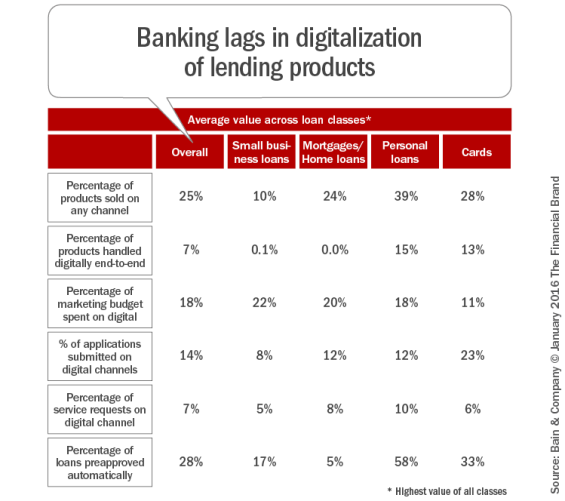
Most of the banking industry’s early efforts to digitize the consumer experience has focused on transactional services such as deposit accounts and credit cards. Much less effort has been spent on more complex services, such as lending, insurance, investments and small business. A study by Bain & Company and SAP entitled, Retail Banks Wake Up to Digital Lending, found that the majority of banking organizations have only digitized a small portion of the overall lending process. For instance, banks can handle only 7% of products digitally from end to end. By not responding to fintech challenges in lending, more than one-third of retail bank revenues are at risk. In a year-end analysis of the top 25 fintech start-ups in the US by Let’s Talk Payments, six firms were leaders in providing lending services, focusing on providing an enhanced consumer experience through simplicity, specialized solutions and better pricing. The firms mentioned were:- Affirm: A next-generation financial services company that offers consumer loans at POS with smaller monthly payments. Affirm is one of several Web startups experimenting with flexible loans by calculating the risk of borrowers based on a variety of personal data points, including information gleaned from social media profiles as well as the cost being purchased, rather than relying on FICO credit scores.
- Avant: A fast-growing marketplace lending platform that is lowering the costs and barriers of borrowing for consumers. Through the use of big data and machine-learning algorithms, the company offers a unique and highly customized approach to streamlined credit options. Avant has secured more than $1.7 billion in funding and another $1.8 billion through its institutional marketplace. More than 310,000 loans have been issued worldwide through the Avant website.
- Lending Club: The second-most profitable company in alternative lending, Lending Club continues to be one of the hottest startups from Silicon Valley. Lending Club is the world’s largest online marketplace connecting borrowers and investors.
- OnDeck: A lending platform for small businesses, OnDeck has loaned over $2 billion to small businesses across 700 industries in all 50 states and Canada. The company’s proprietary small business credit scoring system, the “OnDeck Score,” evaluates thousands of data points to deliver a fast and accurate credit decision.
- Prosper: A P2P lending platform with more than 2 million members, the company has surpassed $5 billion in loans funded through its platform since its inception and a record $1.070 billion in loans in a quarter along with a record daily average.
- SoFi: A market leader in student loan refinancing with over $4 billion in loans issued, SoFi is focusing on student loans, mortgages and personal loans. SoFi’s proprietary approach takes merit and employment history into account to offer customized credit products.
Banking Slow to Digitize the Lending Process
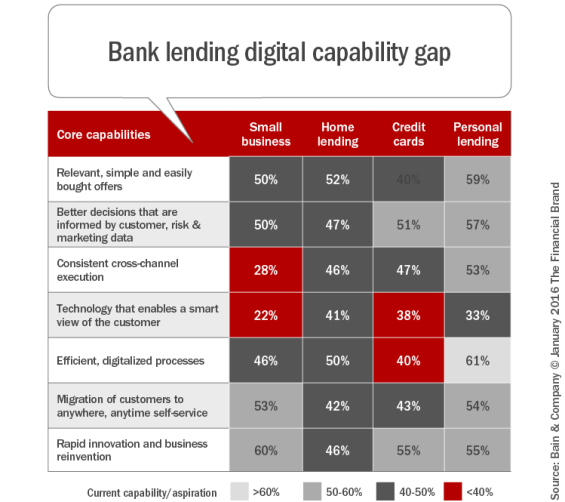
To evaluate the progress of digitizing the lending process in banking, Bain and SAP Value Management Center surveyed two dozen banks in 10 countries. They evaluated how well these banks performed along seven lending capabilities and four dozen operational metrics that were segmented by loan classes and maturity levels. The following capabilities were evaluated:- Relevant, simple and easily bought offers
- Better decisions that were informed by customer, risk and marketing data
- Consistent cross-channel execution
- Technology that enabled a smart view of the customer
- Efficient, digitalized processes
- Migration of customers to anywhere, anytime self-service
- Rapid innovation and business reinvention
 The ‘lowlights’ include:
- On average, banks can handle only 7% of products digitally end-to-end.
- Customers submit only 14% of loan applications through digital channels.
- Most banks lack digital cross-selling expertise, with the average number of loans at just 1.1.
- Banks spend only 18% of their marketing budget on digital initiatives.
- 14% of simple loans and 36% of complex loans require rework.
Significant Digital Capability Gaps Remain
The research study found several capabilities that fell far short of optimal across lending categories. Most of these capabilities are competitive differentiators for fintech firms competing in the lending marketplace.- Delivering simple, easy and convenient experiences. At most banks, it is difficult for consumers to apply for or to check the progress of an application through online or mobile channels. The digital shopping process is cumbersome and few banks have good digital tools to support employees during the product evaluation process.
- Executing consistently across channels. Silos remain at most banks between product areas and channels, requiring customers to repeatedly have to fill in the same data.
- Gathering a 360 degree view of the customer for marketing, sales and service. Most banks reported difficulty in using the available internal and external data to make fast, high-quality decisions when lending money, identifying financial distress or collecting payments.
- Product simplicity and clarity. Most banks have extensive product variations hard-coded into their information systems. This makes it difficult to present products easily and quickly to customers.
- Digital marketing. “Most banks have barely scratched the surface in learning how digital marketing and communications can effectively engage customers. While some have invested in workflow and automation tools, the promise of these technologies has yet to reach their potential in lending,” stated the report.
- Straight-through processing. Most banks have no straight-through processing of loan applications for other than the simplest cases.
Prioritizing Digital Lending Investments
The research suggests that the best way to prioritize digital investments in the lending process is to take heed of the experiences of leading banks and companies in other industries that have made progress in digitizing. The key is to design around the customer’s priorities, not for internal operations. It was found that many banks often rely too much on an operational perspective based on internal metrics when determining digital priorities. While improving process efficiency, they often negatively impact the customer experience. The research provides several global case studies of organizations that have digitized loan processes effectively. These include Commonwealth Bank of Australia (CBA) and Hana Bank who have optimized home mortgages on mobile devices, Fidor Bank’s P2P lending using social channels, and one of the quickest mobile-first personal loan processes available at mBank in Poland. Overall, it was found that the key was to simplify products and processes. Unfortunately, this is difficult at traditional financial institutions that often pride themselves on offering a huge array of product variations, price points and promotions. To complicate matters, the chain of process steps, from inquiry to collecting customer details to codifying collateral to funding a loan, often functions through separate organizational departments. Some banks even make customers use separate mobile apps for their primary banking accounts and credit cards.Investing to Become a Digital Bank
According to Gartner, banks already spend about 6% of revenue on average on IT, which is far higher than the 1% to 4% in most other industries. Becoming a ‘digital bank’ could easily increase this investment. According to the Bain/SAP study, banks making greater digital progress in lending operations have higher IT spend than average. The difference, however, is that the best banks spend much more on changing the bank’s model than on running the existing model. “The leaders accept a higher IT cost because they’re automating more, reducing labor costs and setting the stage for higher revenue through digital conversions. They’re working to pay for the investment by removing errors and rework from the branch and call center, and migrating more basic transactions to digital self-service channels.” The traditional lending industry has been hit the hardest by new startup fintech since this area had been ignored by many traditional banking organizations as digitization of transactional services took place. P2P lending and alternative financing fintech firms filed the ‘opportunity gap’ by launching products that not only helped borrowers but also helped lower operating costs through the use of new technology. The new digital model appealed to borrowers who wanted quick access to cash and a good interest rate. Banks are trying to play catch-up, with many entering the digital lending battlefield by way of partnerships with established and emerging lending platforms. Over the past year, the digital lending market has gathered momentum and interest from established financial institutions. Examples include Goldman Sachs, Blackstone, BBVA, ING, Barclays, Westpac, Santander, the Royal Bank of Scotland and Metro Bank. Banking has already made excellent progress in digitizing basic transactions and workflows. The real payoff, however, is when the more complex and costly processes can be automated, and when the culture of the organization changes to recognize the benefits (and requirements) of becoming a digital bank. Source: Jim Marous is the publisher of Retail Banking Strategies for The Financial Brand. Marous also publishes the Digital Banking Report